It already seems contradictory from the very beginning. Adorno said the blows to bodies were the “principal” and “irrevocable” inputs for history, in which his moral approach comes afore at this point. Let’s elaborate furthermore. Since mundane language fail to convey the sufferings and blows of a subjected body, there has to be another way to convey and express them to others. The aesthetic language comes into play at this point… But this the point, where contradictions surface and that brings the following question to our minds: How much "further" an artwork and its aesthetic language can go? Let us rephrase the question: How much “further” the sensations of a body and its march towards death could be carried along in an artwork? If possible means were available, could an artwork “ultimately” express these feelings as “real” as it can be? For instance, if there was a machine to convey the very suffering in that very place and time and if we could transport this machine to our own time and space to use it, would then aesthetic language still be necessary? Would Adorno see the necessity for that very suffering in that very space and care for aesthetic language for the very reason of historiography? In the same token, as aesthetical language conveys these feelings, at what point should it stop its “progress” or rather its headway toward “real being”? Therein lies that contradiction. For the contradiction of art and its aesthetic language stands still right before us. Which is more “real” -the ones conveyed through aesthetic language or the very experience itself from exactly that time and space (battleground)?
Within the context of what’s written thus far, it is rather easy to say this: aesthetic language would not be necessary if only it were possible (to make it happen through a machine, as we have mentioned before) to go back to the exact time and place where experience took place. Indeed at first blush, this strikes as an approvable assessment. However, another question ensues right here: Is what we call "experience" pertain only to that specific time and space? That is to say, doesn't what we call "experience" contain a "headway" per se? Alternatively, rather could it be asked in a different manner: experience get stuck in its own time and space? Then again we could deduce that may not be so by using another Adorno-esque reasoning. An experience has been experienced, body took another blow during war and suffered, wounded and blood has been shed. This is the first stage of experience where suffering is difficult to put into words through the means of daily communication. (Should we say, “It hurts too much"? What else can we do? Moreover, who can feel the severity of that pain?) That wound tends to be scabbed now that blood has been clotted and pain relieved at the second stage. It is never the same as in the first moment of hurt even though experience still continues. The third and final stage is the transformation of experience (what has been felt and took place) into an ordinary scar where pain ceases to exist. However, who could claim that that scar was completely independent of the initial scar (from the moment it first opened) and detached itself from the original scar? Therefore it would not be too wrong to come to this conclusion: aesthetic language embodies all relative stages and conveys each transformation stage as a whole while using largely all kinds of signs and tokens, etc. and keeping the process of experience within.
We surmise that the potentiality of aesthetic language means much more than a machine that could take us back to the first moment and space where the said experience took place. A conventional and traditional approach in artistic disposition are facilitating us to sanctify art at all times. Nevertheless we have to be aware of a moral contradiction here: If aesthetic language withholding the stages of experience throw us farther away from its initial time and space, or, to be blunt, when first pain felt in body metaphorically reduced to the same level (which is equally important in the sense of containing the same sufferings that could lead to be a signifier later on) with other stages, doesn't that cause us unavoidably to be thrown further away from the initial experience? Does that aesthetic work confronting us make it a mere observable object? Alternatively, has its reality been detached from the initial experience and headed towards another reality? Naturally it is what it is and everybody knows that it would be futile to seek for the pure effect of experience. (We do not mind to remember this fact once again because aesthetic language contains the first experience within itself.) If this is the case, how can we feel the sufferings of each person who (morally) damaged in a war and reach to historiography proposed by Adorno? Do absolute metaphorical approaches and artistic methods of transference suffice to achieve this goal?

One of the most significant examples of this dilemma was written by Karlheinz Stockhausen, the notable musician and composer. About one year after the 9/11 attacks in New York in 2001, he had interpreted the incident as "the greatest possible artwork in all cosmos," in one of his interviews, which put him into trouble and blamed as being immoral by others. On the other hand, he meant an artwork that began with Aristoteles and intersected with Immanuel Kant's views and his philosophical arguments. He was actually talking about a problematic as to how an artwork could morally make "progress" towards the initial experience. Of course, within the context of "Moral", "Sublimity" in an artistic sense. The attacks of planes apparently for Stockhausen were artworks that crossed the limits of moral and came into sight as the opposite of the initial experience by bursting open everything it kept inside. And obviously what Stockhausen had in mind was this: if this attack was a concrete experience as Adorno referred, then an observer, who witnessed it at a specific time and place, should also share the suffering and intensity of it. Thus, the question, to be asked here, is apparent: How much "farther" the feelings of a body and its inevitable march towards death could be carried along in an artwork? Could an artwork express these feeling to its limits in its whole real form if possible means were available? Or could backtracking the initial and pure experience (that is reaching to a point to feel the suffering in its entirety) charge an artwork with moral weakness? Or else all experience to be lived under aesthetic language’s tendency for “keeping”? To sum up, where does the “halting point” or the “limit for its progress” begin in art?
If aesthetic language goes out of limits of initial and pure experience, and by doing so keeps the suffering within, then arises a moral question about aesthetic language and artwork: transforming art into an observable object along with its “keeping” quality… Relentless defenders of aesthetic language should not be disturbed by the term, “observable” because this argument (as explained above) goes all the way back to Aristoteles. It is known that the Greek philosophy and the entailed Neo-Platonism in Medieval ages saddled art with new moral burdens. What Aristoteles said, however, in this context were among the most interesting, because of its proximity to modern art-ethics correlation. In the fourth chapter of his "Poetics", he argues that watching dead bodies may not be something enjoyable, on the other hand seeing them in a painting might actually arise pleasure and delight in him. This challenge of his also brought forth the thesis that the sense of pleasure coming from watching a picture might actually annihilate the factuality of dead bodies. Art, even in absolute mimesis state, owned the faculty of “keeping.” Because painting as intervening a cause between the factuality of dead bodies and observers, or picture as holding a screen before the factuality, keeps observers away from perceptible and turn dead bodies into "observable" things. Furthermore, the quality of “keeping” leads to taking pleasure from dead bodies (or other things that are supposed to take pleasure.)
Let us think art in the sense Aristotle argued, and we surmise that art also contains the immorality of taking pleasure of watching dead bodies in this sense. That is art always contains immorality within itself as well as evil. And evil incessantly threatens the moral structure. It is possible to find the same immorality within the concept of “Sublimity” first used by Kant and later on by Hegel from the 18th century onwards. Leaving aside pleasure taken from "Beauty", pleasures taken from incomprehensible, fear, violence, unrest, annihilation, etc. naturally points toward an art concept that accepts immorality as well. Stockhausen had to challenge the accusations of being immoral, when he described the 9/11 attacks as an art form and made a public declaration (it is debatable how much of it were to be understood by public) to remind that art always houses Lucifer within itself. That is to say, Lucifer as a metaphor of evil infiltrated into art… We should take heed of Stockhausen’s approach here. When he defined the scenery unfolding before his eyes (which was significantly “destruction,” “violence” and “corpses.”) as an art form, he was not talking about a specific language or artwork harboring that specific language. He was only pointing at a moment where Lucifer revealed itself in pure clarity without cloak and daggers. In other words, it was the moment when an aesthetic artwork exposed its “hidden” meaning.

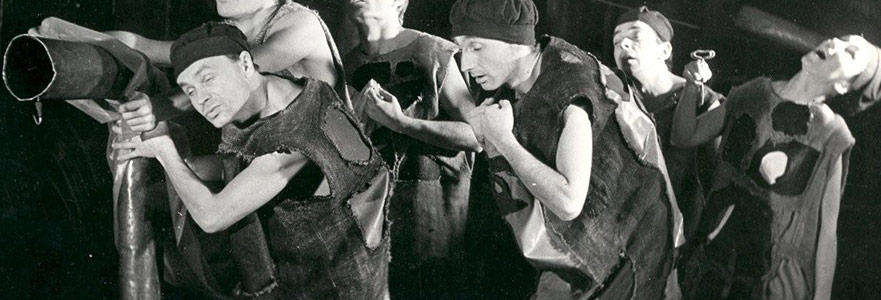
Now let’s rephrase the questions we have been asking so far: How much of aesthetic language can show Lucifer that is hidden within? Or rather, how much of Lucifer’s face make it apparent within an artwork, and how much further can moral limits go? Aesthetic artworks have no definite answers to those questions. Furthermore, Adorno's exigency about "the blows taken to a body and its transference to suffering" that defines his moral rectitude and his uncompromising moral aesthetic language fixation, turn into an unsteady relation. In this sense almost same correlation occurs in the Avant-garde Theater based on a disputable moral foundation since the beginning of the 20th century. Violence unraveled; provocation of cruelty among humans, tendency toward destruction of primitive instincts (mostly found in Dionysian rituals and Shamanic rites) made theater vulnerable before moral criticism. At this point, leaving aside the debates related to how theater could overlap with those rituals and primitive demonstrations, the principal unrest among audiences, artists and theoreticians revealed itself on a moral basis.
To name a few example, G. D. Pawlowski wrote in “Nouvelle Litteraites” in 1912 about Seneca’s play Oedipus (A.D. 1st century) as follows: “The play is a savage medium, however isolating the play from these features would be some sort of fraudulence… blood, hollowed out pupils, disemboweled organs and slashed throats have been reminded in every five seconds during this two-hour play. Death, sickness, plague, nausea and horror were the main ingredients of this play. I am not sure if this play were appropriate to be performed before human beings. In one of the harangues where messenger described how he pierced the eyes of Oedipus, one patron literally got sick. However, there was always an ambulance of St. John ready to take off in these cases.” When Peter Brook staged his Oedipus in 1968 he transformed the play’s religious and cultural context into an existential stand and covered political oppression, torture and wars of his period, which was observed as another version of this cruelty, an unobservable kind. On the other hand, Jean Genet’s plays such as “The Screens” and “The Maids” in which a constant metamorphosis of figures applied as theatrical method (by referencing Artaud, naturally) exponential webs lay bare symbols from their origins, but they also harbor primordial conflicts, racial prejudices, murders, rapes and fantasies of revenge even when they turned into modern rituals. It would not be wrong to say that Antonin Artaud clearly paved way to the foundation of this theater. His thoughts that led to the “Theater of Cruelty “laid the foundations of “Avant-garde Theater.” For instance, Christopher Innes mentions Jerzy Grotowski in his book, “Avant-garde Theater / 1892 – 1992” as follows: “In the Grotowski productions cruelty takes the form of torture and suffering, at the same time spiritual ecstasy and corporal degradation were also possible. Despite the fact that they induced sublimation and cruelty and violence in audience rather than exposing them to eliminate as Artaud proposed, critics hailed those plays such as Dr. Faustus and Faithful Prince as the examples of Theater of Cruelty that were not realized by Artaud himself.”
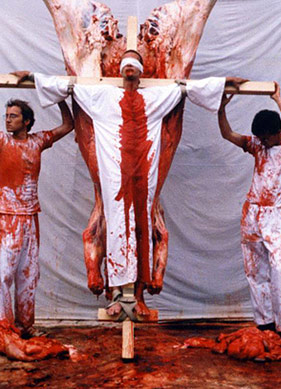
If a short commentary were to be given aforementioned topic: Whether it is an urge to give a message in an Artaudian sadism, violence and madness through a player to audience (this player is the sign-giver by way of his body “in flames”) or other drama artists and theoreticians (they could easily make an army) following Artaud’s footsteps in order to take this thought to different dimensions, they all took a chance to talk through cruelty. By doing so, the definition of savior and victim gets blurry, audience free itself from all kind of primordial ties, and moral norms have been founded outside the observable aesthetic artwork that keeps the experience within itself, or at least aesthetic artwork rescued from being an “observable object of pleasure. “Now, at this juncture raises another question: Does this relentless "headway" in Artaudian Theater that is the sudden exposition of hidden Lucifer, leave Kant and Hegel's "Sublimity" concept behind? As long as this concept produce pleasure, wouldn't it deserve to take its place in aesthetical category? Defining the different headways between "Sublimity" and Avant-garde Theater should be the topic of another article, however here this can be easily put forward: While an artwork (be it a painting, drama work or another form) constitutes its own moral framework, it would not be interested in the comfort of an audience, on the contrary send its audience to the St. John ambulance. On the other hand, the question of morality only comes into display while watching these artworks.

Let us remember the first sentence before concluding this article: Theodor Adorno, in an extremely moralistic manner, maintains that "historiography would not be possible as long as each individuals' sufferings and damages of their bodies in war felt by others." That means we cannot give up aesthetic language if according to Adorno history be written this way and such as the moral essentials in this case. However, there is one flaw in this reasoning. Aesthetic language goes outside the peripheries of first and absolute experience by enabling memory and carry it perpetually to the present, pulling away from suffering thus other things carried by memory make them forget the suffering. In this way, an aesthetic artwork becomes the "history" of initial and absolute experience which is enough to make artwork an "observable" event (once Aristotle called "screening of a painting). We never doubt that the first suffering could be found within that artwork, yet we do not perceive it in its initial entirety (where we find Adorno's contradiction right here). Despite all, we find artworks unraveling Lucifer within an artwork in its all immoral disguises (accusations of immorality directed to Stockhausen).
Now let’s take a gander at so-called “modern art.” Bearing in mind the article previously published in Artful Living, “Inheritance from Plato to Electronic Technology,” it argued a minor quality of art as followed: “A glimpse at art by the end of 20th century shows that as Benjamin put out correctly, art pushed itself forward leaving aesthetic determinations and autonomous art criteria far behind, and assumed the attitude of technological means according to their abilities.” The thesis of overpassing the autonomous art criteria has already been rejected by Adorno in 1935. However, it was crystal clear that both Adorno and Benjamin had agreed on the revision of aesthetic language during the age of "advanced technologies." This mutual agreement, of course, did not mean necessarily the negation of aesthetic language. Besides it was not even possible for Adorno to have thought of that. On the other hand, inevitable ties between technological novelties and aesthetic language could not be overlooked. In our times, we are witnessing many examples similar to those two thinkers and rebuilding the same discussions from the ground zero as we observe some technological instruments or machines assume the function of aesthetic language.

One of the characteristics of this new situation was the synesthesia problematic (according to the previous article) acknowledged as the theme of art since Plato. It is simply the identical perception between sound and image or music and painting. This topic, being around for about 25 years and considered one of the pioneering areas in art, has been embodied by an artwork called “Undulation” and took its place in showrooms of galleries. This so-called “Undulation,” setting out to solve ancient problems, in no way uses an aesthetic language but identifies itself as a technological contraption. On the other hand, the previous article pointed out that a problem has been solved technologically by a performance under the collaborations of a telephone company with a large capital background and an artist. These cannot be called as artworks in any way, but they are still artworks in the sense that solving the problems dealt by the art world.
To conclude: when topics or events of aesthetic language are being solved by machines or contraptions, it gets harder to make a coherent definition on contemporary / modern art, previous definitions becomes history as each new machine or contraption cease to be new, making new definitions go awry. Despite all, one thing stays unchangeable: That problems of aesthetic language are being taken over and solved concretely by machines and contraptions… at this point comes the starting up of aesthetic language from the initial and pure experience, then being carried toward "further" times by constant updates of memory, thus "keeping" the initial and pure experience and getting away from being something "observable." Art does not convey feelings anymore, but transforming those things we are supposed to feel through machines and contraptions into initial and pure experience itself. Thus rendering the moral aspect of aesthetic language unnecessary, it invalidates the urgency to define the limits of moral “headways.” For each time, Lucifer materializes itself before us in its full grandeur. Unless Aristotle's "corpses" is screened by paintings, there is no other way, but to call it art while observing those corpses.
;