ÖNCEKİ
23 HAZİRAN, PAZARTESİ, 2014
SONRAKİ
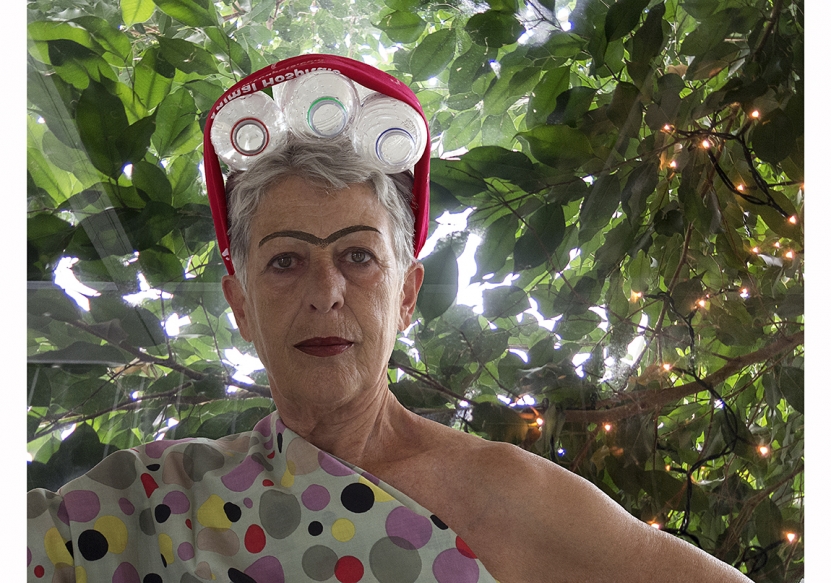
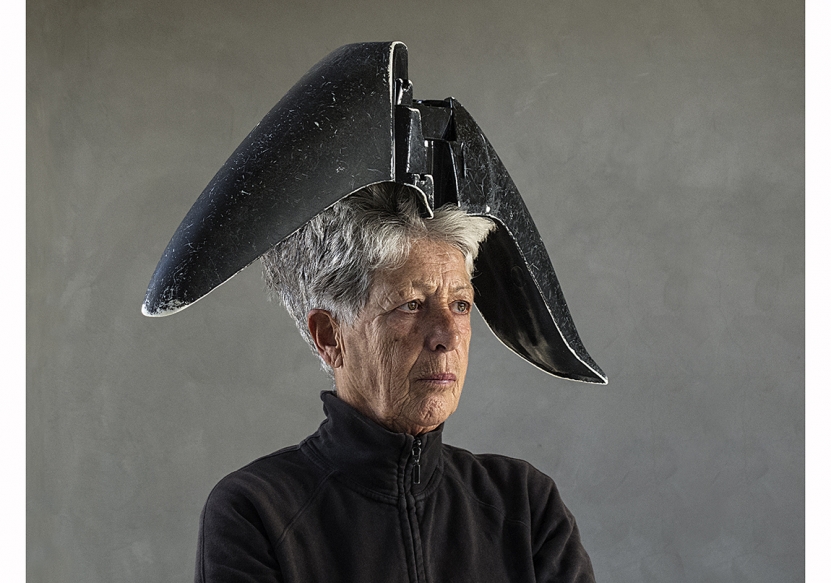
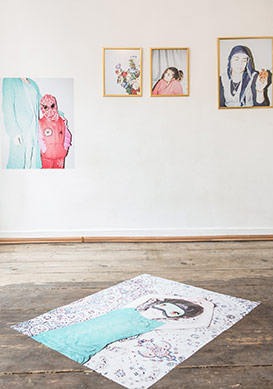
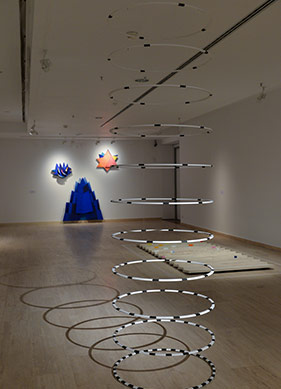
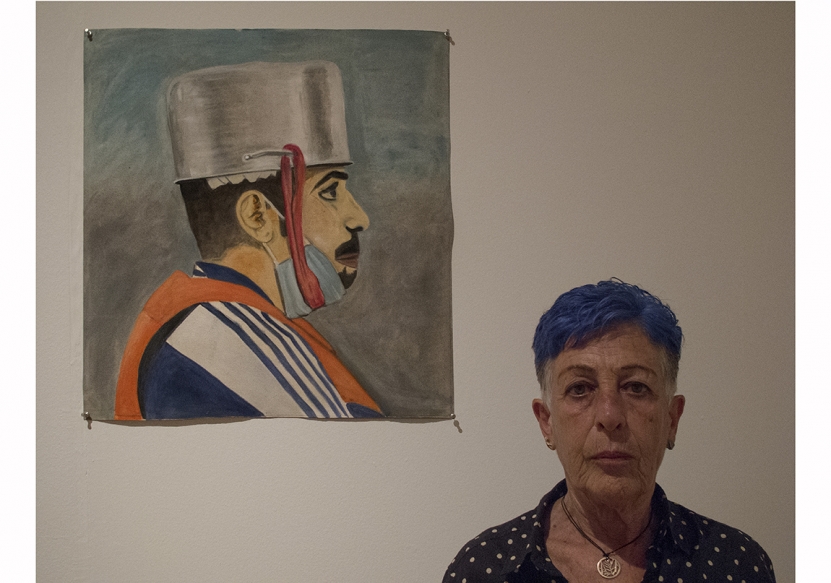
Greeting you with the photographs, in which she was the model, the minute you enter, the exhibition embraces you directly with the effect of venue's spaciousness and neutrality. The exhibition, in which you are a spectator, makes you enter into a completely different environment all of a sudden with the video at the end of the corridor that gives you a feeling as if it is a lamentation if you don't know any Greek. Rather than any other photography exhibitions that you walk pass by, the attribution of these photographs, which make one look at them for a long time, both the effective look of the figure and characteristic countenance, as well as 'the head pieces', which are serious designs as themselves. 'The head pieces', which you can see the real ones in the exhibition, form the basis of the exhibition anyway. Since there is no English explanation of the song in the video, you feel that there is a political and ironic situation through the intonation and the expression of the figure, no matter how much you are curious about the song. Notable, considerable, curiosity arousing due to its arrangement and venue as well as being decent, The Cursed Serpent was in Athens as a successful exhibition.
Producing in various disciplines such as painting, video, photography, digital media, sound and performance, we talked with Eleni Mylonas about art environment in Greece, journeys she has taken in 70s and her exhibition.
What is it that is affecting the evolution of your art from the very beginning; motivates you to produce?
My work is respondent to the things going on around me, how these going-on effect me, to my inner world. This is a journey from outside to inside through art, filtered and diverted again, directed to returning back for me. The process of discovering yourself. I don't start a series or a work with an idea. My guide is my instincts. External factors, things going on around me trigger my curiosity and my emotions; I follow them to discover. The work that comes out in the end effects me in a way just like it effects others.
You are an artist from Greece who has travelled for a long time and made New York your second home. Is there a connection in between your work and socio-political change in Greece?
I was born and grew in Greece. I moved to States in my 20s and decided on my permanent being in New York. I travelled a lot in the world. Therefore I am aware of what is global in the world -what is effecting the world globally- is also effecting me and what is happening. The things happening in Greece today is not a specific to Greece only. It is a kind of a mirror like situation, in which the global bankruptcy of humanity and material values come face to face. Today were are not human; we are consumers. We are dependant on the big corporations, which want us constantly consume, 'buy' and shameless companies. Benefit is on the lowest level. My work reflects the need for common conscious and my sadness on respect that we should pay for the planet we are living on, its resources and towards each other. Therefore, there is definitely a connection; but I am not sure if we can define it as direct and exhibitive.
You have made a long travel from London to Afghanistan in 70s. Could you tell us about your experience? Especially the period in Turkey... How did this journey effected your art according to you?
It was the beginning of 70s; October 1971... It was an important experience that I can't explain with a couple of words here. Colonel Cunta was ruling Greece. I remember going to Turkey from the Bulgarian border. Greek radio in the car we had it on was playing with a static noise. It was very weird. How awful it was to experience my own country as an enemy... When we reached Istanbul, we met with our English friends, who had 'we reached the Orient / the East' feeling. My feelings were not as such. I felt like home in Turkey, especially on the seacoast. When we reached Afghanistan after many difficulties, I was feeling like home again. It was a different century, another land; yet it was as if I was home. In my home only as a part of humanity which was full of people speaking a different language, from different religions and so far away from original home.
This experience created a blasting inside me; it created a bigger me inside 'me' that is so small and it remained as a turning point in my life and my works.
How would you evaluate the art environment in New York and Europe?
I am not the expert on this matter, but all I can say is that the art environment in New York is in constant global transformation. Today the museums and big galleries of New York appeal to international collectors coming from Arab countries, which are the source of money, Russia, China. We should also state that they serve for a large community that is not buying, but watching, experiencing. There are thousands of artists living in New York; therefore most of the art venues are dragged into the city center; they develop and grow in the city. New art venues are opening: Bushwick in Brooklyn is one of the important examples of this. Area of art is an infinite space. It is very hard for many artists to find an appropriate gallery to represent them in New York. Relationships, communication has a great importance as it is in everywhere. The end point is the money in art as it is in everything...
Despite the economical crisis in Greece, art world is interestingly developing, growing. A lot of new enterprises, alternative spaces, theatre, performance groups emerge. Private art initiatives that are run mostly by volunteers. I think it is time for young ones to move and actually they do with a big energy and hope. Right here and now, a silver life is enlightening the dark situation of Greece that is covered in black clouds with its shine.
How did you start your last series The Cursed Serpent? Could you tell us about the process?
I came across with the pictures of the protesters in Egypt, in which they were wearing hand made helmets, -some sort of- hats they made in order to protect their heads. . Being this creative and their understanding of humour in the middle of a serious situation inspired me. I made patterns and graphic drawings looking at these visuals. Later I worked on these again on canvas with oil paint. During the process I placed my own image onto one of my painting just like the protester, as if I was one of them. At this point, the work captured its own moment and it lead the creativity in photo-graphic works Cursed Serpent.
You are the model in your work. How would you interpret the experience of being the object of an art work?
The model is the works are me; yet it is not me. The person in the photograph is neither me changed nor the personality the photographs shows. But I might that person be as well. There is the key. I can easily say that I am both the person in the photograph and the personality that is being described in the photograph. All these opinions are valid. I am an international person - past, now and future... I am a person who is beyond age, gender, and ethnicity.
There is a video, in which you sing a song / lamenting, in the exhibition. What is that song about? What is its relationship with Karagöz? Would you tell us about it?
As you also know, Kragiozis / Karagöz is a 'perfect man' hero, taking its roots from Ottomans and existing also in Greek shadow play. Mayor and beggar, doctor, cook and thief. The man of creative inventions, witty, cold-blooded in any kind of difficulty. Behind all this sarcasms, there is a devil hiding in the cave and terrorising majority.
Town Crier appears and says:
'Listen here, listen now: With the order of our honoured Pasha, listen all you English, French, Americans, Syrians, Arabs, Afghans, Ukrainians, priests, Chinese, influential businessmen, Russians, Africans and Iraqis. Whoever it is to kill the cursed devil hiding in the cave; they will be rewarded with 100 golds reward (bakhshish), merry with the daughter of Pasha and it on the throne after the death of Pasha. Hear this all you English, French, Bulgarians and Romanians.'
The song ends here; but the story continues. Alexander the Great reaches his horse, but gets caught by snake. In this point Karagöz comes onto the stage by throwing stones at snake; makes the snake ineffective and saves the day. The story is an allusion for the sacred legend of David and Goliath existing both in Bible and Koran. According to the story, David has won the war in between him and Goliath, despite David was smaller and it was believed that Goliath would definitely defeat him. As David was armed with armour, he was thought to beat Goliath. However since he can't move comfortably with armour and sword, thinking that he is destroying his little chance in winning, he takes a stone from the ground instead of sword and beats Goliath by gaining advantage from the weakness of Goliath's weakness in armour. The story is all about the small one accepting his weakness and looking for a different route; by doing so gaining power and brings him into existence.
;