Story telling is one of the most important areas of photography. This form, which became popular in 1970s under the leadership of Canadian photography artist Jeff Wall, attracts attention as an illusion of reality created by the artist as if performing a theatrical play with the mediation of the people in the photograph. Here the photographer acts like director and set up the scene, setting, the acting of the performers and mostly works with a big team just like in a movie or theatre. While the photographs are constructed to stand by themselves even if they are not series, usually big productions reminding cinema are made in order to realize this set-up.
Starting his photography career as an advertisement photographer, Erwin Olaf is a Durch artist who has developed his own language in story telling. Having film works as well as photography, Olaf realizes works that are focused on one subject, and by working with models in a specifically made settings. While photographs can also express their own issues due to the aura created, , their effects increase when they are seen as a series. The most important characteristics in Olaf's photographs strike with catching a certain emotion with either digital manipulations or pose and expressions of the performers, and the reflection of this.
Producing his won work as well as being a professional photographer since 1990s, Olaf's name started to get heard more with his 'Royal Blood' series, which he has realized in the year 2000, and in which he portrays the individuals of royal family members, who are either assassinated or identified with death, in Europe by emphasizing their relation with death. Both the gradation reflecting the coldness of death and the digital interposes, which were relatively new for the time being, has added a unique language to the series.
2000s were an important period in Olaf's career. The photographs were taken in specially made settings and while these settings were designed to reflect a period, the colours used were helping the photograph to be felt as if the portrayed scene belong to 1960s. Also the inertia in the pose of models were originating from a suspended emotional reaction. The eerie feeling that this situation creates show itself also in 'Hope' (2005) and 'Grief' (2007) series making a trilogy with 'Rain'. The state of waiting without a reason transforms into depicting a frozen moment in 'Hope' series. Olaf describes the waiting state in 'Grief' as "a waiting state reflecting the mental state that is right after getting a bad news." During the exhibition of 'Grief' series, there was an installation in the gallery, which was radio news booming in the background, and this news was informing that President Kennedy's death.
Behind Olaf's obsession on this period lies in the facts that 1960s being a scene for big social changes, the rise of feminism and other social movements, increase of globalization as the transportation became easier and finally television becoming a dominant medium.
Producing films using the same setting and models in almost all his series since 'Rain', Olaf is exemplifying that the works produced in both areas do complete each other as well as can stand out separately.
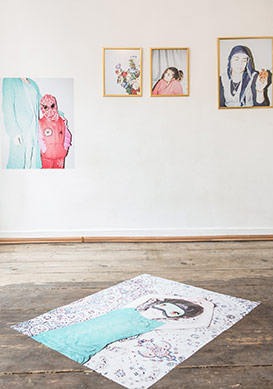
As I have said in the beginning, the new exhibition in CerModern contains examples from his last two works: 'Keyhole' 2011 and 'Berlin' 2012. As the name suggests, 'Keyhole' puts the spectator into a kind of voyeur state. We see child or teenager models photographed with their backs facing the spectator in a way that we don't know the reason, yet think that there should be a specific reason. While this situation makes one think that they turned their backs with an insecurity, folding their arms around their bodies in such a way that is to protect themselves or not knowing where to put their hands reflect a different state of mind they are in. When the curiosity forming inside the spectator meets with technical and aesthetic perfection of these photographs, an environment that is embracing you is formed. Photographs are placed as if they were placed on the walls of a home in some exhibits of 'Keyhole' and in accordance with this voyeur attitude, a film with the same name can be watched through the keyhole on the door that is at some point of this wall.
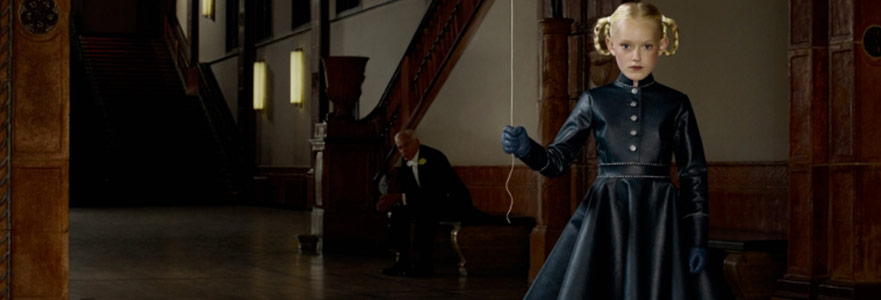
As you can guess from its name, Olaf's last work 'Berlin' is a work that is realized in Berlin. Contrary to the previous works of Olaf, 'Berlin' was realized in spaces existed right before the Second World War which is referenced with this series instead of a specifically formed setting. This choice has a notable effect in the atmosphere of series. Photographs explicitly contain references to German painters of time such as Otto Dix and George Grosz. The children are the main characters of this series. Yet, there exists an installation, in which headless models wearing the costumes of the models in the photos and circling like a small merry-go-round around a kneeled down clown, in the original exhibition arrangement. There are also old prostitutes as if they have just came out of a Otto Dix's pictures, referring to American athlete Jessie Owens, a black model winning gold medals in a way that would make Hitler angry in Berlin Olympics. Taking his self portraits from time to time, Olaf combines this with his affection for stairs and his self portrait going up the stairs with his back turned was among the photographs in the series. one of the reasons why Olay used those stairs is because Hitler used them to go to his loge in Berlin Olympic Stadium, which was one of the main venues of Berlin Olympics that was realized in 1936 and turned into an appearance of Nazis.
Creating a dream world attracting the spectator inside, Erwin Olaf is using a technique, which forms successful environments with light and colours also as a result of being a fashion and advertising photographer, while enhancing his subject matters with references. Winning Johannes Vermeer Award, which is one of the most important awards in art in Holland, in 2011, Olaf has used a significant amount of this earned money -by force of this reward- to realize 'Berlin'. It looks like we will be waiting for the new works of this productive artist. Meanwhile I would like to remind you that the exhibition is going to move to Istanbul by the end of it in Ankara CerModern.
;