ÖNCEKİ
10 ARALIK, ÇARŞAMBA, 2014
SONRAKİ
Uygur Yılmaz is interested in the state of a summer resort, where it is left alone in this cycle, long enough to impress us. For instance, he has displayed Susanoğlu Beach, which occupies a place in his childhood memories, by focusing on geometrical and structural relations in his "Eksik Parçalar (Missing Parts)" (2004-2009) exhibition. This has been ensued by another series called "Burası ama nerede? (Here but where?)" (2009-2010), which he has presented with a rather strong spatial arrangement in NON. I distinctly remember that him installing the photographs of self grown bushes that have become non-spatial and forcing the two-dimension, in the basement and mezzanine of NON Tophane in such a way, which can be experienced in various perspectives. The state of summer beaches in winter were set on the ground floor in a rather dark part of the gallery. While "Burası ama nerede? (Here but where?)" was displaying the "left" objects on a dark beach that will kill the dead season look more dead than ever, in a surrealistic light and presenting a alienating point of view to the entertainment or order issues brought by people, he was also making us question the believability of these images.

Yılmaz's latest exhibition called "ALINDI (RECEIPT)" can also be considered as it is on summer resorts again as well as its previous works. The method and means that Yılmaz is using, are quite different than the last two exhibitions. Being methodically and theoretically parallel to the previous ones, a state of "moving to a gallery" is being realized with painted, folded, ordered 'Ready-Made's. Stating that he didn't do any arrangement or intervention when he is taking his photographs, the contradictions that the artist creates with mechanical replications positioned with interventions, make the limits and attractions of photography visible.
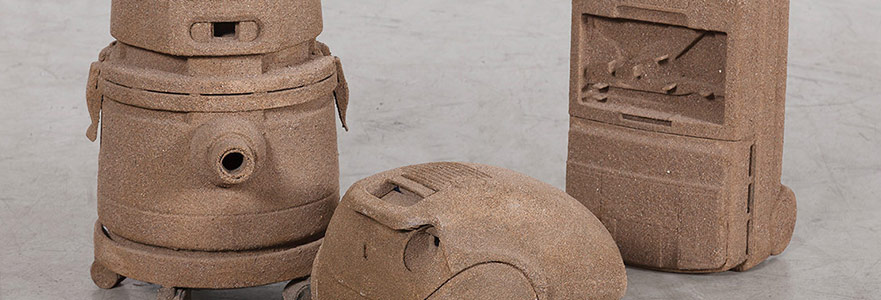
In the video situated in the entrance of Co-Pilot, I see that Yılmaz is calmly and meticulously hoovering the beach and emptying the hoover in the same manner. This video of performance documentation, which Yılmaz named as "Sisyphus at the Beach", is pointing out to the cyclicality that he uses parallel to the spatial and conceptual set-up. In this area, where I only managed to look at the section in the basement made mostly out of "Ready-Made"s, I can only see the sand made vacuum cleaners (Vakum (Vacuum), 2013), which are the last objects of this series.

Giving its name to the exhibition "ALINDI (RECEIPT)" (2014) is made out of tab papers from the tab of a summer restaurant in a linear way. While a huge "Bought" note on each page of the closed tab is connecting all the pages to each other, it is also to discover the clues on the observations of the waiter on the customer or the relationship of regulars with one another through the notes of tea, beer and french fries. The pieces looking like bread pieces, prepared as baits, in this section, are, in fact, are made out of the remains while the exhibition was being prepared. With this detail, it is like Yılmaz is inviting us to have a more careful point of view to all objects more carefully.
The transition section on the basement of the exhibition that is connected to a bigger space is made out of photographs and objects that are intervened a little. Summer resort theme is used to analyse the nature of photographic image in works such as "Talimatlar (Instructions)" (2005-2014) showing a maintenance manual in the contrast of sun and shadow, mosquito net that is transforming photography into psychedelic surface (Grid, 2014). Using an architectural photographic language in a rather wider space, ”Triptik” (2008-2014) is the last work of Yılmaz that is pointing to his previous practice. The problematics innate to the medium such as he problematic of 'right' exposure that is changing the view, the spot state of numerical image, are skilfully providing the transformation of the artist into a new medium. Although "Su Üzerine Su (Water Over Water)" (2007-2014), which continues the series of photography, is a “Ready-Made”, the photography shows itself in the print that has the stain of the artist's hand The length of these dates in the records of all these photographs makes one feel the length of moments.

Most of the found objects, which are simplified with colours such as black and beige are collected either from the beach or the junk dealers in summer resort villages. Radiator grills (Büyük Siyah Araf (Big Black Limbo), Küçük Siyah Araf (Small Black Limbo) and Araf (Limbo), 2013) and electrical cooker resistance (Rezistans (Resistance), 2013) are spread to all four corners of the space like totems in different sizes beyond the heat and cold of summer. The tail of a fibreglass dolphin, which has a "dressed wound" with a fishing net, situated in the middle and called "Yeni Hayat (A New Life)" (2014), is in fact a remain of a pedalo. "Geçmiş alan (Past space)" (2014), that reminds a ritual area in the middle of space is formed out of various lids collected from the beach. While all these objects tell the colonization of coast, summer resort culture and holiday dilemma with the intervention Yılmaz, they can lead to a more conceptual thinking area like personal archaeology or cyclicality.
I felt close to this exhibition, which the artist expands the area of expression to different mediums, probably since I am a person who doesn't go and like to go for holiday due to my childhood traumas as I have mentioned earlier in this article. I can concentrate on intellectual exercises by eluding myself easily from the graceful sadness without banality that is more prominent in the previous series of Yılmaz. The covered nature of a holiday that the workers sell back by consuming their own time is almost impossible not to associate with the Sysiphos' endless efforts in vain. His narration, which is formed around the cyclicality as well as putting a smile on faces, is presenting a relatively different point of view in compared to summer resort exhibitions focused on identity, humour and transformation.

This review is probably a good opportunity for me to mention the main issue that got stuck in my mind during Yılmaz's sincere and generous exhibition tour. Throughout the tour, it is almost impossible for me not to agree on the duality in between human and nature that he mentions. Circular recurrence, which Yılmaz points out in the exhibition, is just like nature, of which we are a part of, reminding itself to us. Summer houses, which are closed during the winter, beach furniture, the rapid erosion of all those unnecessary objects make us feel that nature can exist without us (maybe hopefully). The state of beaches and summer resorts after the season that Yılmaz has been using a subject for a long time, have always made me think about an individual, who has forgotten that he/she is a part of nature. It is necessary to realize that this object that is not seen in any of his previous series, is appeared as an auto-portrait in an assessable way.

Finally, I need to say that I found it quite sad to read in an interview in Radikal newspaper that photography is dried out for Yılmaz. Because, there is not so many artists like Yılmaz, who can dig into the problematics of photography as a medium over from daily subjects such as beach and summer resort rather than self-referential way. Instead of a discussion that is vulgarizing the relation in between photography and reality with the concept of presentation, works, which transform the problems and limits of this medium into an opportunity as can be viewed in this exhibition, make the medium rich. I selfishly don't want well-known artists like Yılmaz or Dikstra, who is interested in concepts such as threshold and transitivity, to give up their beautiful directions.
;