When it is looked at the history of modernisation (westernisation) of Turkey, it is a general acceptance to take the enunciation of The Rescript of Gülhane as milestone even thought the Ottoman historians of today pay a special importance to Tulip Era. The 'renewal' of traditional Ottoman government structure -in other words political organization-, the change of 'weary' structure with another 'better' and more 'successful' one form the core of this rescript. Political elites, who has occupied Tanzimat bureaucratic staff, have completely convinced that to establish a new army and bureaucracy (in western sense) would be a cure for the unavoidable regression (against West and Russia's military force) of Ottoman Empire. Invincible and unalterable Devlet-i Âli (Supreme Government) now had to renew and change in a pragmatical way. In order to do so, the education system had to be organized on a secular and scientific mentality in western style. Starting from the beginning of 19th century, this secularism (of education) period has weakened the religious basis of Turkey's social structure (up to a certain level) and made the groundwork that is necessary for the radical laicism of Republic.
Secularism in education brought unavoidable cultural difference with it. The Westernised staff of Tanzimat and the generation after were going to take the sources of cultural productions as well as mental from the West. Therefore, an ‘Dispute on New and Old Ones ’ 1 , which was unnamed or mentioned in an indirect way, was going to emerge. There were rather moderate synthesis of this dispute as in the examples like Namık Kemal and Ziya Gökalp as well as severe opposition to old or traditional by radical positivists such as Beşir Fuat, Abdullah Cevdet or Ahmet Rıza. On the opposite side, besides the Ottoman intellectuals, who consider the codes of traditional culture such as Ahmet Mithat Efendi, there was a conservative move to make Kur’an and the Sunna dominant again and the names that attract the attention most were probably Mehmet Akif Ersoy ve Said-i Nursi with their unique style.2
When it is viewed from art culture perspective, it is seen that Tanzimat has embraced Western arts directly. Painting in western style has been accepted as the sole style of high art since 1860. and taken the place of Calligraphy art in traditional culture. Therefore painting was representing 'the new' one, while Calligraphy was 'the old' one. Especially changing into Latin alphabet during Alphabet Reform, which was realized in The Republican Turkey, was going to mean that Calligraphy art would be quite disfavoured. So, what was the meaning of Calligraphy art from (traditional) cultural perspective? Also where should we place it today?
Undoubtedly, Calligraphy art had the same meaning for Islamic societies in semantic level as what Jesus and Mary depictions meant for Christians in Mediaeval Europe. Art was the basic mean to express divine message in the most beautiful way in these societies. General image prohibition in Islam created an art culture, in which writing is treated as painting instead of depiction with painting. Thus, the art of Calligraphy was subjected to an evaluation in aesthetical sense as ‘hüsn-i hat’ -meaning 'beautiful handwriting'- While the secularism in Western societies was bringing painting to an individual construction for itself in Western art apart from religious area, Calligraphy art couldn't have realized its own secular transformation like in Western painting since Ottoman-Islam society has started to get modern and secular from an outer effect rather than inner. Instead, Tanzimat artists embraced Western art as the modern and secular expression of art. Therefore, Calligraphy, which is not a autonomous art category, reduced almost to traditional handicraft category and referred to History as craft more than a form of art. As a result our point of view to Calligraphy transformed to an outer look rather than an inner sight. As well as not being able to read Ottoman writing, we have almost given up to subject Calligraphy art productions, which are Ottoman writing's expressions in aesthetic form, in the name of artistic admiration.

According to Ahmet Soysal, who is the author of the book titled Hüsnühat and published in 2004, our perspective to Calligraphy has to save itself from falling into the trap of West-centrism. Soysal, who needs to emphasize that the matter is rather complicated and has a high degree of difficulty, makes an assessment as such:
"We are aware that we are dealing with a difficult issue. There are several reasons for this difficulty. First and the most obvious one is that we have lost our connections with Arabic alphabet since The Alphabet Reform (1928). When we add Westernisation movement to this, the risk for Calligraphy to come into a dead end, is quite big. It is quite possible that we are looking to Calligraphy as a person from West is looking at it. Falling into the trap of asserting Western standards and confirming the art from the point of these standards is another possibility. So, approaches that do not activate Western perspective, should lead our way. The aesthetics of Turkish Calligraphy art should and evaluated within its own standards...3
I think at this point conceptual artist Dilek Winchester's last work called Homage to Emin Barın gains a bigger importance. Winchester presents a kind of point of view just as Soysal requests as well as problematising the complicated and controversial nature of this perspective.
Homage to Emin Barın is a multi-layered installation. Formed out of three parts, this installation is an experiment on a kind of renewal of cultural memory that is done to commemorate the work and importance of calligrapher Emin Barın4 (1913-1987), who is mentioned as 'The last chain of Ottoman Calligraphy Art' and 'The first chain of western, secular calligraphy.'
The name of the first part is Artık Bu Yazıları Okumak, Anlamak Gerekmez (There is No Need to Read or Understand These Writing) and Yazılar Resim Olmuştur (Writings Have Become Paintings). This title is a striking determination of Nurullah Berk in the catalogue of Emin Barın's exhibition, which was held in Istanbul Fine Arts Academy in Istanbul in 1978 (Winchester has made six copies and six different variations of his work from this exhibition). Although Berk's point of view is problematic, it expresses an important reality. It is problematic; because although he uses the old alphabet, he is an artist, who makes Calligraphy works with Latin alphabet. In other words, the works done request more than being evaluated only as a beautiful handwriting, but to be read and understood. When we consider that Berk is the representative of a generation, which can read Turkish written in Arabic alphabet, it would be seen that a kind of statement suggesting that is is not necessary for these writings to be read and understood, leads to a more complicated situation.

On the other hand, Berk is right; because it carries a heritage of a writing that is now can't be read, and a culture that is represented by it anyway. Therefore, they are not read even if they could be read or the equivalent of reading them is not quite clear in semantic level. The situation would be more clear if we remember the content of the subject matter that Winchester mentions: The names of Allah, Mohammed and four great caliphs. According to Berk, these writings should be evaluated as sole aesthetic images, of which cultural and public meaning has been diminished. But Berk's situation reveals that this is a controversial matter. He wouldn't have felt to make such a clear judgement if the situation was different: "Artık Bu Yazıları Okumak, Anlamak Gerekmez (There is No Need to Read or Understand These Writing) and Yazılar Resim Olmuştur (Writings Have Become Paintings)."
Winchester, on the other hand, makes one-to-one copies of Barın's Calligraphy works in his exhibition and hints that these writings can actually be read, while she takes some parts of these readable writings in a different six piece series and makes them unreadable and incomprehensible. Thus Winchester problematise Berk's point of view again and invites us to think on this situation once more: Are these writings or paintings? Does it have to be treated as writing or do they have to be thought as sole artistic images? As is known, writing and painting are in fact quite engaged in Ottoman society. According to Ahmet Soysal, Ottoman art fundamentally belongs to a civilization of book.5 As well as being tools for reading and gaining knowledge, the books have been designed to be beautiful objects and treated as such.
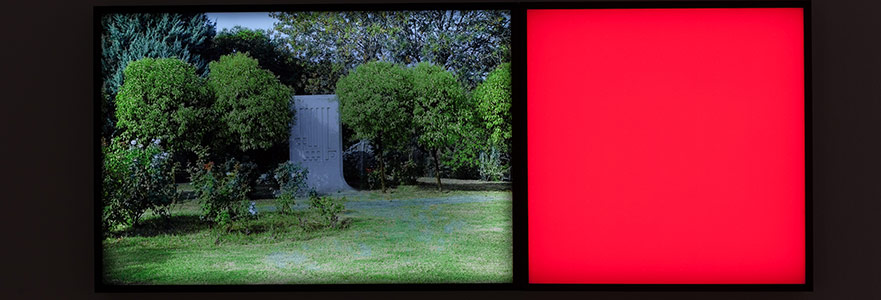
The second part of exhibition has Artist Without An Art title. Artist Without An Art is to take the photo of the writing, written by Emin Barın on the Sadi Çalık's cube shaped sculpture in the garden of Mimar Sinan Fine Arts University and to present the sculpture again as cube. 'A society without an art means a society with one of its main veins has torn apart2 is written on the cube. This replica cube, which Winchester has place in the middle of gallery and being in close contact with Calligraphy works, reminds Ka'ba. The religious writings on the sacred cloth over Ka'ba and secular writings that are written by a Calligraphy artist on Sadi Çalık's cube, make the connection in between stronger.
Thus the third piece forming the exhibition has got a character that is confirming the solid existence of this collective memory. The work called Maşallah RGB is made out of the photograph of sculpture, which was commissioned by Koç family in 1973 to Emin Barın for him to make it with 'maşallah' written on due to the opening of Bosphorous Bridge and placed next to the bridge, and a illuminated board (a reference to the illuminated state of the bridge) with constantly changing lights added next to it. Thus Winchester's artefact shows that the power of certain cultural habitus of ancient culture to prolong itself can appear with surprising scenes and in a network of relations.
The importance of Dilek Winchester's artefact called Homage to Emin Barın can be summarized in three points: First of all, she reminds and/or introduces Emin Barın, who is an artist updating and transforming Calligraphy art, which occupies a very important place in our ancient artistic culture. Secondly, it is a work that is trying to make our cultural memory fall into its place. In fact she is showing the problematic nature and history of our alienation to our own culture by revealing the impossibility of memory loss in this sense. And finally Winchester places herself as a critical artist, who asks questions within this cultural continuity. She, neither accepts that tradition unquestioningly, nor dispersed to the pathological state of ignoring it.

;