Since its opening in October, the museum of the Louis Vuitton Foundation, designed by Frank Gehry, has occupied the art agenda of Paris—an example of the large-scale museums such as the Louvre, Pompidou, and D'Orsay of Paris, the last of such striking institutions, the famous "bag-maker" and important fashion of France. How could it not? Starting with the history of the forested area on which the museum was constructed, how the museum interfered with the locale, the opening exhibition dedicated to the work of Olafur Eliasson, one of the most successful artists of the past few years, as well as many other subjects concern the community, no doubt... Where to start? Perhaps the best starting point is the site of the museum, Jardin d'Acclimatation (Garden of Acclemation), and part of the second largest forest of Paris, the Boulogne forest. Famously famous, the opening of the garden can be traced back to Napoleon in the 1860s and of course to Haussmann; it is important remember the important role of the garden in the cultural life of the time as well as how much that cultural life has changed over the 150 years that elapsed, through the construction of the monument-work museum. The story of this forest that has once again become the center of attention through the museum that Frank Gehry designed, for access to which you need to wait for hours in line, does not have such as a bright history—actually, it has a quite ominous story.
The park, spread over almost 20 hectares, was conceived thematically and as was indicated through the name, it was designed as an expansive area on which different types of flora and fauna could acclimate to Paris. And for some time, due to this function, it becomes a frequent stop for the bourgeoisie of Paris. However, with the displacement of Napoleon as a ruler and the foundation of the Third Republic, the transformation of the area accelerates. The area changes rapidly. The most striking breaking point in this transformation is the exhibition realized by the famous human and animal trafficker Karl Hagenbeck in 1877.
The opening of the exhibition by Hagenbeck, which is unbelievably horrible by today's standards, was through a show of fourteen Nubians with their animals. With winter were six Eskimos on the grass in the garden—four adults, two children, one white polar bear, seals and Eskimo dogs were put on display. Furthermore, various accessories, hunting tools, clothes and little objects were also brought in. Quickly, these ethnographic exhibitions draw the attention of the Parisians and scientists. People brought from different parts of the world live under the curious gazes in Le Jardin d'Acclimatation for a few weeks. All of their daily activities (food, music, dance, shelter, hygiene, dress, religious, sexuality) are observed by the visitors and analyzed by ethnologies. Anthropologists conduct measurements to make use of interracial classifications and to define levels of civilization and they research the development as was experienced by the wild men after their encounter with the Europeans. Le Jardin d'Acclimatation's human exhibitions last until 1931, a full fifty-four years.[1]
[1] Ezgi Bakçay, “Ötekinin Ebedi Gösterisi: Le Jardin d'Acclimatation”, e-skop, 11/1/2013
This garden, given over to the Louis Vuitton Foundation in 2004 by the Parisian municipality to "reinvigorate", viewed in the shadow of a past not too distant, feeling tiny en face with Gehry's dwarfing structure—how could one end a sentence when thinking about the so-called interracial and ethnic exhibitions? Now, it is impossible to find even a trace of this dark cross-section of this past... (I'm saying this as someone who spent a long time in this forest, while looking for a shortcut!) Actually, you can spend a passionate and admiring time in the forest and of course in the museum if you do not know of this important past.
I don't know if it is necessary to speak of Frank Gehry as an architect who invigorates any place that he touches, rebirthing any place from its ashes, no matter what the city, the region. Gehry is the reason for the coining of the term Bilbao Effect in museum terminology, marking Paris's cultural world strongly and sharply. Gehry's architectural design is erected right in the middle of the Garden of Acclimation. One can also remember when the garden was given over to the Vuitton Foundation, Parisians tried to intervene, just like in Gezi, and they did not succeed.
The glasses at the Grand Palais inspire Gehry's design for the museum and the Palmarium constructed in the garden in 1893. The talks for the museum that reflects Gehry's style started with the executive of Louis Vuitton, Bernard Arnault in 2001 and the architectural design proposal of the museum was shared with the public in 2006. The cost of the building is 127 million dollars and it would open at the end of 2009, beginning of 2010 and was finally opened at the end of 2014, having cost 143 million dollars.
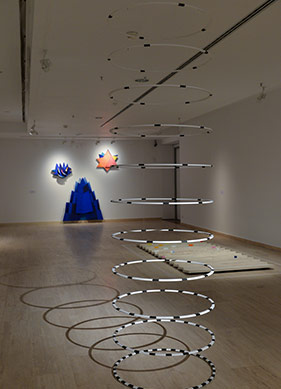
Of course, Gehry's architectural design is bewitching, but it also reminds us of the problem of stealing the museum collection's thunder, a frequently controversial subject. Actually, you can see that almost half of the viewers who cue up to go into the museum are interested more in the architecture than in the collection and Olafur Eliasson's exquisite exhibition. The museum is made up of 11 galleries holding works by contemporary artists such as Ed Hatkins, Maurizio Cattelan, Isa Genzken, Alberto Giacometti, Mona Hatoum, Wolfgang Tillmans, Thomas Schütte as well as perhaps its most important asset, the opening exhibition of Olafur Eliasson's Contact. One of the most popular artists of the last few years, Eliasson brought 2 million viewers over and over to the Tate Modern's Tribune Hall with his Weather Project, dyed 8 rivers with the substance Uranin that he found for Green River and is well-renowned for a reason. We recognize Eliasson, Danish with Icelandic origins, from his large-budget works and big-scale public art projects such as New York City Waterfalls. These human-made waterfalls cost over 15.5 million dollars, were the most expensive public art works in New York after Christo, let's remember that.
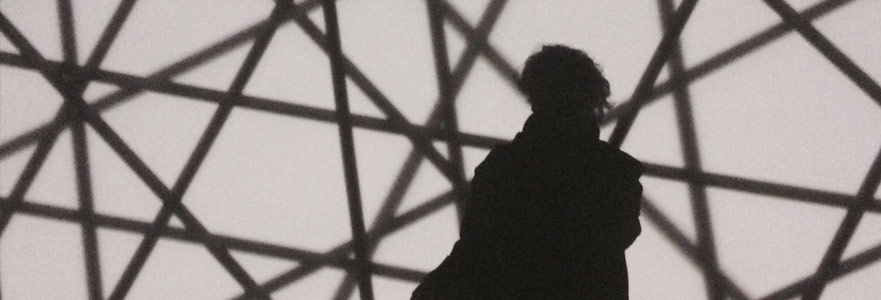
Eliasson, known for his large-scale installations that he constructs using light, heat, pressure, and water, his interactive pieces of optic games, works that imitate nature and natural phenomena, realized Contact for the Louis Vuitton Museum—it is a cosmos that is placed within the museum as a self-contained, independent space. This interesting installation that has been formed by optic devices in multiple spaces constructed within the museum, is initiated with each viewer touching a real meteor, instructed by the exhibition guide. The artist designed the installation by using corridors and circular space; you are directed to a room of shadows and geometric shapes that move towards a "map of unexpected thoughts." You move towards the Big Bang Fountain, to the future bridge through the room illuminated by the yellow-orange horizon line that the artist frequently employs in his works. At the Black Hole, on the roof where you can see the sun, Eliasson's work ends. Eliasson explains, “my exhibition points to what lies beyond our feelings, our knowledge, our imagination and our expectations. This means that each horizon line distinguished what is known from the unknown." He worked with architects, engineers and theoreticians of different fields from the very beginning and today, in his studio that he calls a laboratory in Berlin, over 90 experts think, conceptualize and produce with the artist.
Eliasson's exhibition is almost over. Let's see if the Museum will be able to resuscitate this place and give it a fresh breath of air, as expected both by the Parisian municipality and by Louis Vuitton. Or will the memory of the forest prevent this transformation?
;