Being a young artist these days is not easy! Of course, on the one hand, especially in Istanbul, due to its developing art scene, its art market and the steadily increasing numbers of publications, art faculties, galleries, exhibition spaces, and the general hype around contemporary art, it is supposed to be easier. Though, besides the strangeness of the Post-Gezi-Climate that caused a socio-political limbo also for artists, due to the high number of art production it gets increasingly difficult especially for young artists to be recognized and to get a place within our scene. Next to contextual reasons, also conceptual difficulties make it hard to be an artist today.
Due to the uncountable formal, aesthetical and thematic possibilities of creating art, it is easy to get lost in the labyrinth of approaches, ideas, notions and techniques. Post-Postmodernism’s absolute freedom and total eclecticism have made artistic life more complicated. If everything is possible, and anything can be done or declared as an artwork, how can we decide strong from weak, and how can we decide on the necessary artistic form, content and attitude? In the end, our radical freedom caused an absolute indeterminableness, which can only be handled by brave, engaged and determinant artists who know what they want, and who do not fear to take risks. Otherwise, as we already see today, art faces the danger of becoming a decorative investment tool, which helps the fancy culture industry to propel its notion of festivalism and populism.
All I expect from an artist is honesty, intelligence, braveness and radicalism. It is not much, but it means all! Honesty refers to the commitment to his work. It is not about playing the artist but being the artist. Intelligence refers to the intention of getting beyond the known and common in order to reveal the unknown and unexpected. The further you go on this quest the braver you have to be as you will encounter the unpopular and extraordinary, which is always feared and therefore repelled by the common sense of the masses. Radicalism refers to the extent of the artistic extreme. You might be extremely colourful or radically white, very dynamic or absolutely still. Whatever you do, do not produce mediocrity.
In this context, due to the formal and conceptual character of his work, his commitment to art and his personal attitude Buğra Erol is a great example of a young artist, who manages to form an independent and exceptional position within the mass of contemporary art and artists. I know him since he studied Fine Art at Yeditepe University a couple of years ago, where I remember him as a talented, but also critic, and questioning student. Besides discussing with him issues of art and its theory, as well as watching his artistic progress, I always liked listening to his Greenpeace adventures as a professional environmental activist.
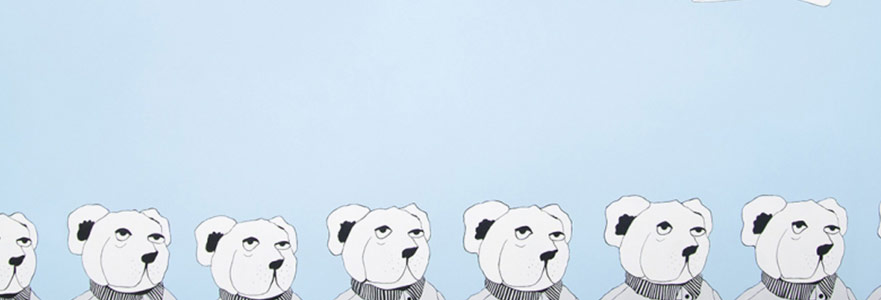
From the beginning of his artistic career, a figurative but deconstructive approach was noticeable in his paintings. Buğra Erol always works with photographic images of everyday scenes, which he artistically loads with weird and strange interventions using deformation and alienation. Absurd stories of human beings, sometimes funny, other times tragic are set in fragmental urban locations.
Recently, the interrelationship between man and nature or man and animals plays an important role, stresses his critical attitude towards environmental and humanitarian crimes. That is why we never encounter harmony, as well as illusionary or dreamy kitsch in his work. A clash of figures, objects, and destructed places creates an uncanny disharmony, which points to our problematic position in the world. As human beings decided to intellectually separate themselves from nature by putting themselves on its top for enslaving the rest of the world, a troubled relationship between us and the rest of all living occurred. This situation of unease is critically reviewed by Erol in various psychological and socio-political dimensions. Though, due to the fragmental and collage-like character of his works, their criticism is neither banal nor dull, as they go against any linear logic or straight narration for activating the spectator to develop his own thoughts and intellectual conclusions.
Besides this, a graphic character is dominant, as painterly textures and gestures are reduced to a minimum. This act induces the spectator to solely focus on the scene of the work. For Erol, more than the act of painting, the visuality of the image itself is of importance. As for him every piece is an expression of an idea, the form, technique, material and aesthetic follow the initial idea of the work. That is why his oeuvre has a strong conceptual character. At the same time, due to Buğra Erol’s talent in dealing with form and material, all his works follow a high aesthetic standard. That is why they are not only deep regarding their content but also beautiful regarding their structural configuration.
Besides that, his will to experiment, to investigate and to play gives his work an exceptional character. As he chooses his artistic form, technique and medium according to the needs of varying ideas, his oeuvre is characterized by a formative pluralism expressed in project based series. That is why it consists of paintings, drawings, as well as of three dimensional objects, installations, videos and street art works. The Dia-Series e.g. is a good example for illustrating Buğra Erol’s artistic attitude. While he worked for Greenpeace in one of its headquarters in London, he discovered bags of Dias from the original Greenpeace archive. After digitalizing them, the organization did not have any use for them anymore. So, Erol decided to take and work with the dias. After playing with the images, he came to the idea of the double layered typographic pieces, which are presented in the current exhibition at Daire Gallery. Collected in a framed light-box, they tell the story of our world in a polyphonic symphony, where the spectator is forced to find his own conclusions between their various formal and conceptual dimensions.
In the end, due to the great balance between technique, aesthetic and content as well as due to his desire to experiment and play, we can expect many more strong series from Buğra Erol. The form will most probably constantly change, and the concepts vary, but I believe the quality of his work will be enduring.
Marcus Graf: Dear Buğra, for the ones who are not familiar with your work, let’s make a short introduction. Generally speaking, which forms and contents interest you?
Buğra Erol: My curiosity is rooted in the place where I live and spread from there. It is insatiable and has many directions. I reflect on my position, my environment and on myself. These days, my priority is the set-up, which I use as the content itself, especially in paintings. In my works, I construct some events/incidents, some situations. I create partially surreal set-ups. Disguising some aspects of the topics that I want others to pay attention to is a strong part of my works.
What are the elements you frequently employ as techniques and forms?
Apart from painting, I don’t find classical methods very tempting. I like my works to be multidisciplinary. In terms of methods, I like to act in intersections but I keep the conceptual framework stable. I actually like to draw upon the potential of the moment I live in. Fully make use of its advantages. If I think it is necessary; I can dig trash bins for material to invigorate the work’s impact. In terms of form I prefer harmony (mainly cool colours) and some sort of emptiness, which contrasts the environment I live in.
So therefore in my paintings I use fewer colours and in my installations less material.
A provoking question: Don’t you have a style?
It would be beautiful, if I didn't have one. If we think about style as a frame that surrounds the work, it can feel to be very limiting. I don’t fancy the thought that people would categorise me with regard to some specific techniques and works. If that is what people expect from me, to have a consistent style, I might not meet this expectation. But I can passionately follow a method, if I find it exciting. Today, I have a style. It is visible in my current works. But I really like it to be changed tomorrow. I would like my style would alter when my take on the world transforms into something else. I’d like them to be in constant change. I hope I can achieve that someday.
Then, I am curious, then how do you choose the materials and the techniques?
I don’t. The Subject does. After making up my mind on what subject I want to work with, I let the subject does the rest of the job. For example, I might want to use painting as a medium but the subject I work on might detest it. It might require becoming something else. Perhaps it needs to become a sculpture. So I try to let the subject determine the technique. I find this approach rather necessary in the realm of contemporary art and I also find it stimulating for myself. This method extends the limits of my work, and besides it makes my learning process more persistent.
This is your first solo show at Daire Gallery. So, could you please introduce the exhibition’s idea and conceptual framework?
The conceptual framework of this show took shape approximately two years ago and in the course of the following year the draft version was completed except the slides. The slide work is added later because back then I had not travelled to the UK yet and found the slides. Nevertheless, combining activism and art is something that I always had in my mind. About nine months ago, right after the first meeting at Daire Gallery, I presented my idea to Selin Söl (director of the gallery) as a project and we agreed on it. For nine months now, I’ve been thinking and working very hard for this show. I believe that Daire Gallery perfectly fits my show and me.
For this particular show particularly, I have invented a gang consisted of people who live and wander in cities, who sustain the system. As opposed to cities they live in, the space I created in my works is deserted and quiet. The goal of this gang is to start “The Revolution of Denial.” i.e. “The 4th Revolution”. You might want to ask why I invented them. In recent years, I have noticed that people are fully aware of the consequences of their actions and what they have done to the environment. But then they are too reluctant when it comes to act upon it. This reluctance triggered the idea of the gang.
How did you come up with title “Good Luck” for the show?
I don’t believe our world presents an optimistic scenery. So I thought we might use some luck.
I would like to talk about some of the works in the exhibition. For example what is the story of “Luck” that you exhibited in Contemporary Istanbul?
Last year, for three months, I worked in a workshop of Greenpeace UK. There were preparations for protests, meetings and among them routine jobs of course. One day, while doing one of those routine jobs, I came across some slides in the trash bin. Today the slide technology is considered pretty much inconvenient and nobody cares about the slides anymore. So I decided to take them and bring them back to Turkey with me. It was not an easy assignment to classify these slides that date to 1974-2004. There are pictures among them that document animal slaughters; environmental disasters and some of them also have evidential value. I superimposed the pictures and created collages. The syntax of the collages demonstrates –in a way- no obvious connection. But of course all the pictures I used have a giant common ground.
Why did you superimpose the slides?
It has more than one reason. I superimposed the slides because I wanted to own them. I also wanted to narrate the scenes that we might otherwise prefer to ignore. This layering process also allowed me to add dimension to every frame. The pictures, I chose to superimpose possess no obvious connection. In this phase, for every frame, I placed aesthetics above everything. There are small fictions in some frames. For example, in one picture there are whales in tandem with a nuclear submarine. Even though that this is something that I constructed, in reality they already share the same ecosystem. Or there are surreal whales in the sky. When the shot of a dead fish and a nuclear power plant superimposed, the scene resembled an explosion. I could have thought that this picture belongs to Chernobyl.
Besides we see “Luck” used as a discourse.
“We rely on luck? Presumably we believe we are too lucky or too smart.”
You question this as an artist, dig for it and therefore desire to accentuate it. So I presume that “The Revolution of Denial” is an important term to grasp the conceptual framework of the show?
I have this opinion that we are trying to create a new world a new kind of a realism that, we desire, belongs exclusively to ourselves and this is the reason that I chose “The Revolution Of Denial” as my subtitle. I’ve also added the fictitious gang that tries to preserve it. We might not be conscious of it but we all are members of this fictitious gang. We resemble an invisible virus on earth. Robert Johnson is the father of the concept “The Revolution of Denial”. He mentions three big revolutions: Agricultural Revolution, Industrial Revolution and “The Revolution of Denial”. I’d like to add The Digital Revolution in-between. He, Robert Johnson, basically says that we are aware of the costs of our choices. We know what needs to be done to repair our mistakes but we don’t take any action. Because we might not be that civilised to disrupt the evolution with logic. We are way too selfish and too conformist to bother. I have no intentions of offering a solution for the issues I raised in my work. I just reconstruct the society I live in with my values and my aesthetic concerns.
How do you select each word inside the slide-work?
The words I chose to put in slide-work possess a strong connection with the message of the slides. The pictures I used in Slide-Work helped me to demonstrate what the gang is in denial of. In the meantime their content coincides with my paintings even if they do not posses the same form. They also refer to the gang’s position. The slides tells stories and the words are their titles. The Same relation can be found between my paintings and their names.
Apart from, the Slide-Works in the show at Daire Gallery, you exhibit some paintings on canvas. How would you describe their formal and contextual matters?
The slides have a direct link to the topic of the show. As I mentioned before, the slides helped me to illustrate what we human beings prefer to ignore. But the paintings are a little bit more indirect. They are composed of colour-blocks and contours. They tell the story of the imaginary gang that created “The Revolution of Denial”. Their message corresponds with nature.
In most of your paintings of your recent series, in front of a monochrome background, strange half a man, half an animal figures are placed in uncanny environments in front of a monochrome background.. How did these creatures enter your painterly world?
They are the members of the gang. They wear animal masks (to demonstrate our disconnection from nature). They also wear suits because they mostly reside in cities. The environment they are located in is so deserted and quiet, none of them would be able to generate a sense of attachment. The masks fascinate me as they fascinate many other artists. When put on they either rip away our identities or give us a complete new one. The animal masks suited the idea of the gang very well. Because I think that we possess another identity that we are not aware of or we prefer to ignore.
Often, nature plays a subversive, but important role in your work.
My connection with nature is very hard to describe. I am representing the first generation of my family, who is born and raised in a city. I struggle with the idea that I have to live with the results of the decisions my predecessors made on my behalf.
However I find the times we live in are also of great importance. These are weird times, paradoxical, the times without any big wars; it is perhaps because of the existence of the nuclear bomb, the mightiest of the weapons ever invented. This is the first time in history that the human race is so dominant and the population in cities outnumbers the population in rural areas. That does not sound very sustainable to me so I find this situation is worth emphasising.
How did your life as an environmental activist for Greenpeace influence you as an artist?
What I witnessed and experienced, has influenced me deeply as an artist. Being too close to the issues I expressed above, really affects one. In the past seven years I have participated in many protests as an environmental activist with Greenpeace, the biggest environmental organization on earth. I worked as a seaman in ships. I was taken into custody for many times. But I have doubts now. In my opinion, the greatest undisclosed purpose of an environmental organisation should be to destroy itself along with the issues it deals with. But the real situation is far different from that. The global problems are the primary source of their fuel and their achievements are only symbolic. Therefore I started to believe that environmental activism should be something individual. It would be better if we didn't gather under the same roof after all.
You deal with a variety of media and disciplines. Besides paintings and drawings, at Daire Gallery, we also see a video work and an object.
Today, everything that surrounds us is so intertwined; therefore I find it very important to practice in different disciplines concurrently. In my series, in exhibition set-ups, I group the works under different disciplines. For example, I use painting to establish an indirect connection with the subject of the series and I make installations to create a direct one. As I have mentioned before my ideas are free to choose their own medium. So what I do is only helping them to be harmonious. Besides being an easily predictable artist does not suit me.
In the exhibition, we also see an object between ready made and sculpture. How would you describe the role of three-dimensional objects in your work?
In The 4th Revolution (the name of the installation), the installation that is composed of disc formed trees in pizza boxes; I wanted to establish a direct connection with the consumer culture. Usually the consumer goods are served to us after traversing many processes. We have no clue of what we consume since we do not see them in their true form. And besides I guess I fancy producing weird things.
In our age every product that is introduced into the market somehow manages to stick. As there is already an overflow of goods, when the heap of the advertising and marketing sectors adds to that, it creates a very distressing scene. Our consumption habits are the major reason of many environmental issues. That is why I’d like to produce my own goods. Utopian, I know, but sometimes I imagine a primitive life completely outside of the realm of the consumption chain, I want to achieve this for the sake of myself.
;