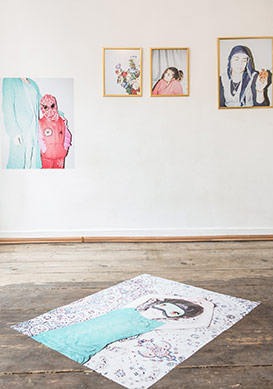
A work that is exemplifying Margaret Lee's absurd and daily aesthetics -maybe they are not even two separate things- http://www.suzannewhite.com/new-astrology/AquariusGoat.html. Since the artist is questioning to work on her own, this is also a collaboration with Antoine Catala. If it is wanted to be said out loud what is seen in each photograph that is exhibited with two glasses of champaign and roses, in English, then what is heard would be 'I want to see you'. The answer of Margaret Lee for the criticism suggesting that this is a work appealing only for the ones who can speak English and try to read the visuals with language: champaign and roses are giving the hints that this is a romantic meeting.
Transforming the relationship in between language and photography into a materiel, this work, which makes one think that the images from Google are combined in an automatised process or these pictures have some kind of importance for the artist, is rather 'contemporary'. What I mean here is: this is a scene fictionalized by Lee's, which maybe we feel close since it instantly reminds us the point that our relationship has come to with visual, makes us smile and it looks as if it is the continuity of the flow of photography in our daily life rather than the currency of visuals or artist.
This is a collaboration of three people realized as Lee's answer to a proposal for a solo exhibition made for another curatorial - artist project, which was realized by two artists. (The reason for me to cite this proposal is because I think the artist is using collaboration as a tool. The reaction of other artists, research period ad the dialogues in between them do directly effect the transformation of exhibition. Since the phases of process are shown in the exhibition, collaboration, production, dialogue become transparent.) Starting with Lee peeling potatoes, the exhibition process continues with Michele Abeles' involvement by taking the photographs of potatoes. Started by Lee (it would be wrong to call it Lee's exhibition) and continued by Darren Bader creating potato sculptures and an installation, this exhibition explains the assembly of realistic photography and fictional space as well as what is represented in photography and experiencing what is in the photograph, over something that is as simple as potato.
An 'updated' version of Joseph Kosuth's chair, photo of chair and the dictionary meaning of chair, it reminds Martha Rosler going to a kitchen and explaining semiotics with the objects in the kitchen. (Joseph Kosuth, One and Three Chairs, 1965 & Martha Rosler, Semiotics of the Kitchen, 1975) When language is shaping our thoughts, is it really possible to percept images visually?
***
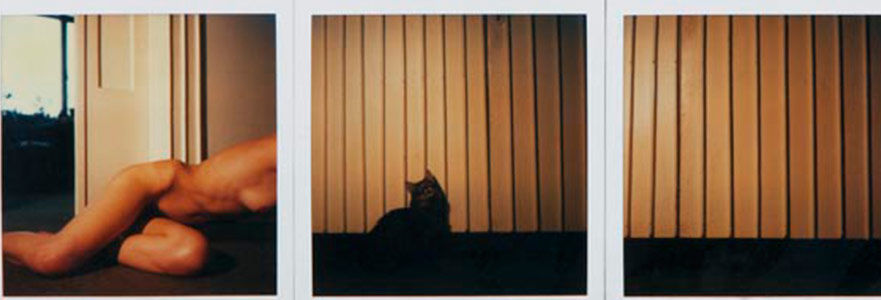
Done by manipulating the polaroid surfaces, the polaroid works of Lucas Samaras gather psychedelic and auto portrait and are not easy to watch. The situations that he realized in domestic environments, which I think are Samaras' body, face, home, and its continuing process with polaroid features photography's chemical and alchemical process as well as its characteristic of recording a memory. Using the channel that we associate to memory such as polaroid, to create chaotic colours and states, the thing that interests me in the process of Samaras is the tension in between the interventions of the artists and the daily. The naked male body seen in the weird beauty of polaroids, sadomasochistic tendencies and the kitchen chair, fridge on the background remind us that what we are looking at a photograph.
These signs reminding us the relation of photography with 'reality' can also be read as an example of visual and conceptual experiment that polaroid makes possible when used as a channel.
***
Photography is a part of a process in the factory of Andy Warhol, who has a completely opposite visual to Samaras and his concern being directly copy a document in his polaroids. He has a sincerity that we maybe never associated with the polaroid visuals of Warhol, who has recorded everyone around him with photography and film. The polaroids of Warhol, in which make-up, skin and look seems more striking, shine out from the works he has done over the social environment the artist created. Using also as a study for his paintings, these photographs are important examples of his multi-layered relationship with artist's image production as well as being functional. Surely we shouldn't forget the humorous photo that he has taken with a skull in order to 'make art after lunch'.
***
The reason I went on this short visual journey was my wish to write on Şahin Kaygun. When I was trying to associate the tension in between 'picture-photography', which is mentioned in the articles written about Kaygun, with my own history on visuals, the thing that occurred to me was how the style of positioning of photography in the art history of photography in order to be exhibited and bought especially in the institutional level became a drawback later on in time.
None of the galleries in New York was exhibiting photography when John Szarkowski, who was selected to be the photography curator of MoMA (New York) by Edward Steichen in 1962 after Steichen himself. There was a rather modernist thinking on the basis of Szarkowski, who was accredited with shaping the thoughts of Americans on photography, defining photography as an art medium: separating photography from other mediums and making it valuable is its relation to the 'moment'. That perfect 'moment', which the photographer catches with his/her observation talent, was something that belongs only to photography and it was making photography an art object. Contrary to photography aiming to tell a visual story of humanity in Edward Steichen's 'Family of Man' exhibition in 1955 that was formed out of anonymized photographs, Szarkowski's photography was associating photography with medium such as painting, sculpture by highlighting individual vision and production.
Therefore, once confused tension in the works of Kaygun was not because they were in between photography and painting, but it was because they were rather in between photography and photography.
Rather than being a tool, photography is the center of gravity for Kaygun, who shows what can happen, happened in the past, what he dreamt of instead of showing whatever happened and presenting this through one-to-one manipulation of photographs. In other words, the works that the artist intervenes with paint are in fact associated with flattening, two dimensioning plane of photograph; not with the painting area. There is a tension in between photographs, in which the texture is more real than the ones in real life, skin and fabric are mixed up, the bones that are about to come out of chest is felt, and the colours. The area, which make us forget that we are looking at a photograph and opening a window to a moment, and the colours that Kaygun is using, are as if competing for the attention of spectator.
One of the tools used by Kaygun, who uses the permeable limits of reality as a material, is breaking the relation in between photography and time. Highlighting the inevitable relationship in between the 'moment' and photography with the photographs he puts one after the other and tears into pieces, this approach Kaygun that avoid to consume a 'moment' with another 'moment', place, time, is in fact maybe closer to our daily perception. The details that we grab in the first few seconds after we enter a room, hierarchy formed involuntarily in between the things we saw first and the ones we realized later on can be read over Kaygun showing the details, which make themselves slowly seen when looking at a female's body, by separating them.
With Separated and interfered photographs showing a moment in time line, what remained from Kaygun's exhibition in Elipsis Gallery is the artist flatting three dimensional objects, bodies around him with a plastic instinct and contiguity, familiarity to his subjective experience of 'moments', which he re-creates after pulling into pieces. Just because of this, I think Kaygun's work can situate photography nearer to daily experience by shaking off reality from the document that has been an annoyance for photography.