ÖNCEKİ
30 HAZİRAN, PAZARTESİ, 2014
SONRAKİ
We spectate and are spectating 31 artists in total in both exhibitions from Poland and Turkey organized with the collaboration of Wroclow Culture and Art Center and Kuad Galley. Opening the first one on May, the second one of the exhibition opened on 5th June and is still open.
Suggesting a remembrance and celebration of the historical relationship in between two countries, this official initiative within the scope of "600th Anniversary" contains a series of events for the culture and art world on interdisciplinary plane.
The diplomatic relations in between Poland and Turkey dating back to Sultan I. Mehmet Çelebi in 1414 according to Jan Dlugosz's "Kroniki" / “Chronicle”, have developed and gotten richer politically, commercially and culturally for 600 years. Adjoined in the 15th century, two countries got connected to each other from the cultural perspective as well and has a special place in the the political-geographical map of the world.
It is important to have a look at the Poland Turkey relationship in 20th century within these 600 years of rooted historical past. Yet these relations were damaged and these long formed relations came to a standstill due to the ideological domination of Cold War area starting with the Second World War. This situation lasting until the demolition of The Berlin Wall and has ended with the fall of People's Republic of Poland on 4 June 1989. Signifying the beginning of economical and political changes in Poland, from this date onwards Poland had become a free and autonomous state and taken important steps on the way to democracy and economy. The Republic of Poland has become a part of UN in 1999 and become a part of European Union in 2004.
The relations couldn't have come to the level, where it should have been due to the slowness in the long-term changes in official diplomatic relations, economical collaborations and the cultural exchange even in this wind of change.
Therefore, the exhibitions, concerts, events and speeches realized in different cultural institutions within the year 2014 are important and valuable contributions to the conciousness of 600 years of friendship on a peaceful plane.
I find the exhibitions held in Kuad Galeri important since they form a fresh and open communications network in between artists and art experts from Poland and Turkey. Also the works we have spectated do have the character of being a contemporary source to read the content of contemporary art and its practices between two countries.
The curator team of both exhibitions consist of Agnieszka Chodysz-Foryś, Beral Madra, Güneş Nasuhbeyoğlu and Małgorzata Sobolewska.
RUPTURES and CONVERGENCES creates an individual or collective moments on ruptures and convergences to a common concious with touches from today Ardan Özmenoğlu, Ferhat Özgür, Çağrı Saray and Uygur Yılmaz from Turkey have attended the first exhibition. 19 artists including Patrycja German, Piotr Bosacki, and Karolina Bregula have attended from Poland.
We spectated the works of Piotr Kmita, Tomasz Partyka, Piotr Skiba, Konrad Smolenski, Tomasz Kulka, Katarzyna Krakowiak, Agnieszka Polska, Anna Molska, Karolina Freino, Joanna Rajkowska, Nezaket Ekici, Koray Kantarcıoğlu, Tunca Subaşı, and Sümer Sayın in the second exhibition opened in June.
As in the first exhibition, we meet with the works referring to the roots of two cultures in the second exhibition in June. Witnessing the distance that the artists both from Poland and here form when they are questioning the issues in the period from 90s up to day, is important in order to compare the production in between two countries. When focusing on the differences or the similarities while keeping the heritage of political, economical and cultural past, also makes the exhibition meet with the spectator on a documentary level.
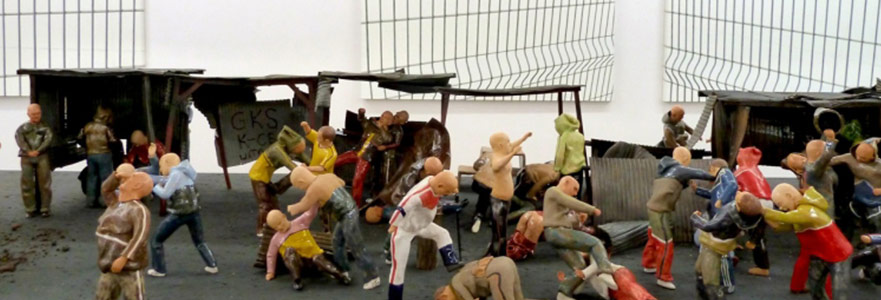
Trying to read the artist's production practice transforming into an artistic object accompanied with the individual experience and concious, enables new readings from inside and outside. One of the works in the exhibition providing a reading as such is the ceramic installation of Tomasz Kulka called Street Fight made out of 120 pieces. The ceramic figures in the installation, in which he builds the street fight of hooligans in the market place he resides, animate a street fight with all its details. Action, violence, ambition and the social identity he creates with the expression in the figures transforms into a social exclusion, racism, hatred and intolerance metaphors in this very colourful installation. We spectate the so-called working class people in the identity of a football supporter in the scene Kulka creates. The fight here affixes us to a universal scene with all its vitality. Our bodies growing prodigiously when faced with these ceramic figures, looks at a kind of scene from above as usual.
The artist clearly repeats the scorn for homelessness, unemployment, poverty in the city as well as the alienation and growing problems forming as a result of these. On the other hand, Kulka depicts the chaotic world of an individual with a double-sided reading and the metaphor of violence within Istanbul's dazzling urban transformation scene.
The video of Anna Molska named as “The Weavers” borrows the title and the dialogues of Nobel priced German writer Gerhart Hauptman's play called Die Weber (The Weavers) written in 1892. The play portraying the uprising against the poverty in Silesia in 1844, “ was banned by the police the first time it was staged and then it could have been staged in a club "as closed performance" in 1893." This play was exposing the negligence of rich employers and the life of working class in poverty with a realistic language.
The things that were lived before the 1848 March Revolutions, transition from carftmanship to industrialisation and the power of capitalism leave the weavers to unemployment, poverty.
Anna Molska shoots her 12-minute movie in Slesia, which is now within the borders of Poland now. Textile industry has superseded the coal mining, which has been present in the district for a long period of time. Natural resources were dried up and other sorts of fuel sources have taken place. Whatever happened to Hauptman's weavers has now happened to coal miners now.
Molska have worked with the proletaria in this video. Labourers, discuss with each other during they are on their lunch break when they are having their lunch on spoil bank. In her dialogues the artist uses the sentences that, Hauptmann uses for weavers. By only changing the characters of the pressure on the proletaria, created riot and unsafe working conditions, the artist gathers labour and memory on a timeless plane side by side.
On plane, in which we saw the darkness with Soma reality, it is possible to realise reaching from Silesia to Soma with this video; to face with the truth through literature, theatre and contemporary art triangle.
At this very point, it is important to get closer to Tunca Subaşı’s aluminium casting bread called “9 Slices of Bread (9 Dilim Ekmek)”. The bread on the wall which is explaining the significance of leading a life in bare minimums in a very realistic language, creates statements with its existence that transformed into a metaphor to struggle to survive, and the artists of a country, which has a past hanging on an iron curtain.
The 2 metre long sculpture of Sümer Sayın called "Around the Boundaries (SınırlarEtrafında)", which we have seen in Art On previously, offers a different form on boundaries. This column, which you can realise that this might be the map of turkey when you only get closer, looks like a pedestal, which has forgotten what it was carrying. Appearing with its pitch-black existence in the gallery, the form is repeating Sümer Sayın's playing/destructing/transforming method, which she frequently refers to. Together with the uncertainty appearing in this sculpture, the eye realises border lines, which it can follow/not follow, roots somewhere on the floor. And one do proceed on the concepts of root, race and gender. Maybe the sculpture that the pedestal has forgotten has become permanent somewhere down there.
Talking about gender, Nezaket Ekici’s 7 minute performance recording “Proof (Kanıt)” is transforming the gender label stuck on females over the issue of being with a gender, into a strong performance together with an oily baby cream.
When we are watching it, we witness that Nezaket is trying to get rid of the baby cream by focusing on the details of her face. It is also possible to say for this performance from a different angle that this woman, who is trying to get rid of her face and intervene to traces of time, is rediscovering her face like a sculpture.
Joanna Rajkowsk’ s bookwork called “The Uskudar Dogs (Üsküdar Köpekleri)” is inspired by a real story that is lived in Istanbul in 1911. A year after the dethroning of Sultan Abdulhamid II and The Young Turks being in power, it has been decided that the street dogs in Istanbul should be removed from the city. First the puppies were terminated. Then the officers collect the dogs and take them to Sivriada. There, the dogs dies by savaging each other due to hunger and heat... This incident is told in detail in Catherine Pinguet's book called Istanbul's Dogs.[1]
Living in Uskudar for a while, the artist Joanna Rajkowsk directs her camera to the street dogs, which made the cemeteries their home, in this district of Istanbul that is full of cemeteries, while keeping this incident in her mind that has occurred more than 100 years ago. The photographs collected in a book called The Dogs of Uskudar touches the friendship/alienation formed in between people and animals as well as the problem of animals being excluded from society.
The last date to discover now, which is formed on the back pages of history in pursuit of different witnesses, with the collaboration of globalisation, to meet with differences and similarities is 26th June.
[1] http://www.ykykultur.com.tr/kitap/istanbulun-kopekleri
;