A legend was being written for my name or maybe that legend gave me a life. It is being estimated that it was written by Homer between 800 and 600 B.C. in Ionia. My name is Odysseus. This is where Hamartia -the reversal of fate- starts, right here at this very moment. The scenes were going to acted one after the other -rhythmical just like in the rehearsals. My ethical and righteous character was going to go through a transformation just before the dawn. I was going to make a terrible, ineffable mistake. This fate has been written long before my birth by the gods. Neither my love, nor my companions or the blind prophet Tiresias are responsible for what happened to me: I wish to state this before the play begins; because they only give news and slowly prepare the audience to my painful end. The realities, which the audience knows, but I could never see are placed impeccably in the plot and action plan by the writer. The audience is going to feel the most intense feelings when they are leaving the theatre in deep pain due to the downfall of a supreme character like me. Catharsis: tears, screams and that divine feeling. Catharsis, meaning "Purification of soul", is explained in Ars Poetica by Aristotel as such: "theatre has a very strong effect on purification of desires since it shows people themselves from an outer perspective".
There should be a peripeteia in every play. Just like the three unities rule: as place, time and action unity is never broken, a sudden change in luck, in which the character's fate changes, should absolutely be. The primal noduses causing fluctuations in the souls of audience, the internal conflict of the character, the reversal of character's fate all of a sudden are all going to make the adventure continue and an enthusiasm, that came out from participation as a whole, was going to surround the whole stage. I wish to tell you this exuberant story of mine shor as a heart beat, but with a strong feeling.
"When young Dawn with her rose-red fingers shone once more
the true son of Odysseus sprang from bed and dressed,
over his shoulder he slung his well-honed sword,
fastened rawhide sandals under his smooth feet
and stepped from his bedroom, handsome as a god. "**
My fleet formed out of twelve ships, laid along side of the land of Kikonians in Thrace. First we got attacked here. I have lost six of my men. Then I had to fight with Cyclops; ran away from the fury of Poseidon and my crew were crunched by giants. As if the thunder bolts of Zeus, my search in the land of deaths and nine unmerciful days I spent on the pole of my smashed ship were not enough, there were countless suitors back home, whirling around my beloved wife Penelope like fireflies. My long and painful journey ended when I reached home dressed as a beggar and reach my wife and son.
** Homer, Odyssey
* The Valley of Wolves
The artist Peter Hristoff, who has separated my tempestuous story into themes of war, identity and homecoming, is now in Istanbul. The works of Peter Hristoff, who is a member of faculty in New York School of Visual Arts as well as the advisor of "Praine Halı (Praine Carpet)", which is a wavering atelier located in Menderes Valley and aiming to support the women of the area, are being exhibited in many public and private collections including NY Metropolitan Museum.
Interrelating works, which are set off from Ancient Greece, the concept of heroism and Odyssey, are nowadays being exhibited in C.A.M Gallery that is situated on Beşiktaş Şair Nedim Street. The artist is whispering to the ears of audience the question: "So who is your hero?" Righteous and strong hero typology is having breaking points when it meets with today's popular culture.
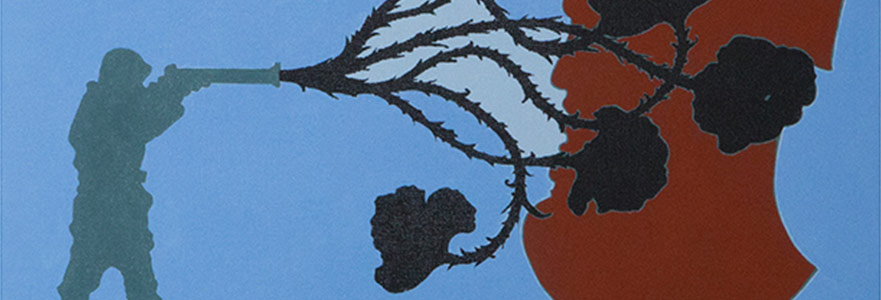
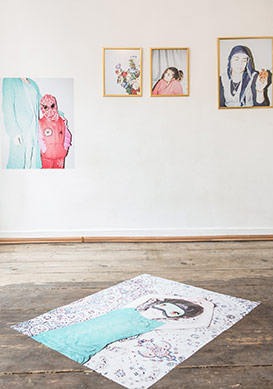
Hristoff is exhibiting his works on paper, his painting and his rugs in the exhibition. When you are looking on the pictures, in which he uses a theatrical language, you feel like you are analysing a theatrical text. He is positioning the plane of picture just like a stage. The artist is explaining this plane as such: "Various charters interact with each other on this plane -they exist and then disappear and then appear again - and they reveal the subject and idea I wish to explain. The subject matters that I dwell on: identity, ego, power, archetype, religion and violence. I take live models, museums, art history works and popular culture as my references.
The symbols of male genitalia in the pictures are both ridiculing the male ego and appreciate it. The images in Classic Greco-Roman sculptures are imitating the Ancient heroes' sculptures with the silhouettes of porn stars with missing organ.
Cross references such asOdysseus fits almost exactly into a personality of modern heroes and the narration fits into today's narration styles. The legend does not move on a straight line.
The narration of the legend is similar to today's novels or action movies with ups and downs. The incidents in Odyssey are not being animated in a straight alignment; but with going back in time, memories, jumping ahead and change of scenes. Peter Hristoff is reflecting this characteristic of the legend to his works. It is presenting a post modern Odysseus to the spectator. This is where transition from lack of knowledge to knowledge - in other words Anagnorisis- starts.
;