When are looking into artists history, it is possible to observe that artists go through a series of period, in which artists take some artists as their role model and they analyse their particular work with a never-ending passion as well as appropriating those works for themselves, in every period of Art History especially after 20th century. For instance, Picasso feels an amazing dedication to Velazquez's Las Meninas and draws this legendary paintings in his own style over and over again. You can even see a part separated only for Picasso's Las Meninas adaptations in Picasso Museum in Barcelona. Just like Picasso, Dali also chooses Velazquez, Las Meninas, Rafaello, Millet, Da Vinci, Matisse, Vermeer and many other artists as a subject matter for his art over and over again. It is also possible to encounter certain works, which have always been inspiration for artists such as Las Meninas. For instance Manet's The Luncheon on the Grass and Olympia pass into history as Cezanne's, Picasso's and Frank Stella's -so to speak- kind of an object of desire.
When we look into art history in Turkey, it is actually a very surprising fact that these "cross-references", which can be identified in various forms such as inspiration, modelling, confrontation, greeting history... An approach that is avoiding to mention the names of old masters or sources of inspiration, attracts attention, let alone a confrontation, which can be described as a duel in some works. You can link this this fact either not to have an artist, who could have been a role model, or the artists not having enough knowledge on art history or knowledge on artefacts, or else percepting to be unique as not to look back. Whereas it is obvious that Ai Weiwei's Fountain of Light is a respect and update of Tatlin's The Monument to the Third International. Hence we can easily say that artefact feeds and reproduces artefacts... It is possible to define the attitude of Turkish artists ignoring anyone except themselves or -better to phrase- their attitude to ignore what was before them, as a modernist reflex insofar as it is possible in the post modern world. It is certainly obvious that this issue has got other extensions, but I think it is beneficial to note this as well...
This long introduction above coincides with "Artists Pick Artists" exhibition in ArtSümer, which will last almost two months. Artists working with ArtSümer have been paired up independent of each other in the space of gallery by defining artists names, which they feel close to themselves as artistic attitude, attracting their attention or interest them, for this exhibition. Therefore a collaboration that we ado not encounter so often, has emerged...
Gökçe Er/Komet; Gözde İlkin/Yasemin Özcan; Erdal Duman/Serkan Demir; Onur Gülfidan/Berkay Tuncay; Merve Üstünalp/Duygu Sabancılar are forming the artist couples of this exhibition.
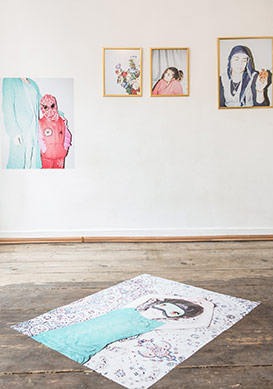
While Gözde İlkin's work, which she has realized with a wall carpet that is generally used as a interior decoration object, is reminding a lot of concepts such as found, appropriating for oneself through intervention, it, in fact, makes us think the reality of image on the carpet and its connotations. Applying The Statue of Liberty in States onto a wall carpet, the artist transforms the distant one to closer and also to a decoration object in a sense. You might think that the land of freedom is only an image and also this image in your head can easily be unstitched like the threads attached to this carpet. Yasemin Özcan's work, which she has first exhibited in Sinopale, right across İlkin. Yasemin Özcan is responding to institutional standardization with dress patterns by using a plain narrative. Being made unique by framing with frames that are in same style and dimension, these objects of this serial production reach us with a reference from an ordinary looking tailor shop in Sinop which has a "any kind of official-civilian clothing is tailored" sign on its window. Özcan is maybe aiming to make us remember the misidentification of what is official with these details, which don't look like anything or any form at first glance.
The work of Komet, who attended the exhibition through Gökçe Er's invitation, called "You Went Off Then (O Zaman Çıkıp Gittin)" work dated 2007, is form the basis of Er's work both from structurally and contextually. As Komet's painting is feeding Er's canvases with birth, breath and death themes, it also forms a contradiction due to its dimension.
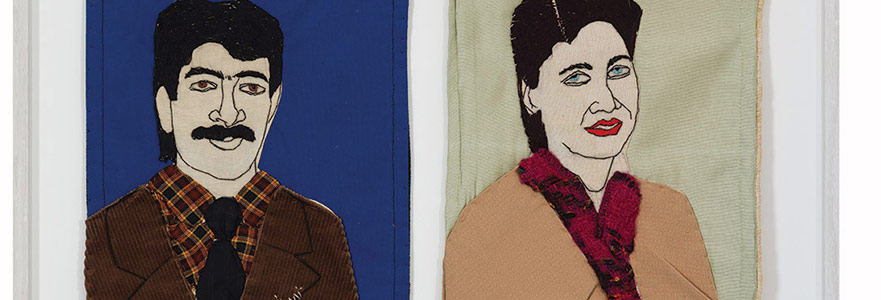
Merve Üstünalp's portraits form the quite interesting works of exhibition. Reproducing the head shots of a couple, which she has found in an accidentally bought second hand purse, by sawing them with fabrics, the artists is transforming what is reproducible into a unique object and carries the ordinary to a contradictory level. When presentation and immortalization of the important and extraordinary are remembered in the tradition of portrait, the artist is revitalising the identities of individuals, who are maybe long dead, with her work. The name that Üstünalp includes to the exhibition, is Duygu Sabancılar. The artist is questioning contextless and empty discourses of today's politicians over some sentences, which have been clichés and have long lost their meanings, in her work called "Afiyet Olsun (Bon Appetit)" from Vaadedenler(The Promisings) series. While she is doing this, she is creating characters, which are reduced to a template, by laying identical figures next to each other.
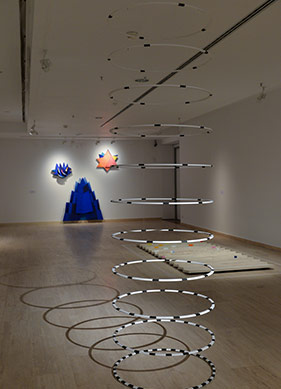
Making an ideological cross-references with a different shield form inspired by presidential force form, yet changing many details, Erdal Duman is focusing on the main attribute of a current period. Appeared previously with works containing political references in his previous works, the artist is making criticism on the institution, which makes militarism as a shield for itself, with his shield. He is suggesting us to look more carefully on how the governing power plays with the symbols and the reality lay behind it. Serkan Demir, who is the artist invited by Erdal Duman, is deconstructing the forms with different functions and place them to a different context with a similar approach. Therefore he makes the spectators think the perception of forms on societies.
The last couple of the exhibition is Onur Gülfidan and Berkay Tuncay. Berkay Tuncay is making us question fiction and reality by using still-life painting, which is one of the most classical theme of art history. Creating images on the variability and the authenticity of what is seen and what it is in reality, the artist is developing an ironic point of view based on the wrongs that we know as rights. Onur Gülfidan is making us focus on the surreal vision of the world, which is playing with our perception by means of known images of mass culture, with his work called “Ne Yaptığını Biliyorum! (I Know What You Did!)”

;