It is obvious that art has gone under a radical change when compared to past periods- there is not doubt about this and we keep on repeating it all the time. As it is said so: The first step of this change emerged as art started questioning aesthetic language and then abandoning this aesthetic language. This is true in a sense: Although the artefacts today are representing the data freely from almost every period (which is a characteristic of art today), they have got side separated from the 18th century aesthetic theories and the language coinciding with these theories. As I have mentioned in other articles, one of the reasons for this (maybe the first one) is that some of the "things" that art has to imply (these so-called implies are mostly the ones in relation to art and philosophy) can now actualize through technology and there is no need left for implications (For instance please see “Platon’dan Elektronik Teknolojiye Taşınan Miras (Heritage Carried From Plato To Electronic Technology)”, Artful Living / 18. 11. 2014). In this sense art's need for an attitude that returns what is told with implications directly to perceptions, rather than implications themselves. In other words, the thought that is put forward, is transforming into a perception perceived by five senses beyond "being thought" in art.

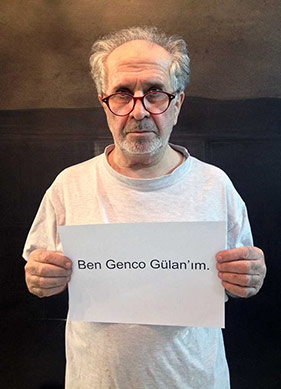
Although -for instance- the problem of "synaesthesia" in Plato's "colour-sound' combination has gotten itself into plenty of various forms in art until it reached us today (let us remember Kandinsky-Schoenberg collaboration), its final destination has become exactly listening and a "session" of watching whilst listening, rather than thinking and feeling about this union. Hundreds of examples as such can be given within Contemporary Art definitions. We are now in a period, in which we present it with its tangibility rather than making people to think about and feel "something". The art works, which we will be mentioning within the context of this approach, is Genco Gülan's sequence of "portraits" that he has done in internet environment and with photographs. While Genco Gülan was exhibition his own photographs there, he uses the names of "others" on a paper he has in his hands or when he is exhibiting "others" portraits, he was giving them the paper, on which his name was written: he was implying the images and the names form such weak union as the names and portraits mix up. Surely this process was an implication. Yet, when the previous periods of art are considered, Genco Gülan's implication slowly elude from implication and start to indicate a more concrete situation (it can also be called the implication of implication's concretization) Now we need to open this subject a bit more.
Everybody knows "themselves". This process of getting to know starting with the thought "there is an I within me" in its most primitive form, "I" is a defined concept in every situation and with all doubts although it signifies a curiosity on what that " within me" is. The person in front of a mirror (or looking at his/her photo) identifies his/herself with that image; but then again he/she sometimes can't get away from the curiosity that it grows on what "I" is. The image of "self" produces a power that triggers curiosity each time. A person telling "I" with confidence is in fact him/her putting a question about his/herself forward.
If "I" is a determined absolute concept, then how can it be defined? A person, who "knows him/herself" and define this self as "I", memorizes his/her body as he/she ruminates the image and does this by combining all past images in his/her mind - he/she doesn't have doubt about being his/herself even if his/her image changes over the years. The body has changed and is changing; yet it is "I" in every situation and there is no doubt about it. If the body is not staying in a certain way, it still belongs to "I" as a "suspicious" form. Therefore, there should be a definition for the concept of "I" (like form) despite all changes. There is a need for some consistency points in order to achieve this. When Descarte has created "cogito" as a concept, he hasn't discovered a path no other than clinging on unapproved hypothesises: it should be referred to "other" concepts that can be linked to "cogito" and he directed to a trilogy as such: "Human", "animal", "intelligent"... These three concepts gained function within the context of "species" and their "specific differences", which have surely been taken over from scholastics. Human was an "animal" with "intelligence"; animal was a "species" and and having an "intelligence" was revealing "specific difference" related to human. In order to get to know "human" with "intelligence", we needed to unquestionably know what "animal" is in the beginning; but also we had to unquestionably know what the one having the "intelligence" is. Knowing them all was going to teach us what "human" is in the end.
However Descartes didn't limit himself with this and said only "I think". "Thinking" wasn't an area of "knowledge"; we didn't need to go after it. Because "thinking" was given "in himself" and this couldn't be nothing but a straight forward implication. And then he added "suspicion": "Suspense is ... When I'm suspicious, there is something I am not suspicious about and that is what I, who is suspicious, thinks. What is I anyway? Does it not exist if my body doesn't? I wouldn't know this; because I can be suspicious from the existence of my own body. the only thing I wouldn't be suspicious about is I am thinking since I am suspicious." "I am thinking" is a determination within the logic of these implications. "It was determining the existence of thought and the existence of thought was being determined as the existence of the thing that thinks." Descartes is saying that he, himself is something that thinks; he is suspicious and he expresses himself as "I exist". "In that case, he has discovered the terrain, in which the essence is the subject." 1
There is also this: When Descartes suggested that the subject is an essence, he has put a separation in between soul and body. This aforesaid separation is more than a separation of individual's body and his/her body, but it is a separation in between the subject belongs to essence and that essence-subject's state, which can be experienced. In other words, if a subject can only know and determine his/herself as essence, how can this be experienced by senses? In other words, what are chances for a person to determine his/herself? Descartes can't give an exact answer for this; we must to wait until Kant to get an answer for this. Here, Kant searches for and finds particles of subject (even if there is the danger of falling into deception), which can be saved from senses. Empirical subject... This is a subject, which can be lithe through various appearances; but is suited to a "heard experience" at least and also is dependent side of that subject's body. Therefore, Kant figures out a way to transform subject into "knowledge". On the other side, Kant furthers from the point, where Descartes has reached. Even if subject is given as a present to person's "heard experience", another topic arises from a different subject. This is a transcendental subject, which is beyond the person's empirical subject (and will never be able to transform into that empirical subject).

Even though Kant's transcendental subject is not the same with empirical subject, it is situated in the same body with it and this transcendental side emerges in all empirical subjects and forms their contents. In short, that is the system of all the unity of empirical subjects and contents. That is "thing in itself" or a “noumenon”, which the subject gains from its very nature. Something that is nothing other than being thought about... Now the same question arises again: When we use the word "I" in confidence (and yet it is still an undefined and absolute concept), what is "I"? What is "I" that is different than what we see in this mirror (or in our own photo)? Here it becomes divaricate: we are both face to face with "I" and we are thinking about an "I" that is cutting through all "I"s (all "other I"s) as well as grounding them. A subject that is transformed in "knowledge" is now dragged out of "knowledge" once again.
There is a widespread sentence for Kant's subject and says: "Kant's subject is bored of its own subject and thinks to 'become somebody else'." This is a pertinent determination and emphasizes the universality of subject. As a content system, the subject spreads from "I" to "we" and then to the thought of "being human". The subject has become a phenomenon in its full sense: it has appeared as much as it could have; but it has become something that is re-thought by involving that universal subject system as well. This is, where the subject can transform into all "I"s, get through from one to the other, and most importantly this is the evolution of empirical subject into a quality, in which " it puts itself in someone else's place": Emanating from being a concept of "freedom", "mind" is attributed to subject and offers a sense of community (and legality within itself) to that subject. It should also be thought as such: The subject defines itself as an empirical subject in its each state of appearance - in other words, each appearance of "I" is limited with a location and time and this limited appearance of this "I" explains that there exists no "essence" behind it. That is why each "I" that we perceive refers to its own appearance conditions (momentary formations) rather than "self" as a phenomenon. Each and every time this is a partial subject. Yet, thinking what these conditions are, how does the empiric subject shape and remain according to these conditions, how is the transformation of the subject in front of every factor and the reach to the opportunities, which will be representing itself going to be realised mean relegating our mind to a transcendental subject again. Transcendental subject "keeps getting bored of its won body."

The problematic of "being human" is Hegel's area of interest. İt may be more appropriate to understand this as (with one addition a letter) "being humane". He was as if he started off from that primeval differentiation - in other words the differentiation of "human" and "animal"- when he started to talk about "I". But, he didn't work the problematic in his "being humane" from a different channel; contrary he furthered from where Kant has left. The subject of Hegel was not content with thinking about itself and system of contents that it belongs in order to "be humane". A harder task was given to him. The subject was going to suppress its "animalistic" motivations ( ambition to "own" originating from any kind of need, which is to live and maintain its life), but most importantly the subject was going to share the distance in the process of "becoming human" with all other subjects. The subject was forced to it. This meant that the person had to show how can that person remain to abide to the transcendental subject, which Kant set forth, how can he/she coincide subject with universal laws; how much can he/she turn these laws into practice as well as thinking about them, to all the other subjects. This kind of necessity was showing that empirical subject was going under rather a heavy weight; took the responsibility to carry transcendental subject to empirical subject and both the relationship "between Is" and the necessity to explain "something" (discourses and actions) during that relationship. Maybe the so-called situation is to have the approval of self (the state of "being humane" itself) by those"others" as well as "I" being "somebody else". This approval of others evokes a kind of a power struggle within the frame of "being humane" rather than being a relationship in between "other subjects": With the power of "being humane" competing against "others"... But by sharing this "being humane" with all the subjects and between subjects...
At this point - in other words first "I", then "us" and as a result at point of "being humane"-it is easy to bring this action of Genco Gülan forward. It can be said that: Genco Gülan is exhibiting a retrospective of this historical relationship in between subjects by sharing the phenomenal structure of the body representing the self (by switching the names of "others" with the image of body or his name or image with the image of the body of "others"). This could have been such an explanation that can't be objected; yet, it also meant that an easy way was being chosen (as it is stated) and some things remained incomplete in that explanation. It is not that hard to feel the existence of rather a deeper action. At least this should be thought in the beginning: Who is the one demanding to unite his/her own body or all of his/her "I" with the names or images of "others" during this action -all of the figures in this action? The answer is simple: No; this is only requested by Genco Gülan and have other subjects approve of it. The image of Genco Gülan appears to us constantly with the names or images of "others" and that name or image presents its own "I" as "not I". Maybe I am "all" those names or images... "I can be all"... The action then transforms into an image of universe through exhibition of phenomena one after the other or inside each other and ends up having an artistic definition. On the other hand the action says this: "I am somebody else" (we constantly see figures and variable names and this all approves this situation)
If Genco Gülan is presenting himself as "other" each time and he needs this in every situation as well as forcing "others" to be "somebody else", then what is done is nearer to philosophy than art. Because it sounds as if Genco Gülan is saying something like this: "I" and "others" - we are the adverbs of each other and "I" want this like this. When "I" exhibit "others" on an immanence plane with myself, I tend towards an "inclination" with them ("all" of others) and aspire the temperament of "others". While Genco Gülan is presenting himself on a inclination plane with "others", he doesn't take the place of "other"; but he presents "being somebody else" or "becoming somebody else". "Becoming is not a being and when Nietzsche is becoming Dionysus, Dionysus also becomes the philosopher. Here, Plato is the one, who started first: "When he was transforming Socrates a philosopher [a philosopher as Plato himself], he has become Socrates himself at the same time.” 2
İt is these "being"s or "becoming"s appear as "conceptual personae", which are substantial personalities that have been away from implications. When a philosopher changes the personalities he has chosen according to his/her own temperament, he/she inevitably changes his/herself temperament according to the temperament of "others". "Conceptual persona has got nothing to do with an abstract identification, an icon or an allegory: conceptual persona lives and insists. /... While those personalities become something else than what they historically, mythologically or currently are, it is the fate of the philosopher to transform into conceptual persona or personalities (Plato's Socrates, Nietzsche's Dionysus, Cuse's Fool) Conceptual persona is the becoming of a philosophy or subject that is valid for a philosopher." 3
Genco Gülan is now narrating his own discourses in daily life (he has to do it since he is a subject); but these discourses reach us by being subject to the "other". The discourse of Genco Gülan has turned into his action at the same time. Verbal action: "I" and "others" - we are the adverbs of each other... And when these verbal actions heading towards us, they always make references to "third person" -in other words to "conceptual personae". When "I" (Genco Gülan) am talking with "you", I talk as the "other"... Frankly, "I" am a subject as "third person" and I am talking as "he"... But, substantially speaking "I am somebody else and I am substantially a subject".

Genco Gülan's action sets off by using his own figure as the equivalent of subject's concept within the state of philosophical integrity and he applies a concrete "being" or "becoming" by involving "others" (after getting their approval). Transforming this philosophical attitude into visible figures at the same time, he includes this into the field of art; it is just like (as seen in the examples of Deleuze and Guattari) Zarathustra, who is Nietzsche's "conceptual persona", transforming into a theatrical figure...
Finally, it can emphasized that presentation of philosophical discourses as "being" and "becoming" and transformation of them into figures related to art is a dichotomy that these two integral areas create within themselves. In other words: It is the possibility of art's "composition" plane to get into each other with philosophical concepts. “So much so that the gap of one is filled by the wholeness of the other." 4
[1] Gilles Deleuze,Kant Üzerine Dört Ders / Felsefe Dersleri 2 (Kant's Critical philosophy. The Doctrine of
[2] Gilles Deleuze / Felix Guattari, Felsefe Nedir? (What is Philosophy?), Trans.: Turhan Ilgaz, Yapı Kredi Yay. 1993, p. 63.
[3] Ibid. p. 62
[4] Ibid. p. 64.
;