ÖNCEKİ
25 ARALIK, PERŞEMBE, 2014
SONRAKİ
Degenerating and changing the state of existence of things by gathering them together, collage suggests another level of seeing. The eye is going to have another experience unlike before, upon the things that come on top of, next to and following each other.
Important name of German avant-garde Kurt Schwitters is a routine breaking and leading artist. Collage is the language and the center of Scwitter's art. Although his name is mentioned in Dada, it is frequently mentioned that he creates his own Dada. Having meaningless poems in various forms, sonata named "Ur Sonata" containing voices that are meaningless when they are next to each other, Schwitters releases a magazine, which is composed f meaningless pieces and pieces with special meanings. He calls this magazine "Merz" as he calls all hi oeuvre. This name is a found word as it is in his collages. In time, Schwitters would be using this name, which he has found out based on the word "Kommerzial" (commercial) 1 , for all his works.
Over the time, "Merz" has become a name explaining all his art. When installation was not even being pronounced, him filling the place he lives with sculptures and found objects would be accepted as the first examples of installation art in the future.

Any kind of object that comes to mind takes its place in his production language over the time. Tires, tickets, newspaper cuttings and many others. They have become sort of a dairy containing hints about that day's life as well as involving daily life objects in collages and daily life objects getting into art as found objects.
Hannover Merzbau (1922 -1942) is the living space that Kurt Schwitters has built for himself in Hannover and got ruined as a result of bombardments during the war. This place, in which he lived and made his manifesto live among all the productions called with the name "Merz", which Schwitters has created his own language, is a space that gives birth to art and inserting the person entering the space like an object -making that person almost a part of a collage. Schwitters has made Merzbau’yu, twice more as one being in Lysaker* near Oslo and the other one in UK, but unfortunately none of them exist any more. The last one has remained half done due to the death of the artist in 1948.
Ali Artun writes these on Merzbaur: “Schwitters starts dreaming about Merzbauor in other words Erotic Cathedral, which is his architectural masterpiece that he dedicates his life on, with some sculptures, which he calls Merz-column. Agony (Leiden, 1917) is considered to be the first one forming the core of Merzbau This is the assemblage of trash such as wood, cardboard, junk metal sheets, broken furniture pieces, painting frames. The death mask of his son Gerd, who died very young,is at the top. The number of columns increase to ten in seven years. He names the sculpture that he refers as "big column", as Cathedral Of Erotic Misery (Kathedrale des Erotischen Elends – KdeE). Due to the allegorical intensity symbolizing Schwitters' architecture, Merzbau is also started to be called with the name of this column. Other elements of the structure rather than the columns are the collages looking like reliefs.” 2
Braque has involved first the glued papers in patterns and then into the paintings. Picasso would be following him and collage would progress together with cubism. Merzbau is a dream home, a poem, a magazine and a life, which progresses within the freedom of collage and assemblage in the center of Dada and constructivism. Making collage live as a pluralist element in the production language as well, Merzbau is a memory home, in which Kurt Schwitters exhibit his work.

Brian O' Doherty says that, "It is hard to kill idealism in art; because an empty gallery itself acts as if it is art anf thus protects art. Schwitter's Merzbau can be considered as the first example of "gallery" idea as a transformation space that is filtered from a world colonized by transformed eye." 3
Brian O' Doherty, who is the writer of "Beyond the Ideology of White Cube", disintegrates the idea of gallery in modern art and explains object and its relationship with exhibition space as well as talking about the existence of spectator in this relationship. Irish artist and critic O'Doherty says related to his Merzbau, whcih he made in 1923 in Hanover and got wrecked in 1943: "When Merzbau was built, we had to wait for 40 years for installation art and the idea of experiencing the space has yet to emerge. Everybody has become aware that their space was occupied and as Werner Schmalenbach wrote, 'the creator is gradually dispossessing his work of art. The urge behind this occupancy was not very clear, although as Schwitters says 'the myth of city is the one that sources the creation of the work of art." 4
Objects proceeded and is proceeding either side by side or by themselves in the art history. The fate of things that is united with installation during its journey from collage to assemblage, made the ready made objects stronger. One doesn't need to be an oracle to have an idea on the future of collage in the increasing possibilities in the limitless universe of digital age.

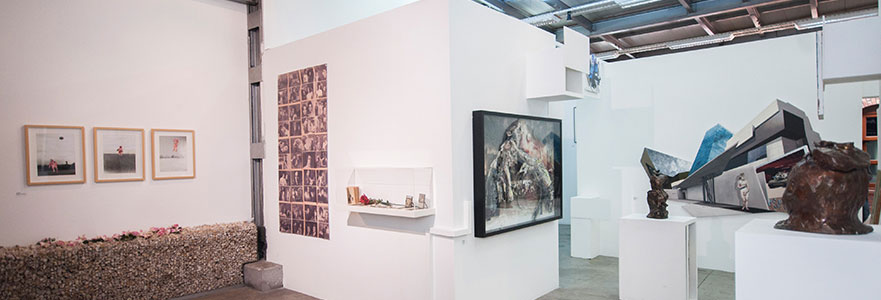
MERZ 3000 "The Future Is Collage" titled exhibition held in Plato Art, is making a reference to Kurt Schwitter's Merzbau. The design of the exhibition expresses indebtedness to Merzbau, which was an experimental space similar to montage through expressionist and cubist spatial interventions.
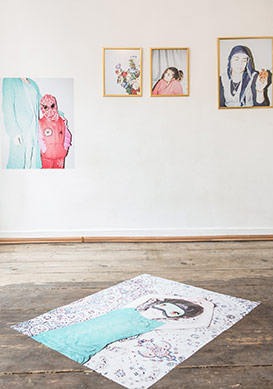
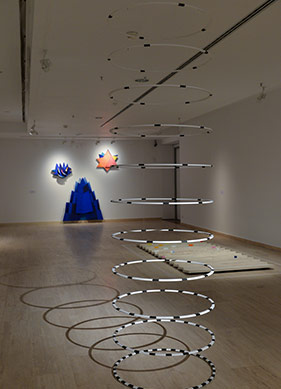
"The Future is Collage!" is a group exhibition showing the existence and importance of collage in contemporary art and as well as its proximity with other mediums. The works of nine artists carry the status quo and the meaning of collage for contemporary artists.Also, since the structural rules of collage and montage are applied, the exhibition is presenting an alternative experience that is going behind the classical "white cube". Due to this fragmental structure of the exhibition, the space and visitors, become the universe of a wide and unique collage, in which the ideas, interpretations and experiences are all related to each other.

The curator of the exhibition Marcus Graf. Sergiye; Bora Akıncıtürk, Deniz Ayral, Özge Enginöz, Buğra Erol, Mustafa Horasan, Seydi Murat Koç, Lara Ögel, Damla Özdemir and Arda Yalkın attend with their productions, which are produced in different mediums and unite in the collage denominator.
Marcus Graf has included the architecture of Schwitters, whom he is inspired from. This is a space transformed into a labyrinth, which is trying to rip the known sterile exhibition visiting action and yet can be disturbing for the audience at first. Moreover, the extensions coming out of walls, frames, niches are the pieces of this chaos. But, this alienation can be even less if you remember Merzbau. The things you see on the walls, in niches and extensions are there to reminf and salute the language that Schwitters is using in the production remembered as Merz, and the unfinished existence of collage.
İnspired by expressionist and cubist space, Marcus Graf focused on the artists, who work with collage, for this exhibition. Merz 3000 is a name containing irony inside since collage is fully in art today as well.

;