Capri was a center of interest for people since the Neolithic ages, Ancient Greece, the Roman Empire. Capri is located on the tip of the Napoli Bay in the Mediterranean and it is not too big at a mere 10.4 km2 —twice as big as Büyükada. Such a small island becoming a center for travelers from many different countries in Europe since the 18th century and also a frequent stop especially for artists and writers since the 19th century enabled the city to become a place that was referenced in literature.
Capri, while being a frequent stop for artists over time, is also recognized for embracing artistic activities in the recent past. At the foundation of the exhibition "Capri Trend" is this quality of the island. Fondazione Capri, founded in 2009 to preserve and promote the artistic and cultural heritage of the island, considered photography to be the appropriate tool for this purpose and invited photographers who are Italian or who live in Italy, forming a resident artist program that would enable them to produce new works on the island. The exhibition brings together series of photographs by Olivo Barbieri, Murizio Galimberti, Francesco Jodice, Irene Kung, and Fedrinando Scianna, mostly produced during their participation in this program.
Irene Kung, born in Switzerland, but living in Rome for a long time, depicted the well-recognized points of the island in her black and white photographs. In her images, it is possible to recognize ordinariness and a plainness that evoke the viewer to think. The buildings and landscapes that are lit by the moonlight become frozen images through the long exposures, but this monotonousness trigger the need to look at the photographs from u-close, creating a consistent, self-contained series. The tonality of black and white is diminished by long-exposures, especially in the photograph depicting a villa on top the rocks, in which the rocks become one with the sea, an image that makes the viewer look at it for an extended period of time. Other photographs of architectural detail in which Kung's long exposures and depth of field resembled pencil drawings, abstracted from their surroundings. It could be said that Kung, through this approach gains a portrait of the objects that she focuses on.
Following are Maurizio Galimberti's photographs, related to Kung's photographs in their unique approach to architecture and the selection includes works from two different series. The first two works, first one dedicated to the variations of the same place in a Hockney-like method by Polaroid and presented together from 2011, is very striking. The other series is of landscapes and various details from the island, but with the tonal values, these monochromatic photographs are reminiscent of the 19th century, although Galimberti made them in 2010.
The only photographer who fore grounded the human element was the Magnum Photos member, Ferdinando Scianna, who is known for showing the behind the scenes of fashion. Most of the photographs by Scianna in the exhibition are from travels to the island from before, but a photograph from 2012 is also included in the exhibition. Scianna's black and white photographs, which are humorous, showing the relationship between the human being and the environment that they are in, reveal the photographer's sharp eye for observation.
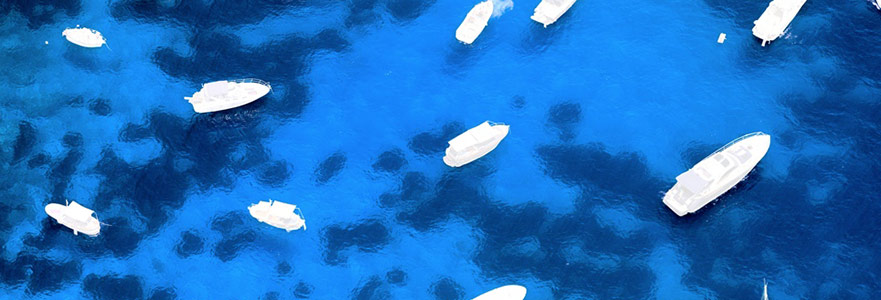
Olivo Barbieri became famous with aerial photographs that interrogate whether what is being seen is a photograph of reality or of a model by playing with depth in images of sites that are symbolic of the city, especially from the world's larger cities. Lately, he has been making series of images that show the human's place in nature and the magnanimity of rocks, mountains and other natural entities. In the photographs from Capri, he made aerial photographs of subjects that could be considered touristic, such as boats that are gathered in a bay, but created abstractions by using methods such as seemingly overexposing when presenting the boats, producing a white image or putting bands over the eyes of the people who are swimming in the water, wavy due to the helicopter that the photographer is in. The negative print of the sea landscape of the twin islands, one of the symbols of the island and which can also be seen in works by other photographers, striking today as the time before the digital era is almost forgotten.
Francesco Jodice's photographs, exhibited on the temporary walls built in the middle of the forum area, were mysterious, evoking curiosity as to what was behind the photographs. When looking at the photographs, while you first think that these are just ordinary landscape photographs, you feel that there is a story behind them. To learn this story, it is possible to look at the text on the exhibition on SALT's website or by looking at Jodice's website. The photographs in the series are based on Jodice's contemporary interpretations of spaces depicted by Neo-romantic painter Karl Wilhem Diefenbach, who died in Capri in 1913, and whose paintings are in the museum in Capri; Jodice's works are thus called Diefenbach Chronicles. Jodice sets on a journey in pursuit of Diefenbach's diary and presents the photographs that he produced with contemporary texts. While the absence of a text on the process of this series creates an ambiguity, not presenting the texts that accompany the images at all—most probably because the texts are in Italian and their translation presents a technical difficulty—makes something feel amiss.

Another aspect of the exhibition that should be discussed is the method of invitation to the island for production. This method is risky as you are not able to predict what the artist will produce, but which support conditions under which the artist can work freely and if it is sustainably pursued, enables an important corpus to emerge. It is also important as in addition to supporting production; the institutions are able to present unique content. ‘Doğu’nun Kıyısı’, recently produced by Silva Bingaz is a successful example of this, recently produced during a three-week residency that the artist had in Japan. Years ago, some Magnum photographers had come to Turkey to produce new works for an exhibition that opened at Istanbul Modern, ‘Magnum Fotoğrafları ile Türkiye’. ‘Türkiye’de Zaman’, realized by the newspaper Zaman by inviting important photographers from around the world to Turkey created a variety of presentations of the today of Turkey, except for the disadvantage of limited time for the photographers' production. Through the resident artist program that enabled the exhibition "Capri Trend" to form, specific content on the today of Capri is produced, making references to the island's place in history. This programming, while reminding people of the island's name, is also striking as a contemporary and creative production and documentation process.
;