İrem Sözen is a young artist, born in 1984. Her intimacy with photography starts through meeting Jeffrey Baykal Rollins at the Bosporus University in 2004, where she was trained as a civil engineer. Later at Politecnico di Milano, a masters in architecture and the PhD program in İTÜ's Faculty of Architecture that she is pursuing as of now, and many photography workshops, including ones led by Michael Ackerman, Rafal Milach, and Ania Nalecka. And the self-published artist's book from 2012, "Recall."
While the first time I met İrem was at one of the vision expansion workshops organized by Genis Aci Proje Ofisi back in 2011, my seeing İrem's works as a whole for the first time was thanks to the Recall book. Later, I was able to see her works, understand her practice, and even work together for the "Parallel Realities" exhibition that we curated at Elipsis Gallery's last Editions exhibition. (2)
İrem is a photographer who enjoys the selectivity of the memory, its unreliability, failure, or in other words, it playfulness, and places this at the center of her works. İrem narrates stories of experiences that left a strong impact on her, re-constructing a parallel reality by bringing together photographs from experiences of connecting and detachment from different times in her series, "Recall." The past, with every effort to remember, leaving up to the memory, adding or misconstruing, re-constructing the past, seems to be detached from reality—instead of becoming meaningless, it would be charged with completely new meanings.
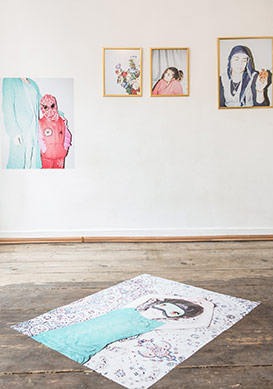
İrem exhibits a similar sensibility in her exhibition, which opened on January 21st, and reconstructs the past her personal history as she remembers it or as she'd like to remember it. This re-constructed past cannot be seen as a linear weaving of events nor an underlined story. As the curator of the exhibition Ilgin Deniz Akseloglu writes in her catalogue essay for the exhibition, İrem "takes as a point of departure the accumulation of memory that deviates from chronology, without a specific sequencing and with jump backs, realizing her mental excess looking back as an after act.
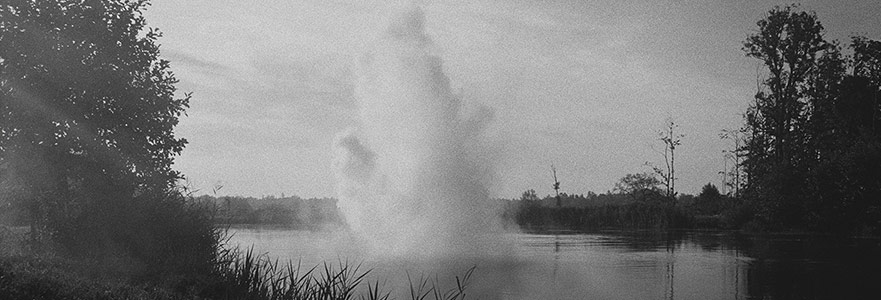
A blossoming tree that extends its arms into the darkness of the night, cleaned beans on the cutting board and the knife that shines with the light of the flash, a man sliding stones on the sea or a child, the rings most probably formed by the stone that was sliding on the still water, a woman with her top naked and right next to her the naked body of a tree that shed its leaves, again illuminated by the flash, a man opening up his way within the dense flora... These photographs, fragments of stories from different times, become independent of their stories and become parts of a new story of the past by coming after each other, being brought after each other in İrem's memory/construction, detached from the stories they belonged to. Similar to everybody's memory, İrem's memory also fragments memories, attaching them to each other, matching them, selecting and disrupting the order to update them. "Our memory, like imagining, constantly constructs creatively to form itself. Autobiographical memories are not as reliable as we think. Actually, even the strongest memories can be ruined. First, my stories never fully corresponding to reality seemed strange and painful. Then I started playing with it. It felt good to play with it. Restructuring, both the past and myself," says İrem.
In İrem's work, whether they are portraits or photographs of nature, there is a dimension that always keeps hidden rather than revealing. These are not photographs that openly expose. On the contrary, the photographs hide by leaving outside of the frame, concealing behind bushes, fog, grains, hair, leaving in the dark, exposing partially through the flash, almost looking for a lost time and the lived experience of that time but photographs which are never really interested in fully presenting neither the pursuit nor what they find... And exactly for this reason, evoking a curiosity, bringing the viewer closer, making the personal narrative universal...
İrem is particularly interested in the presentation of the photograph in book form and who prefers to show her works in this form, the book that accompanies İrem's "turnaround" exhibition is an extension of this interest. The design is by Okay Karadayilar, one of the most successful young names who research this topic in Turkey and a constituent of the enterprise of Book Lab(3), which focuses on artist's books. It includes photographs that are not included in the exhibition and notes and scribbling that İrem made on her photographs and has a different structure than the exhibition, functioning as a product that can function independently of the exhibition. (It is important to thank here Operation Room as while most galleries are not even publishing small catalogues for their exhibition, Operation Room prepares a book for every exhibition they host and distribute these books to the viewers for free.)
A most exciting representative of the new generation of photographers, İrem Sözen's first solo exhibition "turnaround", which follows two group exhibitions that she participated in last year, can be seen at the Operation Room until March 21st (4)
Notes:
(1) http://www.artfulliving.com.tr/haber_detay/1097/yavaslamanin-getirdii-tanidiklik-hali
(2) "Parallel Realities", 15 May-21 June 2014; Artists: Tuğçe Ayerdoğan, Oğuz Karakütük, İrem Sözen; Curators: Refik Akyüz, Serdar Darendeliler (Geniş Açı Proje Ofisi)
(3) For more detailed information on Book Lab, you can look at the article Ali Taptık wrote on Book Lab 2014, realized between 18 September–12 November: http://www.artfulliving.com.tr/haber_detay/1515/kitap-laboratuvarinda-ikinci-deney-donemi
(4) For those who want to see more works by İrem Sözen: http://www.İremsozen.com
;