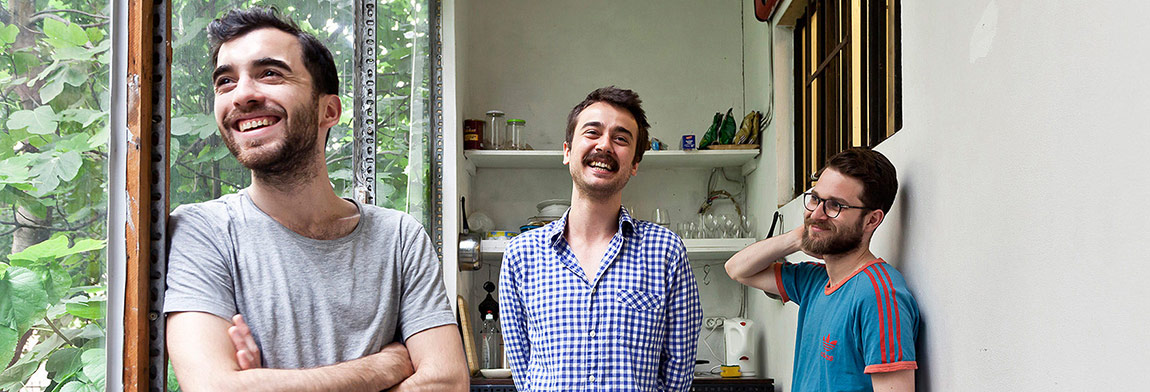
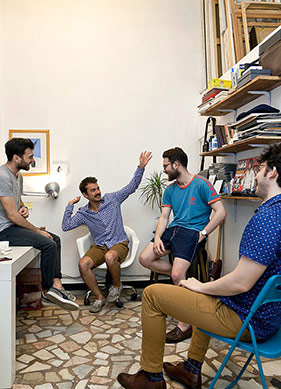
You have known each other since your days as student in Mimar Sinan University's Department of Painting and now your ateliers are quite near each other. As a group, did you feel that holding an exhibition was the only way to show the art work you’ve all been doing?
Toygun: Our relation has been going on since university. We were even working in the same atelier -Atelier 5- in the university. Surely the university has finished and we rented ateliers here -Yeldeğirmeni. So over the time one of us sold a painting, the other couldn't, the other had an exhibition and the other one's name is heard more... Then we just realized that our relation is getting tense (laughs) The only way to remove the tension was an exhibition.
Sabo: As a matter of fact, we can say that this exhibition is a start. We can continue with different projects in different areas together with different people or with a bigger team.
So where does the name ORTAKSALON (COMMONHALL) come from? Hall is a place that is for common use. Does it have any other meanings for you?
Burak: We set off from that point anyway. Everyone has got a room in the house and there they keep on their productions - just like we do it here. But the moment you leave your room and get together in the common area, then everyone has a discourse. One word is said; one conversation is spoken.
Sabo: You also have visitors.
Toygun: You host your guest there and your guests leave from there.
Did you also have an aim to place your exhibition on a conceptual framework or give a message other than showing your works together?
Toygun: I think they can't be separated in a long term relation as such and in an exhibition formed of its own accord. There are stories that Sabo has already been telling for years; I also have mine and Burak has got his: they all are into each other. Frankly we saw if the works are really meet on a common ground.
Sabo: People asked about which painting belongs to who in the exhibition since we don't have our names written next to the works. They can actually be confused.
Do you have any idea how that feeling is formed? Because when I look at the works individually, I saw what you have told; but the mutual experiences in the overall exhibition were there even if you can't see it clearly.
Burak: Yes, there is not a clear connection anyway. The cooperation in the exhibition existed more as a point of view of togetherness, rather than the works. In fact, there is a cooperation of perspective and that makes the works look like one another.
Sabo: However each one of us has a got a different issue while they are creating their works. The things that they are doing or thinking when they are creating their series are quite different.
Toygun: It is possible that the place he wants to see himself is also different as well.
Did you happen to say "I can do that too" when you look at each other's work?
Sabo: It is as if we are doing them all together. We discuss it in every level of it and ask each other "i'll be doing here like this, how do you think it should be" or "which technique should I use".
Toygun: Sometimes we talk about something and then I say to myself "i wish I did that". But this guy put it forward so well that if I do it, it will be both meaningless and repetitive. (laughs)
Sabo: I think we will be able to hide these things, when we grow older (laughs).
Toygun: It is also a beautiful thing to work together. We see the pictures of Man Ray and Dali together -there are environments as such. They supported each other's nonsense to make them look more convincing. We want our relation to continue: sit nervously together when we are 60 and think to ourselves "I am more famous".
We see you like a detective, who is trying to enlighten the matter by connecting the clues, in your work in the exhibition. Who are prisoners of B file, Sabo?
Sabo: The installation I made on the wall is like an arrangement explaining the formation of exhibition process as well. Because, there are sketches of the paints and photographs as well as the materials I used and didn't use. It is like the wall of a detective - in fact it is the wall of an artist, who is trying to find the result. That is humour of it. This series - B. Dosyası Tutukluları (Prisoners of B. Files) series started as a series formed out of dual portraits and big scale oil paint on canvases. As I have told in the small text I wrote for the works in the entrance of the exhibition, there are people, who live in an unknown place in an irrational society and I am tracing the rebellion against an unknown authority or a demonstration that they have done. But the demonstration is unknown as well. In fact I started this series by increasing the question marks and not giving any answer to any of them. Then I painted the states of these figures during arrests. In the portrait section, I told the part, when their pictures are taken and archived after the arrest.
So do you think the style of exhibiting this work reflect the artistic practice and working method?
Sabo: There is a piece from each and every work I have done so far in this installation. I paint anyway. There are compositions, in which I added my old works and the new materials I tried. I like the idea of collecting these under an unknown concept. The thing I am expressing in this work -just like in my practice- is in fact an inconclusive loop. The spectator interprets or concludes it. When I am painting, I chose to leave it at that stage - on the edge.
Yes, there is a feeling of leaving on the edge and inconclusiveness. You are not analysing the incident in cause and effect relationship after making the connection in between the pieces; Burak repeating the photographs he has taken on the canvas in different ways; the visibility of the technique and the process of his narration Toygun is using... When do say 'it is done', while you are working on your works?
Sabo: Each canvas and the work have an aura that the artist and the spectator feels. You feel the result slowly while you are doing it and the next step revives in your mind. Although the result is different sometimes, that energy usually grows or gets smaller. When you leave it just on time, it turns into a very effective work. When you can't help yourself to intervene sometimes, you make the work go in a different direction or ruin it. It would be very hard to be an artist or to create, if there wasn't a process as such. I think the most important thing is the time spent in this area.
How does it work for you Burak? For instance, why did you choose to complete the Gökova’nın 36 Görüntüsü (36 Views of Gökova) series exhibited in ORTAKSALON (COMMONHALL) in 36 pieces?
Burak: This is actually a symbolic number. I wanted to do the same image in many numbers; because the more you go over something, it gets diversified more and starts to tell you the things you don't know. I start to come across with results in this series that I have never come across before. Nonsensical failures can suddenly turn into something that is giving a whole new direction to the series. The number 36 is actually a cross - reference to Hokusai's 36 Views of Mount Fuji. I have completed 12 of them for the moment.
Does the photograph, which inspired you and you repeated on canvas, have a story?
Burak: It is in fact a single image I have photographed almost two years ago in Gökova. Yaz Rehaveti Summer Lethargy) series that I was working on previously, was finished in my mind and I wanted to start something new. There was a kind of leap from that series to this one. I wanted to repeat that photo so many times. First I painted a picture on canvas with oil paints. Then I took the photo of it and then I printed them on the canvases and started to paint over them. This turned out to be a series, which I addressed to the mass production. I wanted to force myself in plastic sense as well: where can I reach by producing something over and over again and what would that give me in the end? Also I didn't want to finish there and then. Once you do it in a short period of time, the canvases start to look like one another. I wanted to expand it over time; so that it would reflect there as well as my point of view changes and the series can revolve within itself.
You live that moment and that photo that you took in Gökova over and over again in each canvas. Meanwhile the images of the works you have done in the previous series are possibly also envisaged. How do these journeys in between time and memory reflect on your paintings?
Burak: I named the second painting of the series as Rüzgarlı Bir Öğlen (A Windy Noon). I was actually going to do a sunset version of it as well. I am not talking about an impressionist attitude. It wasn't going to be a sunset plastically; but I was planning to go back to that moment and diversify it. There was a process of going back to that image and live that time over that image. As a matter of fact, this is still going on.
Toygun, do you have a starting point for your works in the exhibition?
Toygun: I didn't start these works with a statement. I have been painting for a while and they were not turning out to be just as I wanted. Due to the desire to paint everywhere beautifully that academy imposed on us, I was feeling tired when I painted until the end. Then I thought I would find a way for myself, if I get my style closer to the painters I like. Artists like Hockney in my first years in university and then Peter Blake etc... Then I said to my self that since I am going to get pieces like this, then I would put my ideas as if I am telling a story that nobody would understand easily when looked from outside. My life develops like that as well: I get opportunities, works; then people die, sadness, happiness; people come and go into your life... So I said that I would at least choose the striking parts. I have been painting interiors up until now and now I will place these in outdoors and landscapes.
Abstract landscapes and especially the tones of green are prominent in your pictures in the exhibition. What kind of importance do those pastoral images have for you?
Toygun: When I go abroad, my first activity other than museum visits is to see a garden or a park in the middle of a city, if there is any. You can't create a space for yourself like that over here. It is nice feeling to be in nature knowing that modern city is providing your needs. You feel safe. Here we have songs, folk songs written for every vineyard, garden of each region with different emotions. But there are no folk songs written for the forests or gardens of Europe like Nijmegen rivers (laughs). I told my close friends and family that I will paint just for money and my actual desire is to be folk poet. It is not really important what you as long you can transfers your emotions.
You also have a work called Jacob Obrecht, Çok Tecrübeli Bir İsim (Jacob Obrecht, A Very Experienced Name) in the exhibition. Does this name have a specific importance for you?
Toygun: I didn't know until I made the work that Jacop Obrecht was an early period Renaissance composer from Holland. I went to Holland recently with a friend of mine and we got lost when we were walking at night. I had a place to find in my mind. If I find that place, I would find the hotel too and the place was called Jacop Obrecht road. We lost our nerves when we understood that we won't be able to find the place and started laughing. Then we walked for four hours telling stories as if Jacop Obrecht is telling them. Obrecht is making highly racist proclamations in the parliament; he is making statements and sometimes he is being presumptuous.
You were kind of trying to find the answer for the question "where would that be if I were Jacop Obrecht road". So how many trials did you do over the technique and are you still in the research process?
Toygun: Yes, I wanted to do works setting off from the photographs and videos that I have taken during my train journeys. I asked Sabo and Burak on how it can be. Because you need to push and pull. For instance, Sabo said there should be glue in between for the paint not to run down. Paper tape and glue... You never expect that much of development of a painting from these two lousy materials. It looks like I will be transforming my paintings by making these kind of trails for a long time.
So what is ORTAKSALON (COMMONHALL) going to transform into?
Sabo: There is not a distinct project or date. But this was good for all us as a start and there will definitely be a continuation. I think we will have more artists involved in the future. Maybe it won't be us, but them only. The space can change. It maybe in a different gallery or there might not be a gallery. Everything will develop completely in accordance with what we want to give in that situation.
;