I always loved Horasan’s work because of its great way of criticizing the various traumas, false moral values and consumption manipulations that we are exposed to every day. The protagonists of his works often suffer from pain and try to survive in a land of destruction. While his painting oeuvre is characterized by an eclectic and multiple style, in which he uses graphic, surreal, expressive and photo realistic elements, his videos, photos and prints are often inspired by books on nature and on machines, as well as on war. In some series, Horasan criticizes the media’s influence on the human body and the way it forces people to act. Besides the socio-political engagement of his work, he is always looking for new ways of artistic production in order to find alternative aesthetics. In all his works, there is a sense of anger and rage, which leads his mostly deformed figures to cry for an escape from the horror they live with. The bodies, which are often shown in explicitly violent or sexual acts, seem to be imprisoned between the edges of the canvases. Nevertheless, Horasan’s protagonists do never give up.
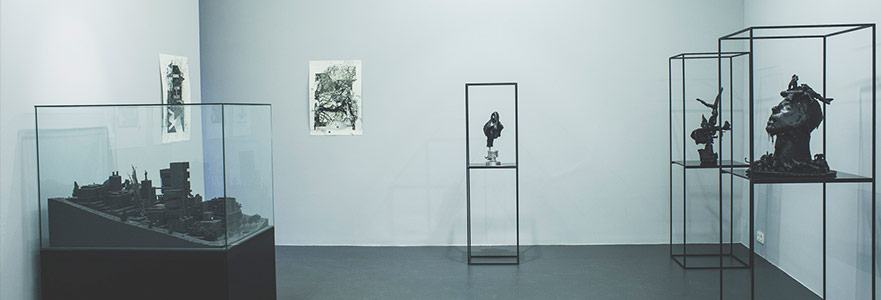
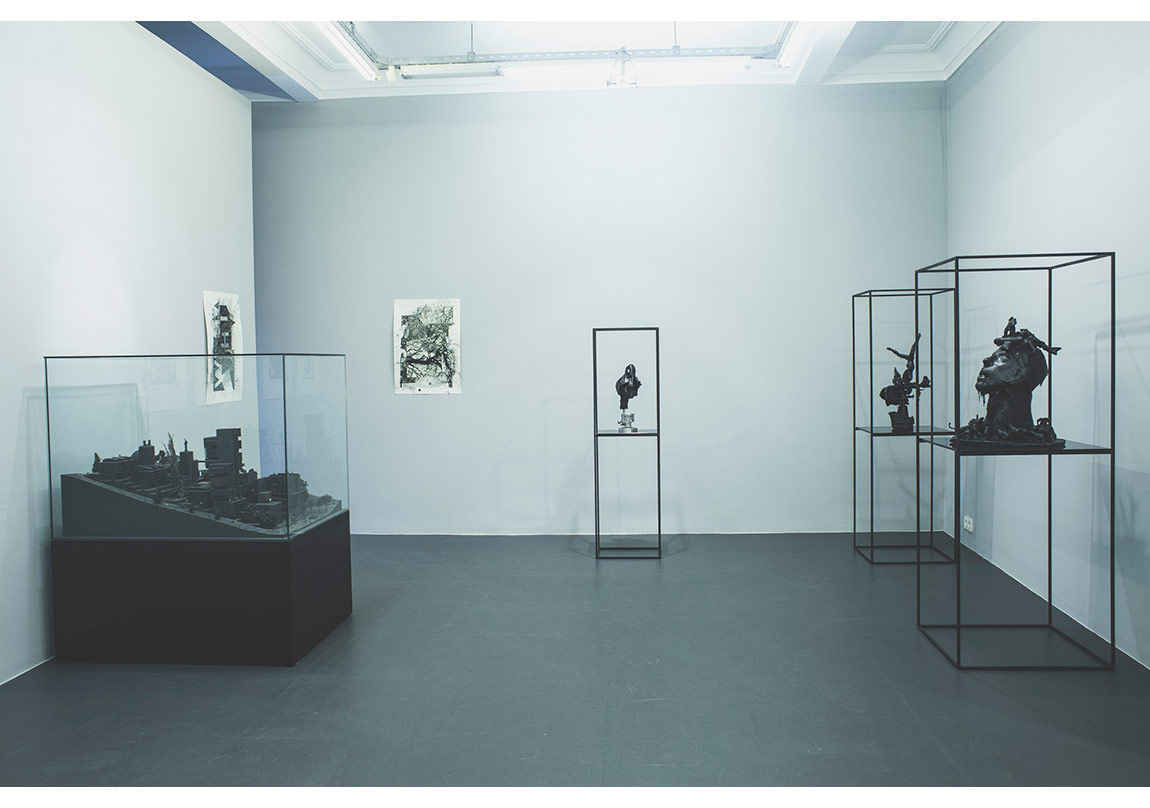
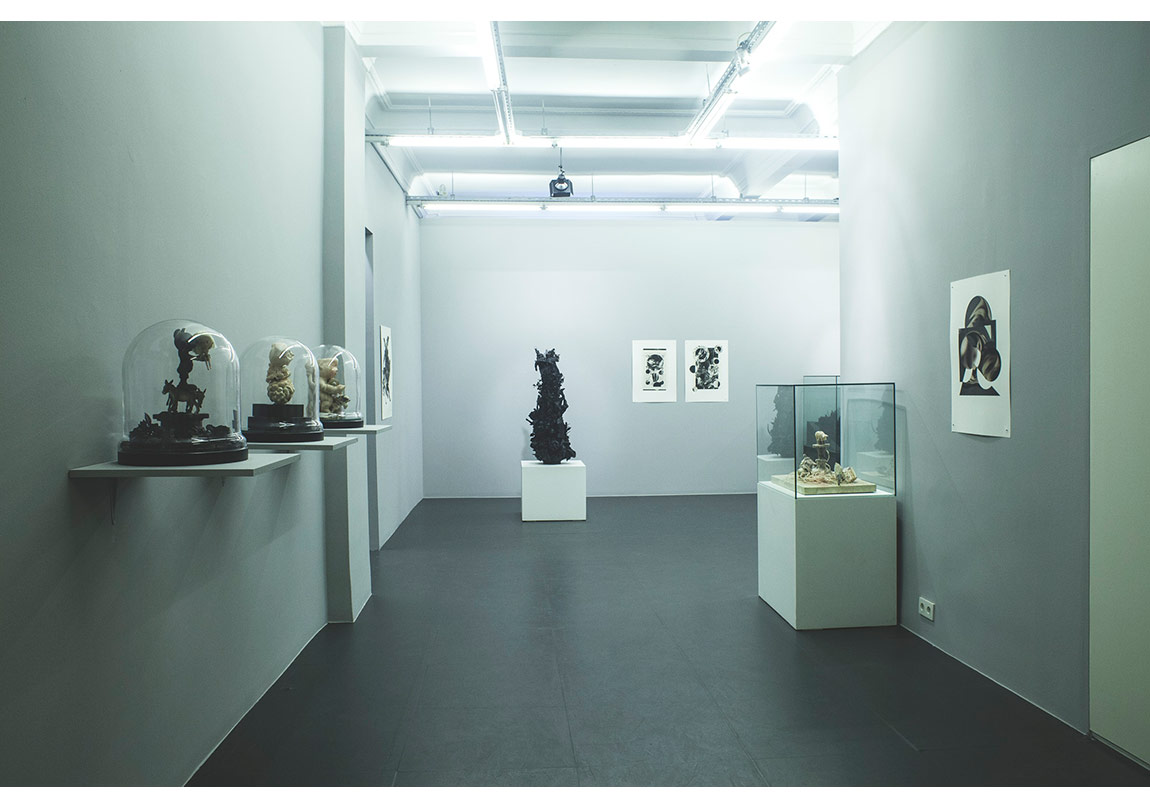
In Sleep of the Darkness, his current exhibition at Pi Artworks, the artist presents a critic and rather pessimistic comment on our current state of society. While playing with various forms of the art of collage, Horasan’s pieces can be understood as dystopic records of our crazy world. The show consists of two parts: Various series of collages on paper and canvas as well as collage-like sculptures made of found objects and materials.
The paper works are made with different production methods and aesthetic strategies. In some collages, cut-out pieces of images are combined in a complex structure, and set onto painted abstract forms of liquid black colour. This leads to following insight in the production process: Horasan first creates an abstract and watercolour-like painting on white paper. This part mostly consists of drippings, and randomly made lines and shapes. Here, a connection to tachism or abstract expressionism could come to the spectator’s mind. And yes indeed, the lyric abstractions in the background of Horasan’s collages can be linked to the same spontaneous, subjective and individual work experience that artists half a century ago were aiming at. In some of his backgrounds, rationally made graphic forms or even letters and words can be seen. These parts challenge the abstract forms in a great battle between consciousness and unconsciousness.
On top of the highly dynamic painterly ground, pieces of cut-out images on paper in various geometrical forms, and bits of letters are combined in a dynamic and rather chaotic syntax. The images used in the collages are mostly parts of close-up photos that seem to depict human body parts. Some images are shaped in circles or rectangles, while others follow a rather free form. In some collages, letters can be recognized as positive or negative cut-out-forms. In total, this series shows a clash of materials, aesthetics and artistic languages, which refer to the socio-psychological clash that fundamentally influences the way we see our bodily existence. Altogether, this series is characterized by a mix of lyric painterly abstraction, geometrical minimalism, photographic realism and references to graphic art and design. The prevailing visual clash is highly inspiring for the spectator as it refers to his world while simultaneously questioning the validity of his knowledge about it. We easily could understand each layer separately, but combined in this highly eclectic mingle, each part now refers to its own reality as well as to the one of the other parts. A cluster of meaning occurs, in which Horasan does not propose a linear way of decoding or understanding. Quite the opposite is the case. The spectator is forced to find his own way into the work in order to create his own versions of meaning and truths between the numerous layers of the piece. This process is aesthetically and intellectually challenging and requires an active observer, who constantly questions the work and its context for going beyond their surfaces. At the same time, the pieces are great examples of how to create collages today without falling into the trap of plagiarism or formalism.
Today, collage is one of the most common forms of production in contemporary art and culture. Every pupil and art student does numerous examples during his education. Rap music, and dj culture, as well as the culture of remix and sampling show direct relations to the production methods of collage. Film directors like Tarantino base their style on a collage-like approach, and our retro-stylized fashion world could not exist without it. For more than 100 years, the art of collage is a proper way for reacting to the complexity of our world. Due to its pluralistic and eclectic being, it is an art form of the metropolis. This heterogeneity, which means the structural and conceptual core of the collage, is the key to its ongoing importance. Today, in our fragmental and process oriented world, it is still one of the leading ways of artistic expressions.
In another series displayed in Sleep of the Darkness, Horasan uses plain white paper without additional paint as ground for the collage-elements. In some pieces, mostly rectangle forms are assembled in an intensive abstract form. Placed in the center of the paper, these works appear as rather ornamental and formalist. It seems that these collages result from the pure lust and passion of the artist to experiment with the art of collage as well as play with its production methods. Horasan loves to constantly renew himself by experimenting with forms, materials and aesthetics. Although the contentual and contextual matters always circle around the socio-political and psychological struggle of the individual to survive in times of multiple crises, the artist never neglects the importance of developing new aesthetics. He finds them by permanently questioning his work, searching for alternatives and playing with given elements. That is why he is able to come up with several variations of the art of collage, and this is one of the reasons why his work always appears fresh, inspiring and innovative.
In another series of paper-works presented in the exhibition, while still focusing on fragmental human bodies, the various parts of the collages are rather coherently combined. Now, they follow a logical composition, as all parts are easily recognizable and clearly refer to certain body parts. Whereas the collages mention above result from a creative process based on a balance of concept and coincidence, this series follows a certain logic ratio, formulated in a clear artistic idea. Sometimes, it seems that the various parts of the collage represent different perspectives on the same figure, so that a cubistic or surreal character prevails in these works. The spectator becomes in these collages a multiple voyeur, as he simultaneously glimpses at several human body-parts at the same time. Also in this series, the artist uses colour images as collage parts. In the other works, the absence of colour underlines and strengthens the formal graphic character of the pieces. These coloured works, although highly complex as well, seem easier to understand and to decode.
As last part of the paper series, collages of animals and human beings can be found at Pi Artworks. Now, as Horasan combines numerous cut-out figures in a rather chaotic but dynamic manner, the pieces become rather graphic and figurative. Also, as the depicted protagonists are often placed up-side down or on top-of each other, the composition seems randomly made. Though, not the reference to reality is of importance here, but their existence in the piece itself matters for him. In the end, an ornamental shadow-play-like composition occurs, which invites the spectator to dive into the pool of animals and humans in order to find his own place between them.
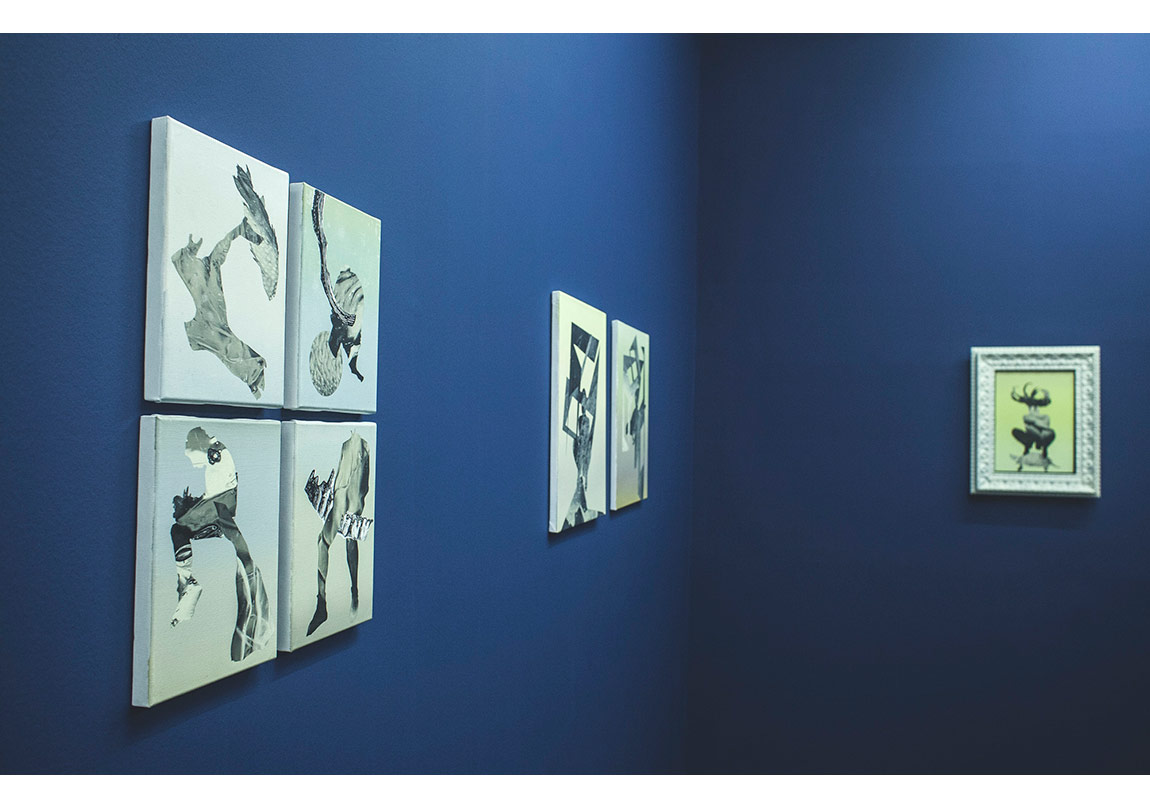
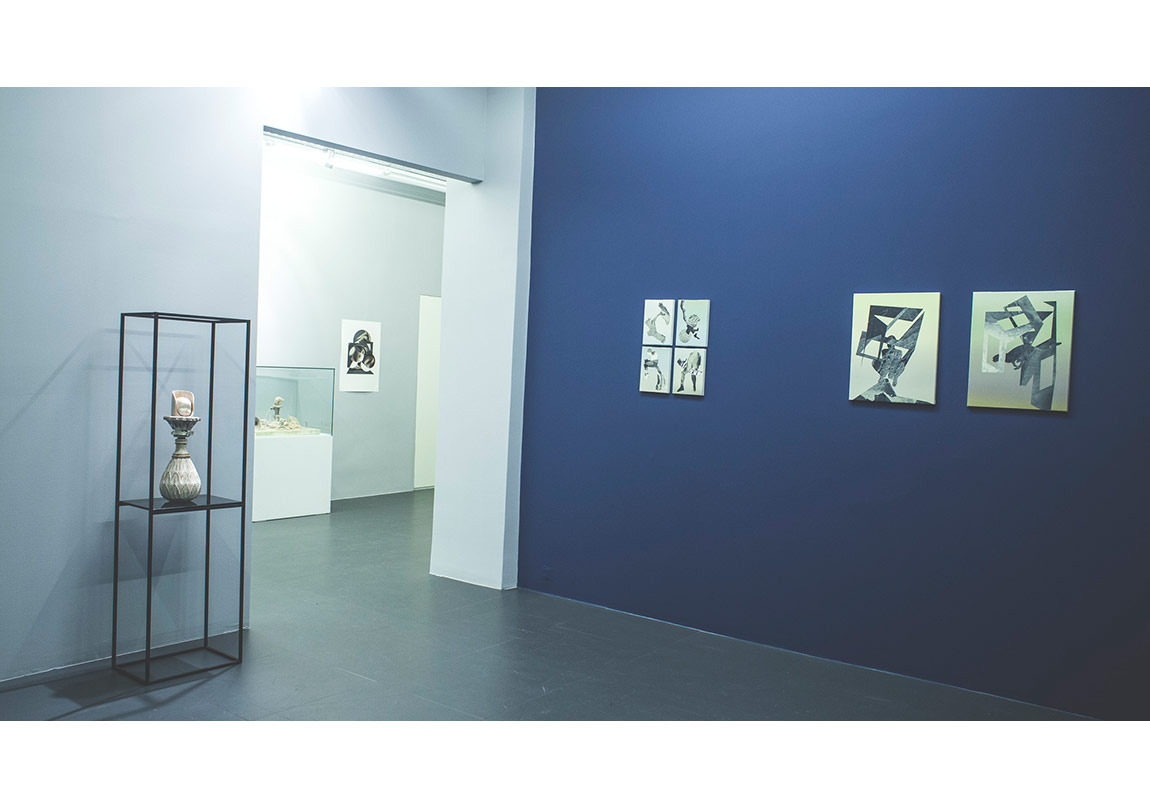
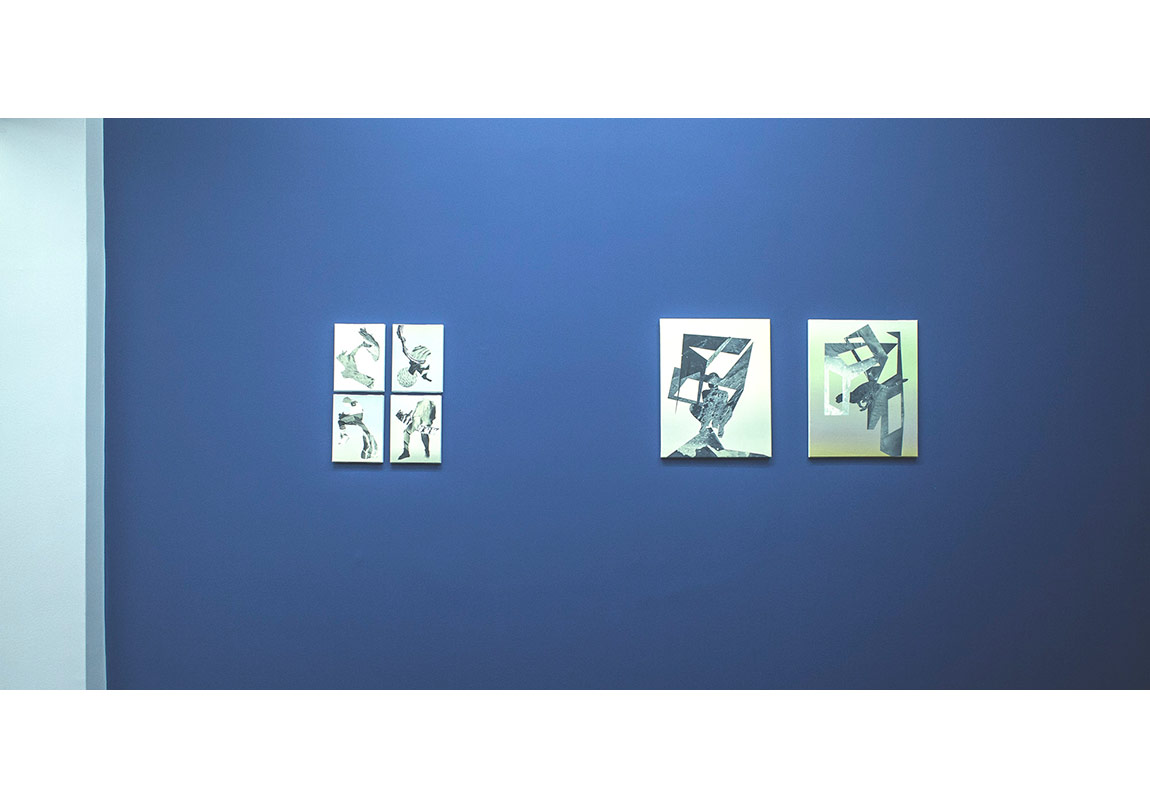
Besides the paper-collages, Horasan exhibits a series of small hyper-realistic paintings, which are based on his collages. In a way, these works can be understood assimilations, representations and imitations of the paper collages. Nevertheless, also they are collages themselves. On a nearly monochrome background, with no textures, no traces of brush strokes, but small grades of colour-shifting, the artist sometimes places various black and white cut-out forms, which we know from the paper collages discussed above. In other works, single or grouped animals or human figures are depicted. Some pieces show a composition with abstract forms. In some works, Horasan adds a white abstract form with a texture of black lines drawn onto it to the main figure. In these works a strange interaction between the protagonist and the abstract form occurs, which adds a new surreal dimension to the work. The white form always looks alien, weird, as if it neither belongs to the painting nor to our world. This alienation process causes a great visual effect that makes the spectator constantly question the meaning of the various elements and their interconnection within the work.
On the first look, it seems that Horasan has adapted the collage-methods and materials of his paper series to painted canvas. It looks like he now puts cut-out paper parts onto small paintings. Though, this is not the case. The depicted parts of the work are not made out of cut-out paper but are painted by him. Here the artist consciously misleads the spectator for questioning his idea of reality. Not only the images themselves are mysterious, their materialistic existence is surprising as well. Horasan first prepares a paper collage, and later paints it in a hyper-realistic manner. The work is not realistic or photorealistic, as the artist neither deals with the reality of our world nor with the reality of photography. He creates a great illusion, and refers so to the relativity and subjectivism of any idea or image of reality.
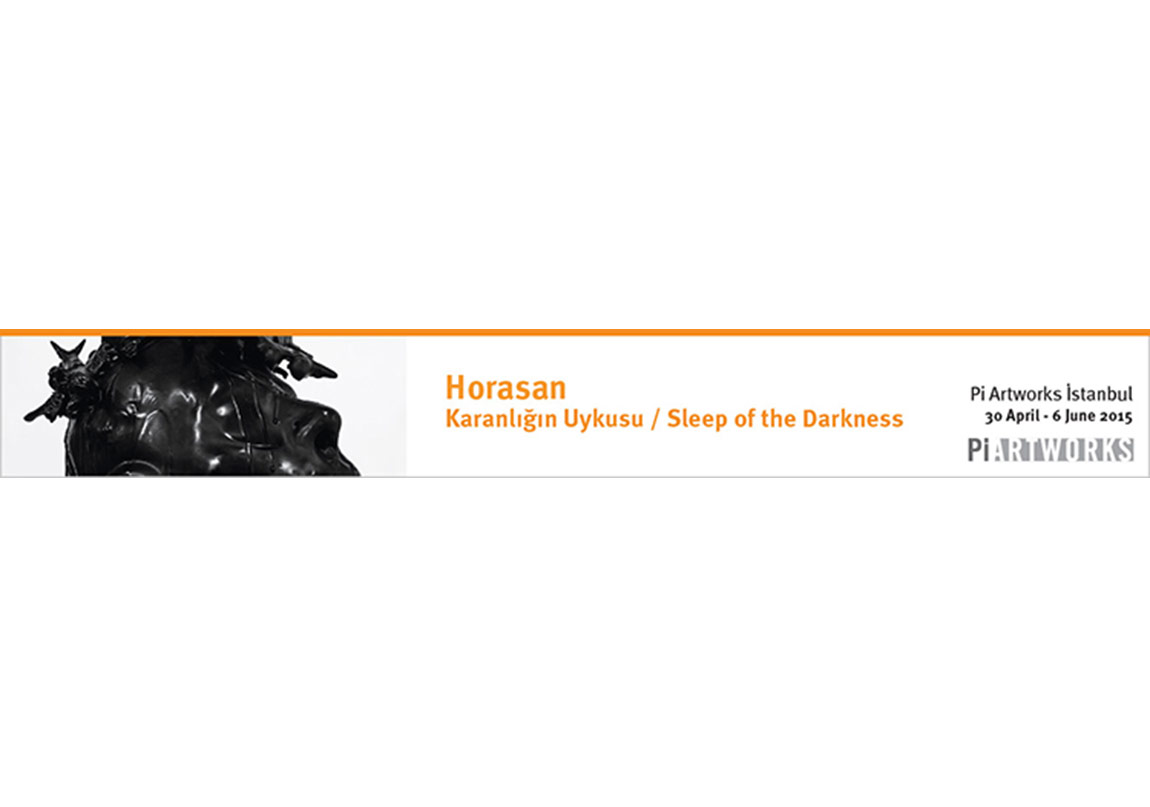
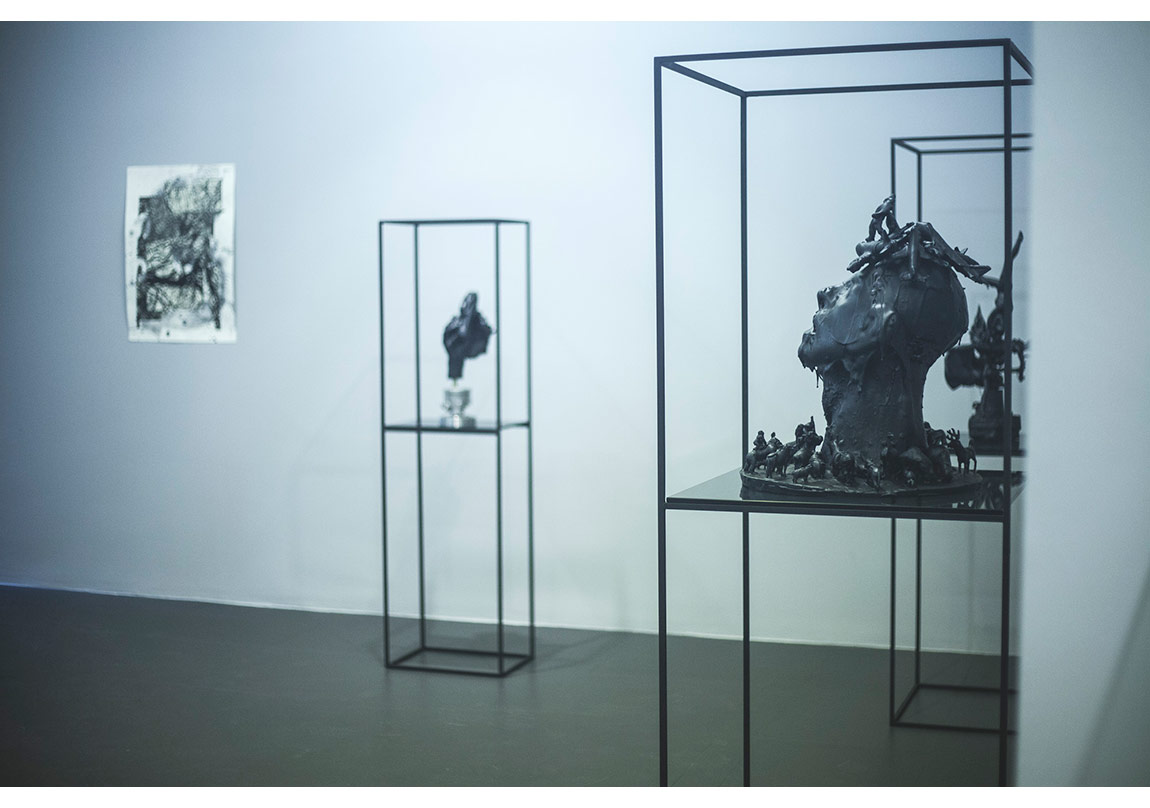
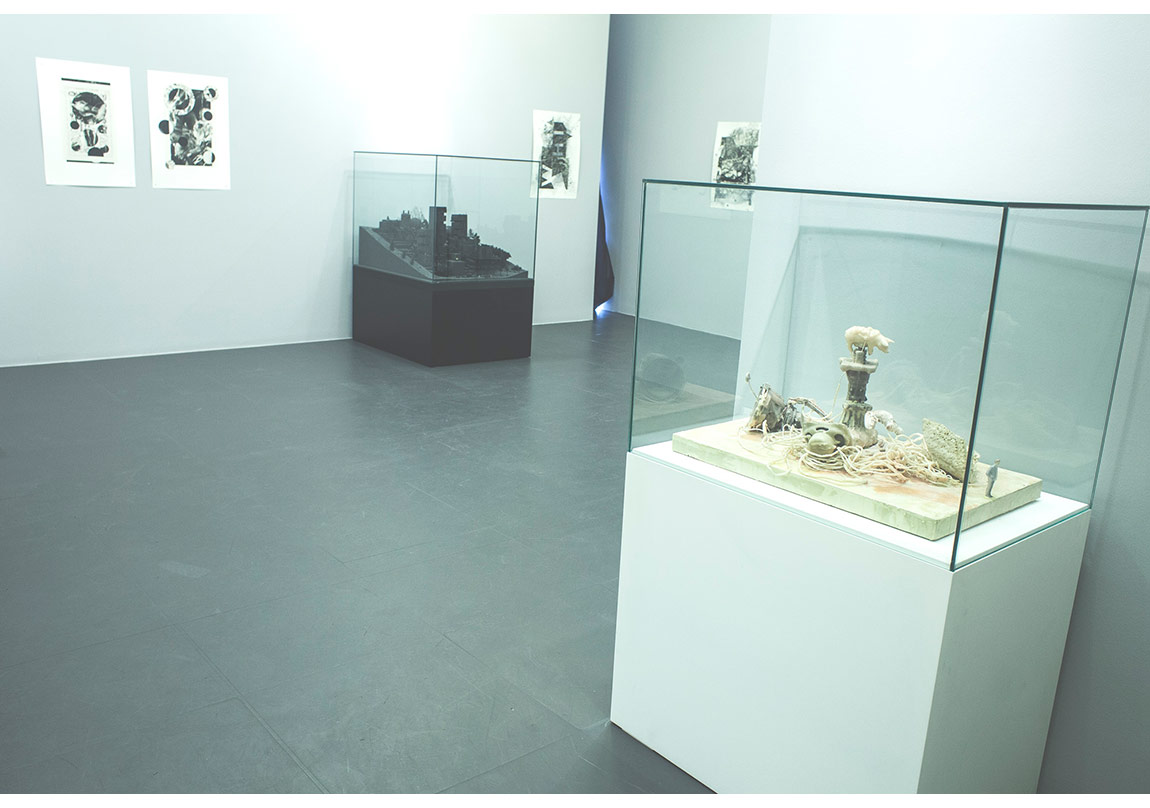
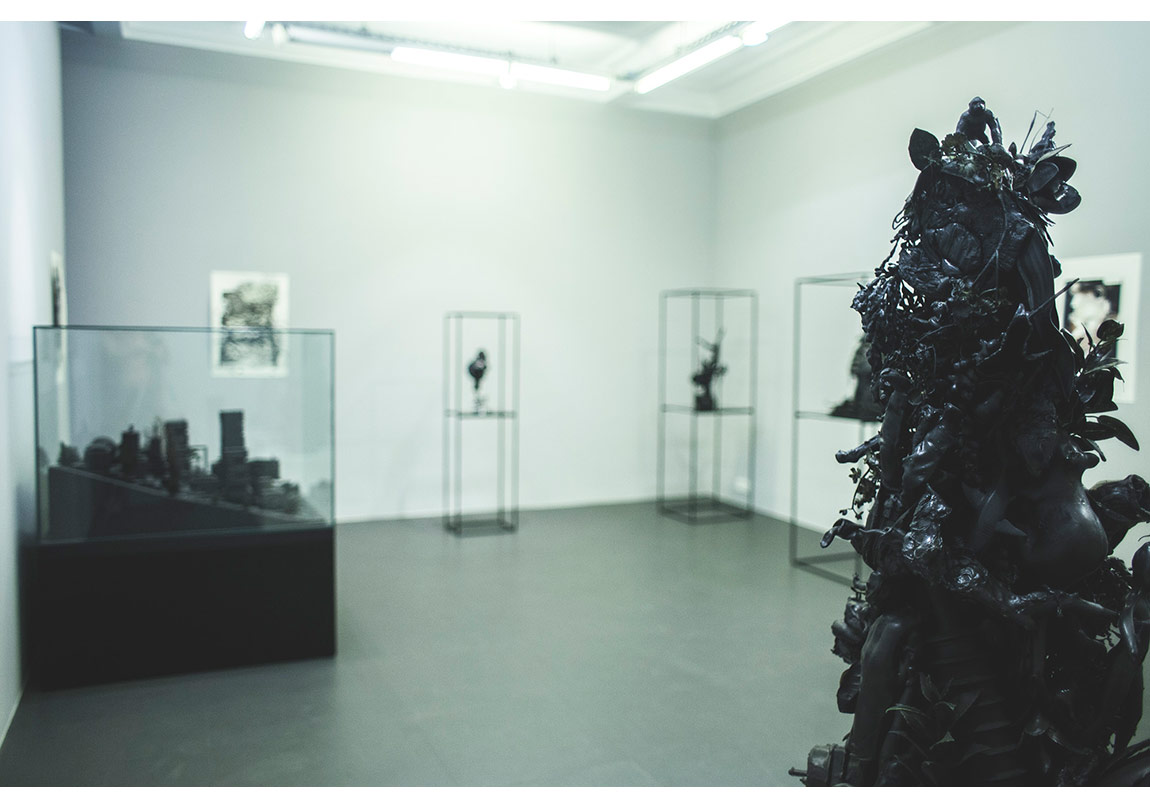
Questioning the world by doubting any absolute representation of our world is also of importance in the sculptural part of the exhibition. Here, three-dimensional collages of found objects can be seen. The works consist of things that Horasan finds in his everyday-life. He permanently collects objects that he considers interesting or appealing. Often for no special reason, the artist assembles things, and keeps them in his studio. The whole of this collection means actually some kind of heterogeneous collage. These objects are now used as material for sculptures, which critically discuss the heterogeneity and eclectic pluralism of our crazy everyday-life. Looking carefully, one can discover various figures, objects, parts of machines, and old toys. Often, they are intermingled with each other, and create a multi-layered structure. Sometimes they resemble a minimal statue, other times an environment and some works look like an urban model. In general, the sculptures can be understood as miniatures of our world, dystopic micro-cosmoses, which are formally, visually and intellectually linked to our life.
The monochrome being of the often black coloured sculptures counterbalances their heterogeneous syntax, so that in spite of the numerous materials they are still easy to grasp. Like absurd reflections of our time, formulated with garbage of our consumption-orientated civilization, they comment on the disastrous state of our world.
There is always a narrative element in these sculptures. Like architectural models, it is possible for the spectator to become a part of this weird micro-world. The eclecticism and pluralism is so appealing, because Horasan manages to reveal the beauty of garbage and the aesthetic of ugliness. This surprising power of balancing destruction and production is supported by the work’s display. Horasan designed individual pedestals for each work, which become parts of the pieces for supporting its visuality.
In the end, Sleep of the Darkness is a show for the awake spectator, who has like the artist not given up the exhausting quest of critically reviewing reality in order to find ways of taking part in its formation. Horasan’s collages are reflections of the broken mirror that once was suppose to show us the meaning of our strange existence. The black models of our world are critical dark visions of the social nightmare that we currently face. The works of the exhibition make us stay awake in order to live sweet dreams and forget the bad dreams that always hunt us even during the brightest daylight. Good morning sunshine...
;