A themed exhibition, which is dynamic and active as well as questioning the vision and state of being 'Modern' - etymologically a French word- and "appropriate to the current century and days", is visited in Istanbul recently. While the exhibition, which can be visited until 16th May in Istanbul Modern (IM), is opened in Istanbul Modern, which has been providing service for the last 10 years in the old warehouse located in the European side of Istanbul, through having the name 'Modernity?' as the title, it also presents a kind of a 'check-up' of the identity of this institution indirectly and the institutional and national cultural politics that is shaped over this concept.
The most important concept that the exhibition, of which Çelenk Bafra and IM Chief Coordinator Levenkçalıkoğlu are the curators, promises the spectators, shows itself with 'doubt'. The exhibition, formed out of 17 separate works of art from 11 international artists, who are recognised in the contemporary art of Turkey and France, gathers the works of Nevin Aladağ, Fikret Atay, Kader Attia, Ayşe Erkmen, Cyprien Gaillard, Thomas Hirschhorn, Pierre Huyghe, Chris Marker, Sarkis, Hale Tenger and Nasan Tur.
Most of the artists in the exhibition transform into the source of both a criticism and a suggestion with bilateral alternative reading and experience styles that they offer to cultural codes, local intellectual clichés and current socio-economic order in their own countries.
Modernity? is an exhibition that questions if there is any other effective civilization method other than modernity; is distant to most of national identities and its presentations, and, in which works with global sold are presented together with aesthetical suggestions brought to this world by artists.
The exhibition is successful at re-creating the developing current contemporary irony and memory in Turkey and France, both of which distinguish as a Republic that are once ruled with an 'empire', in a multiple stricture mood by intersecting with geographical and cultural location.
The first artefact, attracting attention in the exhibition, is Thomas Hirschhorn's 'The One World' (2007), which gives an idea about the exhibition in the entrance and prepares the spectators to the spiritual level in IM. When you get closer to this dystopic work of art, which has a repelling magnetism like 'the grass is looks greener on the other side', you get nailed to the spot once more once you realize the fragility, casualty and indirectness of this world hope that the artist presents.
The pedestal of this giant politic World that is held by thousands of unaccredited hands with a rough material, appear as the examples from violence and belief conflicts, which turn around themselves. Our level of being used to these images in 'The State of World' that is formed out of various 'ordinary' materials such as cardboard, wood, coloured photocopy, arms with resin, paint, polyurethane foam, increases the starkness and routine in a scary way.
Another visual 'magician', who makes the pessimistic, yet realistic in a way, air in IM more with illusion and tempting, is Hale Tenger from Turkey. It can be supposed that she makes an intellectual self criticism with a question mark she adds to the concept of 'Modernity'. Tenger also included geographical and political Globes as the structural base; but it is like as if the artist prepares the spectators to make an ethereal choice in between different worlds by deconstructing the details of globes that she presents. Preserving the symbolism and the element of surprise by making the audience pass through a curtain filled with the feathers of thousands winged animals, this starry, dazzling and invert work of Tenger that we have seen previously in Istanbul, has the characteristics of being one of the most romantic and alternative choreographies formed on strange invert models and the concept of alienation with the name ‘Strange Fruit’.
Another work, which comes right after those two in the level of attractiveness, memorability and scale as well as paves the way to adapt the exhibition more, is from Kader Attia, who was born in France as the child of a migrated Algerian family. Attia transforms all modern Istanbul guests into a temporary King Kong with his 'Untitled' (Skyline) work. In fact this is no more than a cynical modernism tableaux that the artist has produced by adding disco mirrors on a second hand fridge. The work of Attia has a kind of an effect that the spectator is trying hard not to walk around these 'towers' and ridicule on their factualness.
Documenting Attia's scepticism with architectural concern, Parisian Cyprien Gaillard, who was born in 1980 and living in Berlin at the moment, makes the question mark in the name of the exhibition with his destruction and ruin visuals titled 'Mound', which inspects the limits of sacred in the perceptions of the spectators. So much so, Galliard's work gains a more rebellious meaning in Istanbul that is subjected to a non-returnable change for the sake of 'public concern' during the 'urban transformation'.
Since the Modernity? exhibition in IM brings up the most sincere and urgent question in the history of the institution with plastic concerns into the agenda, the ironic and iconic works in the exhibition that engage and occupy spectator, does not end with these works only.
For instance, giving out a sound for the urban destruction that Gaillard approaches the destroyed buildings as a social cadaver, Ayşe Erkmen can't help herself to 'Fış Fış' (raw back) some of the cunning spectator, who think about getting away from this place, while she is placing the forms of military mines, which are no use for her either although they look quite beautiful, into the perception of the spectators as a sneaky traps.
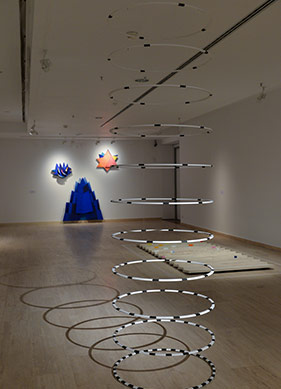
Having both a childish and a commercial form and can also be called sort of a vessel, 'Fış Fış' presents itself as a volunteering symbol for Modernism, in the middle of IM that looks solid and trustworthy, yet when you get closer, you realize that it is nothing more than a geometrical metal lump, ready to swallow and sink you.
Nasan Tur, who works actively on the remains of modernity and continues his works in between Turkey and Germany, contributes to the statement of the exhibition with two of his old works and an attitude for research that is not refusing an argument brought to the museum by Çalıkoğlu and Bafra’nın situated on the harbour of Tophane.
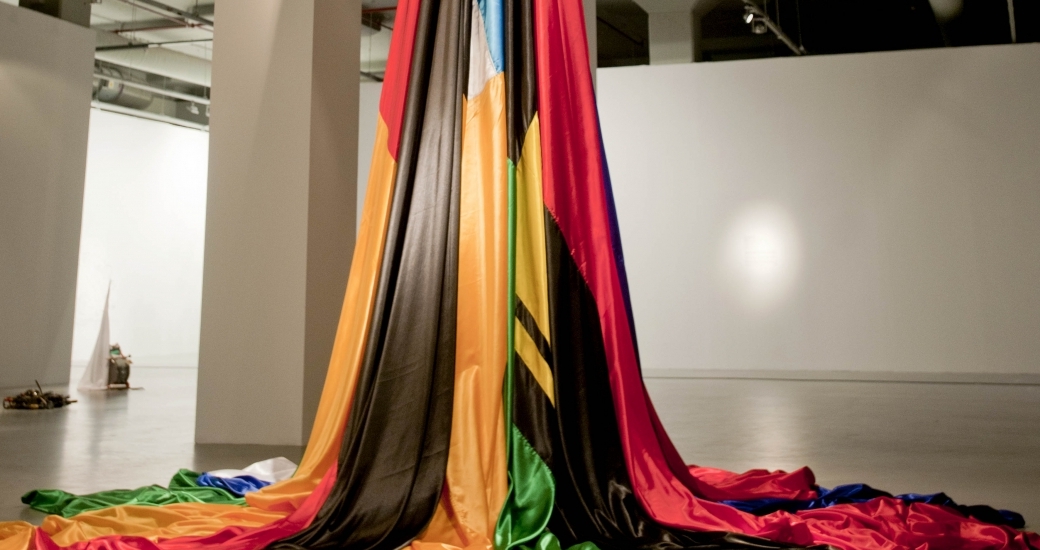
Tur's work called 'Once Upon A Time' dated 2011 which he deprives a number of flags that we are all accustomed from somewhere, from wind and staff, leaving them tangled, crinkly and grovelling, and his installation of portable life gadgets and interactive happening and sculpture-installation project called 'Backpack' dated 2006 are as if they are trying to tell us that even the modernism myth can be volatile, mortal and worthless as well as this concept makes itself visible only when it is vital.
The answer to the memory matter that Tur opened up for discussion over gadgets and individuals, comes from Chris Marker with his big video installation called 'Zapping Zone' - Proposals For An Imaginary Television, which turned into a kind of electronic cultural heritage and we can even call 'modern antiques', and contains a big surprise. Synthesizing MTV aesthetics with our recent intellectual history, Marker proves that he is a kind of a avant-garde, Beat generation artist, who has the instinct of merely today or knowledge highway of years ahead called 'Internet', by bringing very important images and sounds that 'circulate' at the same time in more than one monitor together with us within the same moment. Exhibiting his work called 5N1K on the same floor with Marker, Fikret Atay exposes us to a conceptual torture by making us voyeur of an anonymous interrogation as if he was aware the reality crises that these images contain. Atay's dramatic video piece, which he has formed with a visuals that authoritarian governments are quite acquainted with, is as if it is shouting that we can surely consider Modernism as an aim and scary with its methods or as a passion for power and even if we don't, it has been forcefully imposed on us.
Even so, Sarkis and Pierre Huyghe are maybe the only two artists, who share their unique, glowing 'greenhouses' hard line. The uniqueness in the piece of Sarkis and Pierre Huyghe transfers a hopeful perception alternatives to the pacifism that is formed after visiting the exhibition for a while. Combining architecture, art history, philosophy and aesthetics like an alchemist, Sarkis' mix work, in which he deals with the concept of atelier as a self metaphor, contains optimistic and humane clues of how further or how backwards can a person base or go in a person's struggle for self existence.
The competition of the indefinable surrealism in Huyghe's work with the reality is interesting from the point of reminding the audience that the cliché of believing in what you see, is in fact a kind of a spiritual and sincere test. It wouldn't be wrong to say that Huyghe's work is the most utopian of the exhibition since he transfers the sacred that is hidden in the daily, and the value of unique from an ecological and humanist view, clear as a photography and with a direct medium.
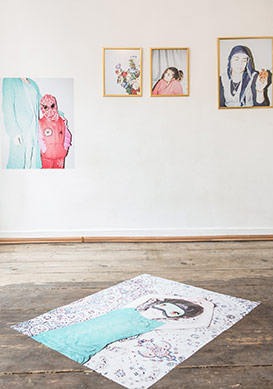
Then again, when we look at the works of Nevin Aladağ, it is impossible not to think the sympathy we feel for the imagination of new horizons that these images contain, and toleration for different approaches that are waiting to be discovered within this daily.
Through this artefact and others similar to this one, we can say "As a concept that is still prone to be questioned and yet not to be answered, Modernity keeps on making the beginning and the end of the World dizzy."
Evrim Altuğ
;