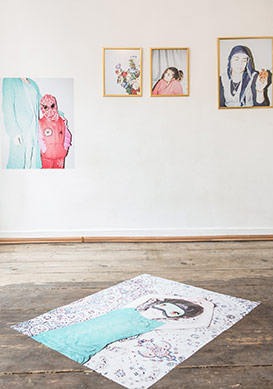
C.A.M. Gallery managed disrupt the time that Biennial was open with two exhibitions by hosting a group exhibition called “Bunu Ben de Yaparım” (I'll Do That Too) curated by Emre Zeytinoğlu and exhibition "Zevkli Rezalet (Pleasant Scandal)" by Olgu Ülkenciler before the biennial got closed. Ülkenciler, whom I wrote the exhibition article of her previous exhibition "Das Fenomen", and who has developed a unique language over graphic design and production of symbols, she went for this kind of naming over from the perils of a lot of conflicting situations appeared since June by creating a different visual this time. So, we can look closer into "Zevkli Rezalet (Pleasant Scandal" exhibition opened on 3rd October.
First of all, we can easily say that the "decoration" obsession hidden in the details of exhibited works in general, as a whole and specifically, reveal the concept of the exhibition easily - surely Olgu Ülkenciler's photo on the display window of C.A.M. as Marie Claire taken by Murat Durusoy gives the hints on the content of the exhibition before this revealing situation. The artist, who is creating a oxymoronic title with the name "Zevkli Rezalet (Pleasant Scandal)", she sets off from a naming strategy similar to Volkan Aslan's writing "Down With Human Rights" on the wall with a spray paint in his Ateşin Düştüğü Yer (The Place Where the Fire Falls To) Exhibition in 2011 or CANAN's "How Many more victims?" poster from the same exhibition: let's remember the name of her previous exhibition "Das Fenomen" again in order to compare.
Ülkenciler is trying to make sense of the period that the world and Turkey is passing through socially, economically and culturally, by making an analogy with Baroque and Rococo periods. On the other hand when you look into the art history in near period or current art agenda, we witness that art is functioning by having minorities, the outsiders, ""absolute others" of the effective society as subject matter and concern, starting off with the statement and aim to make art seen and create awareness. But, in other respect art can play the role of a kind of propaganda with works having direct and emotional engagements, which justifies the language of the powerful through the manipulation of mass culture - even if the artists and their supporters are not aware of it. Art can strongly retrograde in these periods, in which a lot of money is invested on art and it works with some kind of formulas by getting away from the community and experiment: this is a critic on ideology and "subject" rather than form. It is neitherless to say that bourgeoisie enjoys this dramatization more than anything; victory, power and keeping control and visualization of this through continuous dictation can be achieved with these forms. That is the moment when we can see why architecture is being tried to be used effectively in politics. One the reasons why government are maximum sensitive for structures such as palaces or temple with wide large scaled, wide portals, long stairs and large rooms.
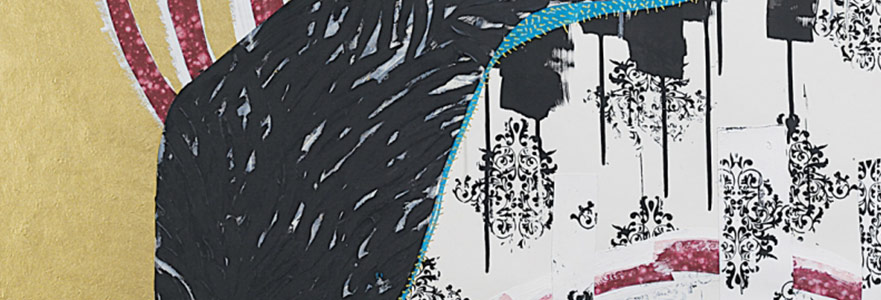
Giving power and authority with details and exaggeration, and desire to embody the national and religious victories exist in the thought structure of all men in power. Specific to Turkey we can suggest that there are two areas, in which the today's government sees weak and thinking to accomplish: Architecture and art. We can glance how a functionality is added to this theme by looking back at the works in the exhibition. There are almost 20 works of Olgu Ülkenciler in various dimensions in the exhibition. Among these there is also a digital printing work made out of 7 pieces and did it as a duet with Aslı Narin. These works, which did not take place in the catalogue, contains black and white pictures of mussels taken very closely.
In her "Auto-portrait" work, Ülkenciler visualize the 'female body' issue, which is has become rather a problem in the last years, over the artist's individuality by locating birds crowding onto a vagina image on the face, one gold leaf on one breast while crows are on the other. Purple mark on the left corner of work refers to feminism as well as implying royalty and religion. The same symbolism can be observed in a different work called "Düşüş (Falling)" with a different theme. “Ormanda (In the Forest)”, “Çıplak Kral Serisi (Naked King Series)”, “Ben Kör Değilim (I am not Blind)” and “Labirent (Labyrinth)” works have the character expressing the concept of Ülkerciler's exhibition with the decorations the works contain and power symbols existing in royal family flags such as lions, eagles. Aside from these, “Karanlık Orman (Dark Forest)”, “Çıplak Kral Serisi (Naked King Series)”, “Ormanda (In the Forest)” ve “Kara Süt (Black Milk)” works have been tackled in a structure emphasizing powerful darkness and the world they symbolize.
The design of exhibition catalogue is designed to be used as poster as well that her previous exhibition "Das Fenomen" had the same design. The text enlightening the exhibition belongs to Emre Zeytinoğlu. The text of Zeytinoğlu, who read the painting language of Ülkenciler mainly over from "kitsch" concept, provides a different illumination to the spectator during the exhibition. But, skipping over "female body", "irony", "humour" and "game" concepts or not touching these methods or themes enough in the text makes the reading of the exhibition incomplete - Surely it is quite hard to claim that a catalogue text should be fully inclusive.
Ülkerciler's usage of gold leaves, baroque decorations and lion heads often contains a humorous, playful yet extremely ironic analysis of local or universal nationalistic and religious politics' materialized views on life, maybe without even needing a metaphor. This is the rebellious language with all its ideational and stylistic discomfort. Turkey has forgotten this language a long time ago. Although this language hasn't been properly learnt since June - because one needs to be a side of something in order to learn- this language has been fully recognised. "Zevkli Rezalet (Pleasant Scandal)" exhibition, which fits right into Umberto Eco's "the open work" readings theorem, has the possibility to visit within the axis of these thoughts. Of course the audience has the last word as usual.
;