To write about Istanbul is difficult, to describe it is impossible. Its urban and social structures are scattered, multi-layered and instable, so that everything in this city is in a permanent flow. That is why here, people have to adjust to a chaos that is caused by an uncontrolled urban transformation and evolution. This situation causes a tensed ground for our metropolis, in which geological, psychological and socio-political earthquakes shake constantly the streets we walk on. Here, the urban structure is not settled yet. The city is constantly moving, changing, transforming and dissolving its urban patterns. Nothing is fixed!
The current state of Saliha Yılmaz’s work resembles the character of Istanbul as also her drawings and paintings are formally multi-layered, heterogeneous and pluralistic. Conceptually, they deal with the intense relationship between the individual and the metropolis, as she discusses various results that urbanization and gentrification processes in Istanbul have on its inhabitants. On fragile drawings and beautiful paintings, she reviews the impact that the metropolis has on us without repeating the common topics and headlines of urban transformation, or the usual architectural as well as socio-political comments on gentrification. Creating a balance between poetry and politics, in her first solo show, she presents visually attractive and conceptually striking series, where mostly single figures are directly and frontally facing the spectator for telling him stories about Istanbul.
I live in Istanbul, but I do not know it. Nobody knows Istanbul! That is why everybody is a stranger in this city. The giant is gentrificated, divided through bridges and highways as well as cultures and classes. When we look at the structure of this city, we realize that there is no coherent core but just a pluralistic, heterogeneous and fragmented urban pattern. Istanbul has a fragmented locality, a hybrid, polyphonic, heterogeneous and pluralistic social system, which exists out of uncountable official and unofficial social groups. Here, you always feel the strong tension that fills its streets and every empty spot of its public and private sphere. This tension is productive and destructive at the same time. Georg Simmel, the father of modern sociology, already underlined one hundred years ago that the modern urban dweller at the beginning of the 20th century struggles to form a modern, individual identity in the face of overwhelming social forces like cultural heritage, external culture and the technique or mechanization of life. Today, this struggle leads to tensions, which either force the inhabitants of the city to become an activist and fight for creating his own space, like many artists do, or to become a passive observer and follower of the leading status quo.
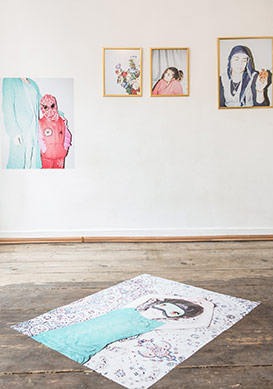
Saliha Yılmaz’s work is an active respond to the current urban situation and its various socio-political dimensions. In a collage like mixture of artistic approaches from realism and surrealism, as well as illustration and fashion-design-drawing-styles, the mostly hybrid figures, which are half flower and half human or half animal and half human, could be understood as city dwellers who assimilate to the pluralistic and heterogeneous structure of Istanbul.
In a way, they have to give up parts of their individuality and human identity in order to match the pattern of the city. The figures in her works are anonymous strangers. In some pieces, like the ones on Plexi-glass, we can discover their dreams, as their silent thoughts get visually revealed. Often, instead of individual faces with human expressions, we see flowers, and animal heads. The erasure of any specific personality allows the spectator to project his own thoughts and feelings onto the figures, so that he can become the protagonist of the work.
Due to the aesthetic and conceptual tensions of the pieces, the eye of the spectator is constantly shifting between different kinds and forms of visual data. The simultaneous perception of heterogeneous matters in Saliha Yılmaz’s paintings and drawings stimulates his mind. This is the reason why they cause next to aesthetic pleasure also intellectual reconsiderations of the known. I believe that this synthesis of form and content is what makes the works so attractive and appealing. Another exceptional matter of the works is it fragility.
The figures are treated minimally, often formally fragmented, and the background is mostly empty. Therefore, there is no hint regarding time or space of their settings or environments. Nevertheless, because of the clothes they wear, we understand their social and cultural background. Here, once again, we realize the socio-cultural meaning of fashion and its design. Just with a few lines and a bit colour, Saliha Yılmaz is able to open up a universe of meanings and contexts, which always directly points back to the spectator. The emptiness and openness of the works has to be filled by him. The pieces need to have an active observer, who fulfils the white fields within the paintings, finishes the lines of the figures and sees through the various layers, out of which the work is created. This action could be understood as a reference to the need of the city dweller to actively take part in forming his environment.
Istanbul is currently shaped by gigantic urbanization processes, which will change its urban face and identity for ever. Our hometown is like a beautiful but deadly monster. It is not easy to get along with it; often it is difficult and sometimes even dangerous. Though, in spite of all, as its citizens and creators of its urban culture, we have the duty to be active in the construction of Istanbul, in order to form an effective civil society within the city. I believe that Saliha Yılmaz’s work is a great example of how to form a contemporary visual critique of our current urban situation, which has a meaningful concept and aesthetic.
;