First we need to accept this: It is quite hard to write on a Semiha Berksoy artefact or an exhibition. First of all, the distance that the writer -in this situation it is me- should put in between what he/She writes about -in this situation it is the exhibition of Semiha Berksoy in Gallerist called 'Halüsinasyon Duvarı (Hallucination Wall)'- is quite challenging. The hesitation of art theory on approaching artist's life when explaining the work of art need to be removed. It unavoidable requires to get away from an epistemological approach. Every text on Berksoy's painting results as being about her; because she is an artist, who make them exist with all her existence. Opera, theatre, music, surely painting and even literature: she is an overall artist, who exist in all fields of art with her love for them all. On the other hand, it is almost impossible not to admire her character and her life story as a person was born in 1910 and tried to make her femininity and her artistic character live through a fantastic strive in the known history of Turkey at the time. Moreover, contrary to a typical artist of the time, who constructs a myth for themselves strategically in the 20th century, Berksoy is just as she is without mindfulness, just instinctive... Making art as if she would die if she did not do it and a person, who procreates and dedicate her like to this production adventure... an artist.
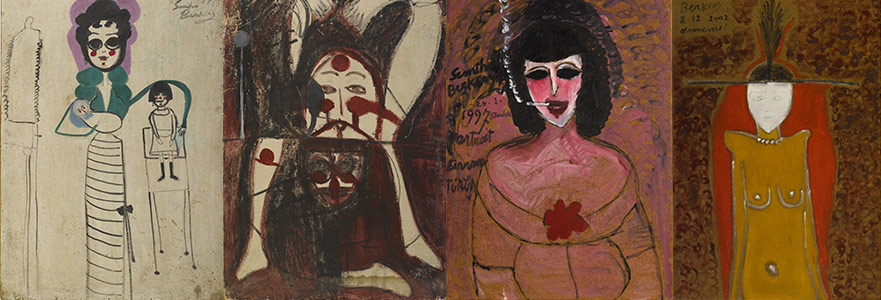
Being a rare character, Berksoy does not put death against life even in the selection, which contains a limited number of works: death is not an end or an annihilation for her and it shouldn't be. This kind of will, to reach eternity, explains such a fertile production by holding onto life so strictly. Yet, she had a very harsh way of facing death due to her mother's death when she was only 8 years old. According to the things the artist explained, her mother Mrs Fatma Saime is the most important role model in her life. She is the symbol of beauty, love and passion. She meets opera first time with her and learns to draw from her as well. 2 Her mother's portrait from her imagination "Annem Ud Çalarken (When My Mother Is Playing Ud)”, “Karanfilli Otoportre (Auto Portrait With Cloves)”, in which she shows herself sitting in the womb of her mother, the portrait of both of them with her under her mother's arm “Annem ve Ben (My Mother and I) ” in the exhibition are the life-long proofs of this relationship, which the death couldn't have put an end. "Anneme Otoportre (Auto Portrait For My Mother)" from the artist's late period works dated 2002 is a work of artist, in which she drew herself for her mother. She is again in her flamboyant state with her feathered hat and her necklace, yet her naked body with a pale white face is under the ground in a coffin. The painting is as if the artist, who has a long life, is celebrating her death and rejoin her mother.
Nazım Hikmet, whom she always kept somewhere in her heart, is again all around this exhibition, which exist in Semiha Berksoy's Spirit. She first fell in love with him after knowing his books and then admired him deeply when she got to know his genius as well as mentioned many times the "white skin as a sheet of paper, blue eyes, gold coloured hair". 3 The "Nazım Hikmet" dated 1978 in the exhibition is one of some Nâzım portraits of Berkoy. Although the picture is not in big dimension, it is picture instinctually giving the mind and his supreme hearth with a dramatic facial expression of this important poet that is formed by a blond haired, white skinned, blue eyed head touching the borders of the canvas. Berksoy's name and date as well as "Türkiye (Turkey)" written on the picture instead of a signature is also attracting attention. He is the poet of Turkey and Berksoy mentions this one more time.
Her visits to the prison and exchanging letters lasts for years. Nâzım has influenced the existence of a young woman and even if they don't see each other; Berksoy's life changes with the things happened to him, and she concentrates on her career. For instance when she learns that the poet is married, she writes her surrealist story called “Mezardan Gelen Mektup (Letter From Grave)”, in which is telling a young girl waiting for the man she is in love with, and reads it to him loud. The picture in the exhibition shares the same name is dated 1972. Indicating that she goes back to this issue in her head and reckons it over and over again even though many years pass after her writing the story and reading it to Nâzım, this picture has a an intense and touching narration with green stripes on a black surface.
The deformation on the portraits of the artist is the transformation of her mood into line-colour. Especially her auto portraits were giving the state of her mind when she painted the picture. “Aşk Otoportre (Love Is In Auto Portrait) ” is a bird that is ready to fly, with bob haircut, pearl necklace and without a body and the feet off the ground. Due to her big voice -as she states about herself- she always puts herself somewhere next to phoenix. 4 The image of a bird is important for her and the relationship she forms in between her life and the phoenix bird do also reflect her pictures. On the other hand, Berksoy reflects herself in a different pictures as her body separated into two and with scribbles on red that is recalling the image of blood. She gets closer to the types of pictures in “Gülen Otoportre (Laughing Auto Portrait)” and “Gören Otoportre (Seeing Auto Portrait)” dated 1969. The other works of artist, whose portrait are prominent in the exhibition, are also the expressive reflections on life - period pictures in autobiographic style... For instance, her picture on a bed sheet called "Anka Kuşu (Phoenix)" do have a story as well as being perceived as auto portrait. She included text partially on painting, which is on a large ground, next to-on top of-under-on pattern. "Semiha burns herself in the oven. She rises back from her ashes..." There is a narration, yet the artist is not concerned to be understood. The words get into each other; they can't be read or end...
The exhibition, containing video, personal objects and documents as well as pictures, is also very successful as its arrangement. When Berksoy is painting, she hasn't been very selective about her materials and she has painted on whatever she has found such as a bed sheet, fridge door. She doesn't care about the formal necessities on colours she chooses or forming the composition when she is constructing her paintings. The artist gives the feeling she wants to give, and the artefact finished there and then. Therefore, unpainted, white spaces are being often observed in Semiha Berksoy's paintings. Some pictures are reduced to two colours and even sometimes black and another colour with contours. The presentation of her pictures in a space can create a perception problem due to these characteristics. Yet this has not been an issue in 'Halüsinasyon Duvarı (Hallucination Wall)' - the artefacts have not been left behind the characteristic space of Gallerist with a graceful presentation. Even some of the coloured walls both helped to percept the work and also contributed to the general atmosphere of the exhibition. The only video work in the exhibition called "Bir Rüyanın Ardından Nâzım'la Konuşma (Talking to Nâzım After A Dream)" attracts attention with a voice that is filling space, but not overwhelming. Semiha Berksoy is seen in the backstage and on the stage of Nâzım Hikmet's "Bu Bir Rüyadır (This Is A Dream)" operetta talking and singing to the camera as if she has Nâzım Hikmet in front of her in the video work of M.Melih Güneş dated 2001. Just as she is with her mimicry, gestures and no acting. She had him in her dream, and she tells: "... I am so very happy that you are alive..." "they were jealous of your beauty, your high poetry and my voice..." "i love you..."
The exhibition has the name 'Halüsinasyon Duvarı (Hallucination Wall)', since the artist once told that she sees the people that she loves on the walls of her room. No specific name was given as the curator/organizer of the exhibition, which is organized in collaboration of Galerist and Semiha Berksoy Foundation. This leaves the questions on who chose the works, how and on what they were done, the set-up of arrangement, unanswered at first. It attracts attention to the team behind the gallery. On the other hand, one of the aims of the collaboration of the foundation and Gallerist that is seen with the exhibition, is explained as "As well as introducing the works of Berksoy in Turkey and in the world, it aims to support to found Semiha Berksoy Museum, on which the works started five yeas ago. ".
Although Berksoy, who has taken her first drawing lessons from her mother, being accepted to the Academy by Namık İsmail after showing him her drawings, working in the ceramics atelier in those years with her unavoidable energy and curiosity, has made her biggest effort in opera, her passion for creating in every field overflows during her life time and makes painting irreplaceable. Kutluğ Ataman's video called “semiha b. unplugged” for the artist, who has started to organize her amazing "Room", in which she places every object like a piece from herself, can be considered as a turning point from the perspective of both her value to be appreciated in turkey and her visibility to increase in the world. Having the chance to see a selection of her works due to the exhibition, we wouldn't know if the museum that will be opened on behalf of her, will be giving all the works of her as well the ones about her; but we are expecting Semiha Berksoy museum in the name of growth of artists' museums in Turkey.
[1] Ateş Kuşu (Fire Bird) Semiha Berksoy, ed. Dikmen Gürün, TC Kültür ve Turizm Bakanlığı (Republic of Turkey Ministry of Culture), Ankara 2010, p. 29.
[2] Ibid, p 16.
[3] Ibid, p 38.
[4] Ibid, p 27.
;