Would you like to talk a bit about the communication and interaction between the two of you on a daily basis? This might enable us to see how this project began
Zeynep Kayan: Our meeting with Burcu goes back to before Torun actually, but we could say that our friendship started there. In the last two years, I was the one who ended up opening and closing the space most often, because I was very productive there! I found myself there often even when the space was not supposed to be open... I think since Burcu joined us, she also enjoyed this task as much as I did. There were days when we ran into each other at the space, saying "if you want to be alone here, I can come back later." Then we started to show each other videos that we shot when we were alone in the space; we were struck by the affinity between them, this excited us and maybe made us take these productions more seriously. I was playing the guitar in the dark room downstairs on the one hand, making recordings. First I was by myself and then later I started feeling comfortable when others were there. One day, Burcu said that she wanted to move with these sounds. I think that this is the most vivid memory, when I started imagining all the things that could come together. Thus, the videos and photographs that we had already made, without each other's knowledge, constituted the night part of the exhibition; the imagination of the sound that could accompany the movement formed its performance.
Burcu Bilgiç: The project really emerged from a very daily interaction and communication. When I first came to Torun and I went downstairs after having pulled the rope, I encountered Zeynep. And then, when I started opening and closing Torun, we both became characters that the visitors encountered on different days. In other words, at the beginning, we were people who related to the space in similar ways, who shared the space, before interacting as artist subjects. Then we realized that our independent productions could relate to eah other. What we had produced in the space followed each other to produce an atmosphere together. Time, space, friends and some shared emotions brought us closer, I can say. What was most interesting to me was this state of meeting that developed organically... At the end, a night that we hesitated to call a performance or an exhibition formed. It is a cross-section of our life at Torun at a specific time; a night that was filled to the rim with videos, photographs, movement, and sound.
At this point, we need to talk more about the issue of "moving performance." At the gallery, you are not choosing to reconstruct the performance, but rather to transform it through representations of it and records. Could you elaborate on this?
Z: Actually, of the "Pull the Rope We're Downstairs", only ten minutes of it belong to a performance. Thus, I believe that we are not trying to carry a performance, but rather the whole night. The videos that you are watching on the televisions in the project space of Zilberman and the sound recordings from the speakers were looped at the night in Torun in the same way. In the performance, we went to the other levels of the space in a way that would not disturb our state of being alone in the other videos. We set a time when we would not see each other and aimed to reproduce the images and sounds that we recorded at Torun. Thus, everything reached its final state at that moment. To repeat this once again would be a form of transforming it into a thing that we knew and that we could control and because of this, I think it is more meaningful to show the documentation. On the other hand, when we look at the performative dimensions of the video works in the exhibition, we thought that they worked well together. The performances work well as videos and the videos work well as performances. When we tried to move the feeling of the night, the atmosphere, we were not concerned with being loyal to the separate constituents of the night. Also, since the project was specific to the space, when it leaves the space, it should be left alone perhaps, that's more meaningful. Now, it founds its own form, we are happy.
And also, the space you are talking about, Torun, is an artist-initiatve and actually, it's the only one of its kind in Ankara. This space, as you have mentioned, is kept open by artists who are volunteers, right? Would you want to talk about the impact of this effort on your practice? What does it mean for you to open up a space?
Z: To keep a space open means to be at the space during the hours and days which were pre-determined to have the space open. We would split up this time among ourselves, yes. Not everybody works in the arts actually. We come from a variety of fields and I think everybody used the time they were in the space according to their needs. For us, our most important point of departure is that this common space is spatial material for the works and thus the works that emerged from this atmosphere had an affinity somehow. Personally, Torun enabled me to take ownership of the performative element in my works, I started doing more videos. But still, perhaps the most important element is the sound recordings. The changes in the videos and photographs might have happened on their own, but before Torun, I never thought I was going to make sound! At least, not like what I'm doing now. In reality, it was a dream, a desire and the space's particular acoustics really helped me with when I was spending time there on my own and then I started experiencing it with others and made a lot of progress in my own practice.
B: Yes, the space is kept open by volunteers. For me, keeping the space open, if you are an artist and if you are keeping open an art space, if the space is not an institutional space, but an "artist-based" space, it is like a studio. If there are other people keeping the space open, that means it is a shared space, seeing others' work, talking about the works. While my production process was private, at Torun, there was always the possibility of having a correspondence. This correspondence was undefined for a long time, then it was Zeynep, then the correspondent to the work that we started to form with Zeynep was everybody who came to Torun that night. Since that space is two-floored and constantly changes and transforms with every exhibition, sustaining different qualities in terms of acoustics and light, this condition of constantly being active can manipulate the production in the space as it is a space that is transformed with each exhibition. In other words, the long hours that are spent there, the constantly changing atmosphere and sharing the space trigger production.
What you are talking about clearly present the important of spaces that create opportunities for shared production or studios that artists can share. Unfortunately, such spaces can only exist as part of initiatives around here. Very few institutions can offer such opportunities and when they do, it is only in the background. As one of the biggest fans of Torun since its founding, the only place I can compare it to is the space known as the studio of AtılKunst, which was shared by different artists and which were open to viewers. 5533, perhaps because of the limitations of IMÇ, is not able to create such a free space, but that's another space, which could be mentioned here.
What we see in the intense darkness of the videos are young-beautiful women's bodies, tasteful clothes, throwing themselves around. Personally, what push me away from the works is its relationship with the aesthetics of music videos. These are not the high-definition images of today, but the videos of the 70s and 80s. Is this on purpose?
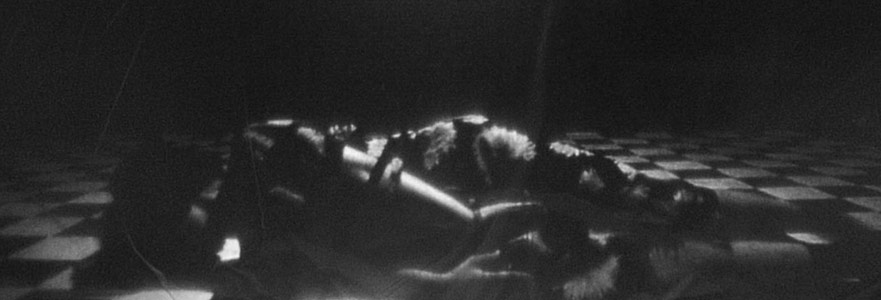
Z: The video aesthetic of the 70s and 80s is of course not on purpose. Personally, I think these are from the images that disintegrate when refilmed and also because of the black and white tones. As a photograph, we would have perhaps said it is the aesthetic of the 70s and 80s, but as a video, it resembles music videos? The videos were exhibited where they were made before, but when they are put in a TV box, the references become muddled. For example, the megaphone used in the video of counting from 1 to 100 was forgotten at Torun for about a year and a half. Many visitors who came by had played with it. The checkered ground of the video of rolling on the floor was the floor of the last exhibition at Torun. Actually, we purposefully did not paint it back to black during our exhibition, because that having been there was important to establish a spatial relationship with the video. In terms of the tasteful clothes, since I also know about Burcu, it was whatever we were wearing at the time! And the naturalness of this, instead of looking for clothes, focusing on the movement at the time, is important for me in all my works. The dress with flowers had scared me at the time, I'll admit, I thought about whether I should be wearing all black, but the aesthetics of the textures that clash with each other seemed interesting and I did not want to repeat this movement with another outfit.
B: The works are recorded, triggered by momentary inspirations. The movements are whatever was natural at the moment; they don't take as points of departure a constructed story or aesthetic.
Zeynep, we know more about your photographs. Your latest exhibitions and series were formed by sequences that evoked the ephemerality of moments, by grouping fading photographs. The first series is made up more of self-portraits. Both are predominantly in photographs. Now, there is an installation that combines video-performance and music. However, the visual language of these videos are not far from that of your previous works. After Uygur Yılmaz's last exhibition, the headline for one of the interviews was "Photography is over for me," although what he was intending to say was deeper and more complicated... However, we often encounter photographers becoming frustrated with the limitations of their own medium, sliding to moving image or other media. Do you have a similar self-distancing?
Z: I can't yet say "photography is over for me." A state of distancing myself from what I know, which stems from photography, has been at hand for a while now. If I think about my first series, of course it's different from today, but I have been in similar territories for 2-3 years. However, while I'm pushing the boundaries of the medium, it would not be correct to say that it's over for me. When I think about my first series, it is quite different from today; I've been wandering around similar places for the last 2-3 years. I started realizing that I was not capturing a "moment", rather performing for the camera or made others perform for the camera, instead of freezing them, making them have "duration" pushed me towards video. Shooting again and again, interfering with the surface, or not letting it be as it is, when combined with video, opened up new paths for me. Video from photography, video from video, photography from video... Sound for me is both very new and not. It was always something that I was dreaming of and seeking new ways to do. In the videos that I made for my last exhibition, the wandering of the sounds of the sea, the wind, and of murmuring were very important for me. But I did not know that I would start to include sounds that I was recording in my own work, but I still don't know really well. Because of this, this work that we made with Burcu is very important for me as it opens up new paths for my work.
Zeynep, I have another question for you. Both in your previous photographs and also in your later video works, there is the act of re-photographing which makes the image fade. This state of re-photographing is very different from that of Daisuke Yokota's. While with re-photographing you are using photograph's plastic qualities (grain, pixel), you are not fetishizing the way Yokota does. This technique is also felt in the videos included in the exhibition. What I find striking in this method is how numeric images made up of pixels create a layer of dust. It made an impact through the estrangement it evoked for someone who was emotional about and thinking on the plastic qualities of the image. Would you like to expand on this state of repetition?
Z: I actually think that the layer of dust was too much in the background. Or let's say that in my first series, this was more in the foreground. But the state of re-photographing never ends... For me, this is nothing further than experiencing the "different" states that the "same" photograph could undergo and the effort to find something that would be striking in this transformatıon. So, again from my older series, "untitled original" forming a "single" image by coming next to each other can be seen as a different result of the same effort. I sometimes explain this as producing and deriving the "new" from the "old" and this is an infinite state. Because each "new" produces the "old" again and this vicious cycle excites me. In reality, Yokota's manner of talking about "repetition" is something I find very close to my own sensibility, but I now feel the need to do more than just interfere with the photographic surface. My mind is crowded by the screen, pixel, dust, tearing, drawing, scarring, burning and lately by imaginations that extend beyond the photograph.
Yokota repeats himself and applies the same technique to different subjects, producing print works with these. I think this is why he avoids thinking about the bridge between technique and content, he has become ordinary for me. In terms of content, he was not able to get out of the framework of city-body-private life-the outside that a lot of passionate photographers get stuck on.
Burcu, “Cankurtaranların Akşam Yemeği” is a performance that I have heard praises about, which I know of without seeing it. I know that it was on a very risky set. It was an improvisation that took place within the directed scenario and spatial intervention conceived by another artist, right? Could you talk more about your working with Zeynep? What does it mean to conduct research on the space and the body in a white space that is often used for exhibitions?
Yes, I did a creative performative improvisation during “Cankurtaranların Akşam Yemeği” conceived by Ergin in 2014. The set could be considered risky because it was high up from the ground and the movement ability was limited, but the work's conception also demanded this. I enjoy producing works that I construct and perform, but I also like improvising within lines defined by other artists. It is a good experience both for me and the person who drew the framework as I like researching the boundaries of those frames. When we start researching, we are able to see where that mode of definition can lead. For example, perhaps something that does not fit Ergin's image comes out of me, within the potentialities of his scenario. There is a specific taste to such projects that are open-ended and that can produce results without predetermination.
Of course, working with Zeynep, we had a very different process. We selected from the material that we had made over a long period of time, separately, and placed it in the space. In addition to Zeynep's performative works that stemmed from video and photography, I came from the exact opposition, from performance to video and we were excited that we somehow met in the middle. Performance is more of a serendipitious encounter, intimate, unannounced but announced, which became simultaneous that night. Making works about the space and the body in a white exhibition space gives me a feeling of outer space. I called Torun "Torun Outer Space" for a while. I like that state of being isolated, I see a huge potential in that most basic, geometric space. That state enables a more direct relationship between the body and the architectural space. To be able to form simple relationships with the architectural elements that can have unexpected results is always interesting for me. For example, my work with the stairs is the result of such an unexpected relationship between the body and the space. This outer space detaches only the body to only the space, enclosing it and produces meaning there. Of course, if this is at all possible.
;