Your works are not the type of works that give people “happiness.” What are your instincts when making work? Is this a way of relaying the uneasiness inside you?
Yes, this is true not in terms of content, but in terms of the visuality. Because I code my works. I think a lot about color and I meticulously work on the tones. And when you work on it so much, the images become really appealing. Oftentimes, this is why the viewers enjoy the exhibition. I actually prefer to leave the content side to the viewer. I want them to enjoy whatever it is that they see. But when people ask, I tell them—it is not as much fun when I tell the story. The content is violence, tradition, murders, child brides, and other such things. Certain geometries, healing drawings, talismans, writing, symbols, colors… I try to heal the bleeding wounds of society by using these. This is always what I try to do. For example, when I’m drawing a girl who was murdered, I imagine her soul finding peace. I say to her, “A painter is dreaming of you and is trying to heal this wound.”
What is behind you trying to heal women who are in pain with your works? Treating and healing social problems through painting is a very ambitious statement.
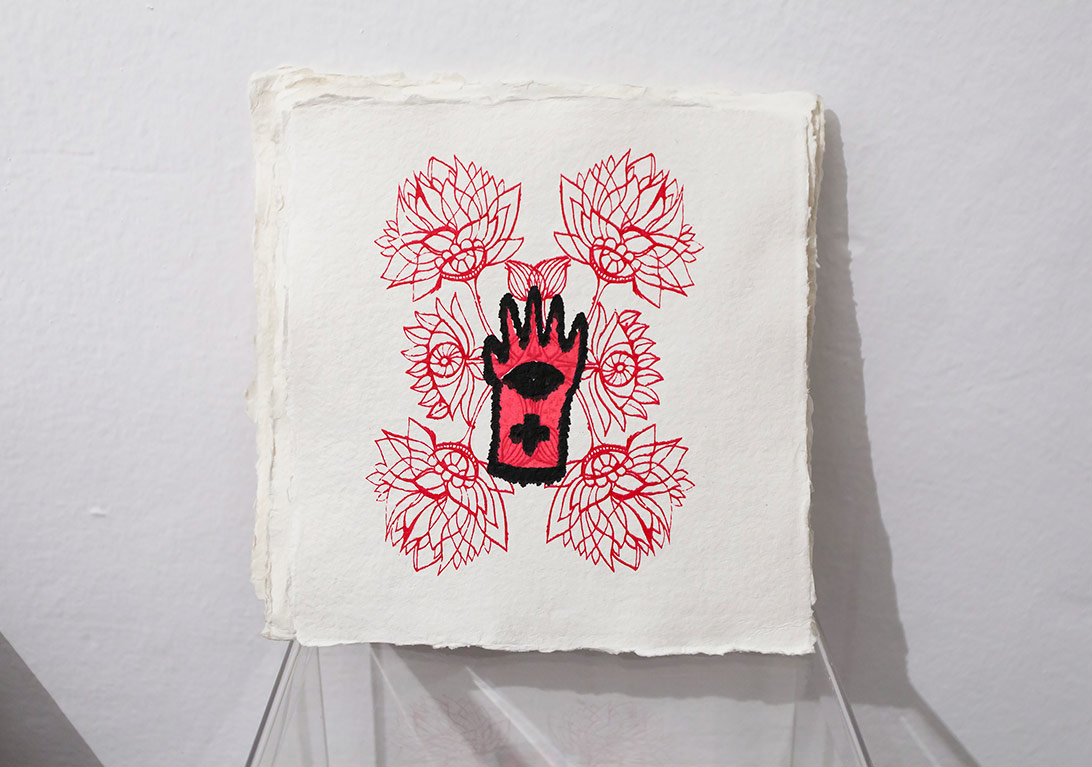
Shamanism runs in my family. There is the power to heal, which comes from my grandmother, she is the hand of healing. I try to charge the works I make with this. Many people in Anatolia were shamans. Fatima’s hand also symbolizes this; it is the hand of healing. Actually, this is an exchange of energy. I can heal the pain of people from my family by touching them, by focusing. This is actually a power we all possess. You can call this bio-energy or positive energy. I apply this using painting, color, drawing. I look at the balance, I add some symbols. I code them; this is a desire to heal, to treat. This is why the viewer does not feel bad when they are across from my works. They are healed by it. I have the instinct of healing inside.
But all your recent works include blood.
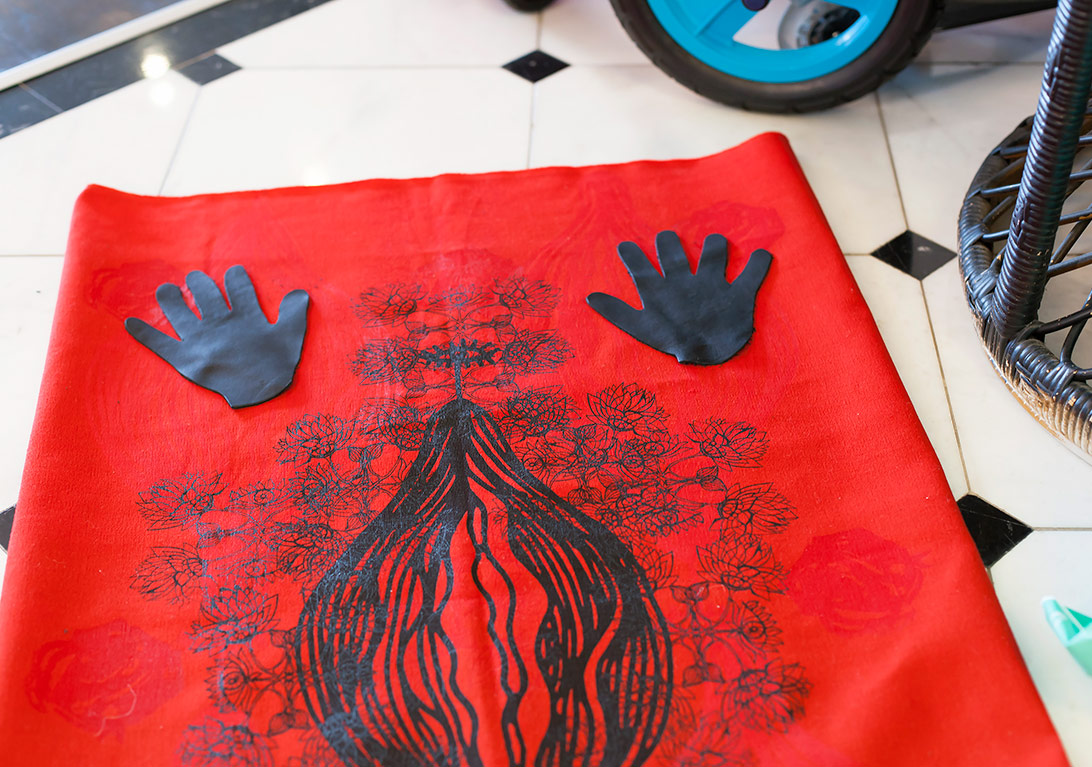
You might see that as blood. A lot of other people made the same comment, saying they saw blood. Blood is a very human thing. On the other hand, I really like the color red. It is a very strong color. This is why I use red a lot. I use green to soften it. Because green is the color of the heart. But I also think that red is a very feminine color. It is very strong and it has a high sex appeal. On the other hand, we use red to keep away evil spirits. When the mother gives birth, she wears a red ribbon. It keeps the evil eyes away because it catches the gaze.
I know that you care about traditions. For example, recently you said “The veil of the bride is closed by someone who has a happy marriage and they pray.” Are these traditions from your family or is this something you are curious about yourself?
A bit of both. When I was growing up, my grandmother whispered in my ear, “We are shamans, you are a shaman, don’t forget that.” I was a child, I lived in Saudi Arabia because of my father’s work; Eastern culture is very interesting to me. A lot of our traditions are lost. I’m not a conservative person, but I care about such things. There are reasons why these things have been sustained as practices for such a long time. It is a beautiful thing to bless a marriage; this is what I was taught. My aunt closed up my veil, this is actually a declaration of intention—two people are intending the same thing. “I love you, I love your marriage, tie my dress so that my marriage is like yours.” Of course, these things are also instinctive. For example, talismans looked beautiful to me. Then I started researching and I got more and more involved. Frequencies, dimensions on the one hand—space also really appeals to me.
In your previous exhibition, there were works on telepathy. You were thinking a lot about telepathy for a while, right?
I still think about it a lot, I’m focusing on this. I don’t know if it’s my antenna that is able receive high frequencies now, but telepathy appears to be natural to me since I was born. I can focus and call animals. I was thinking of something and then a porcupine would come in front of the window of the studio. I started researching what these animals symbolize. All of a sudden, a ladybug lands on my hand. Because I think you vibrate in that specific way and the animals hears you. Animals can hear a lot of things that we don’t.
You said that you thought a lot about pregnancy and made drawings of women when your sister was pregnant. Then you gave birth to your own child and focused on the telepathy between you and your child. What kind of a period are you in now?
This was a time period that started with my sister and I was very interested in it. When I opened my exhibition about pregnant women, I was pregnant, but I didn’t know. I learned that I was pregnant a few weeks after the exhibition. Everything calls each other, this happens to me a lot. I’m focused on the dowry right now. We experienced very heavy things this winter in our geography. Young girls who were killed, violence against women… My mother would always say, “Dearest Sena, these are heavy topics, why are you drawing these things?” But these things are very painful; it’s like a mission, perhaps I can save somebody, perhaps I can draw attention to these issues. This winter my mother told me, “We didn’t understand why you were focusing on these topics, but now we understand, these are very important topics.” With the dowry story, I’m delving into these topics.
How did you work on your sixth exhibition? What are we going to see in this exhibition?
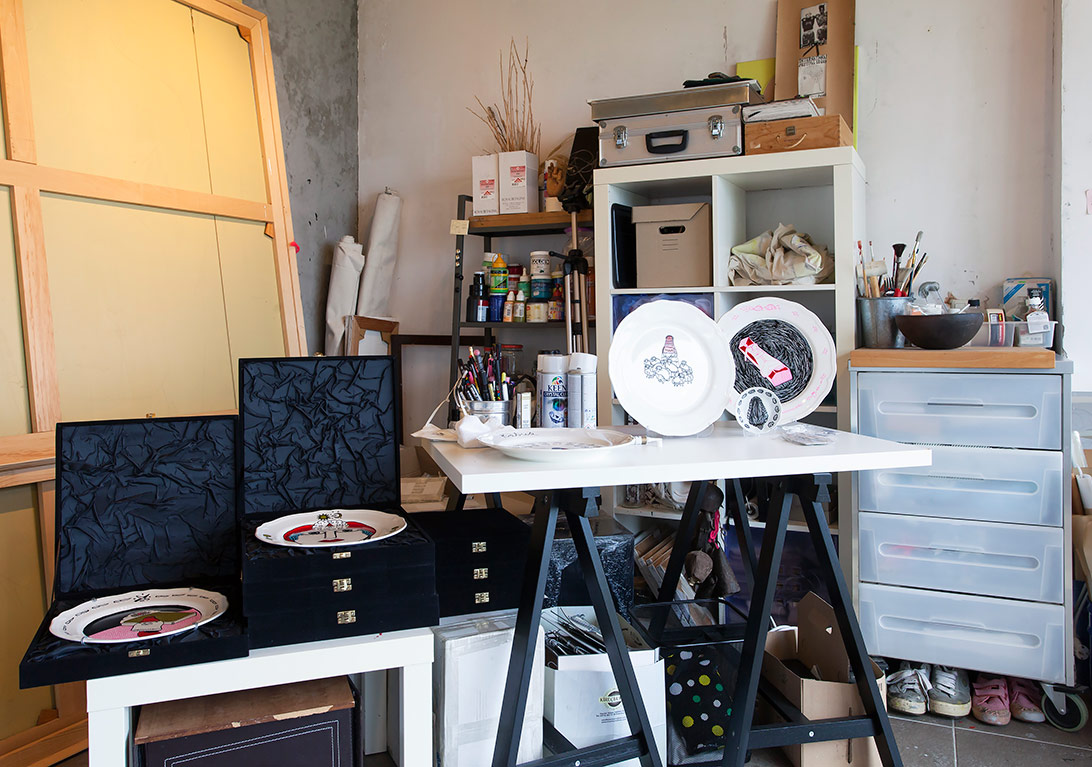
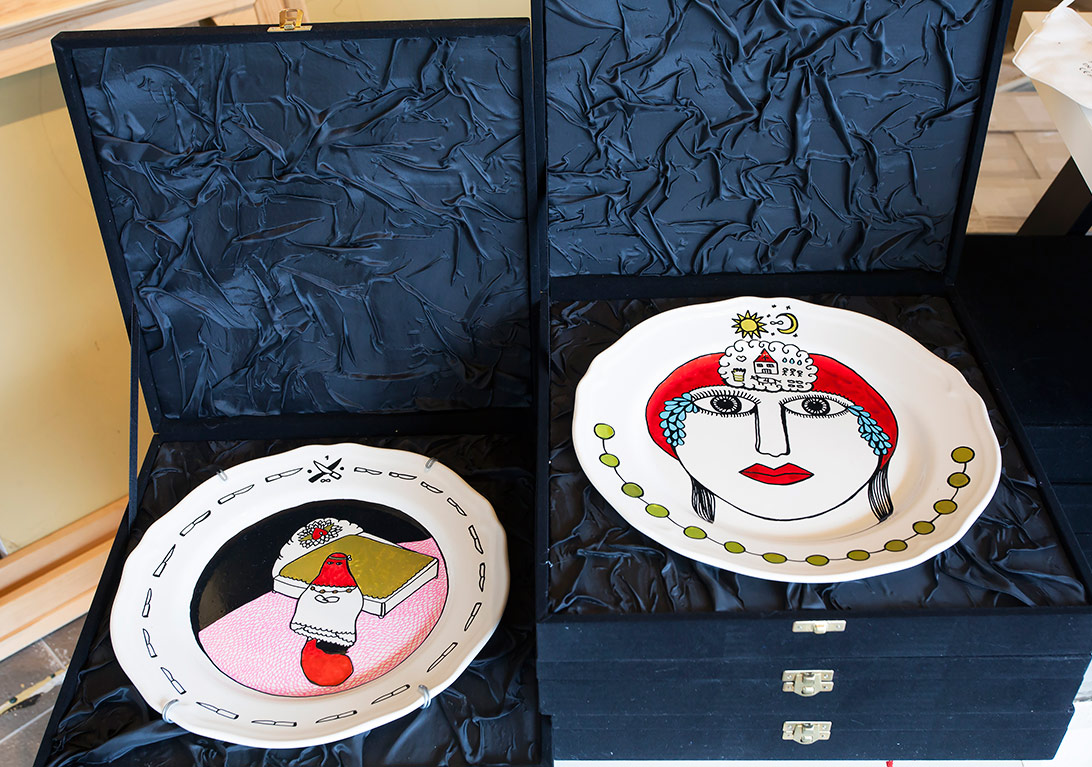
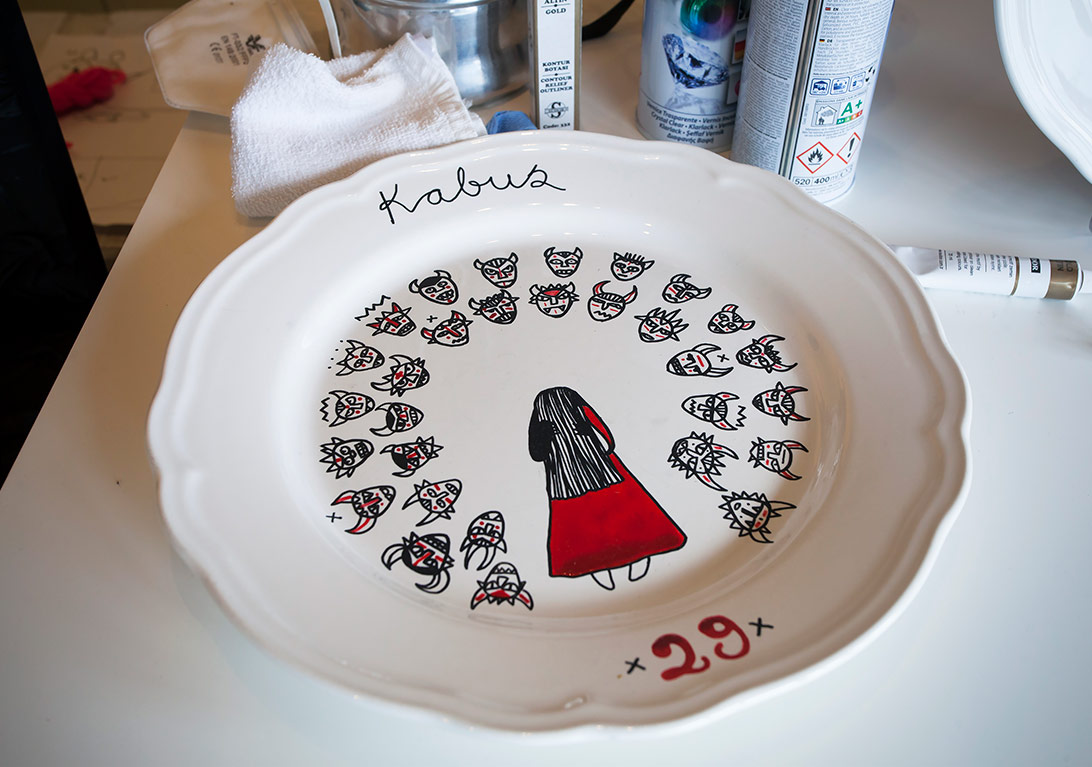
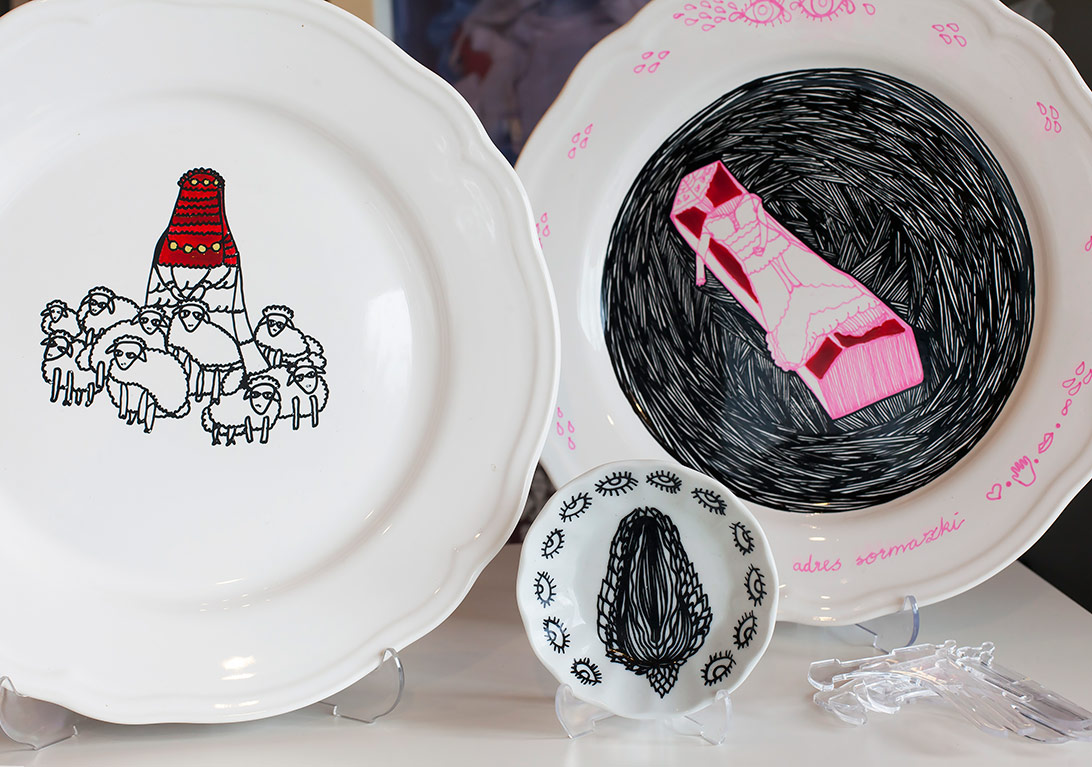
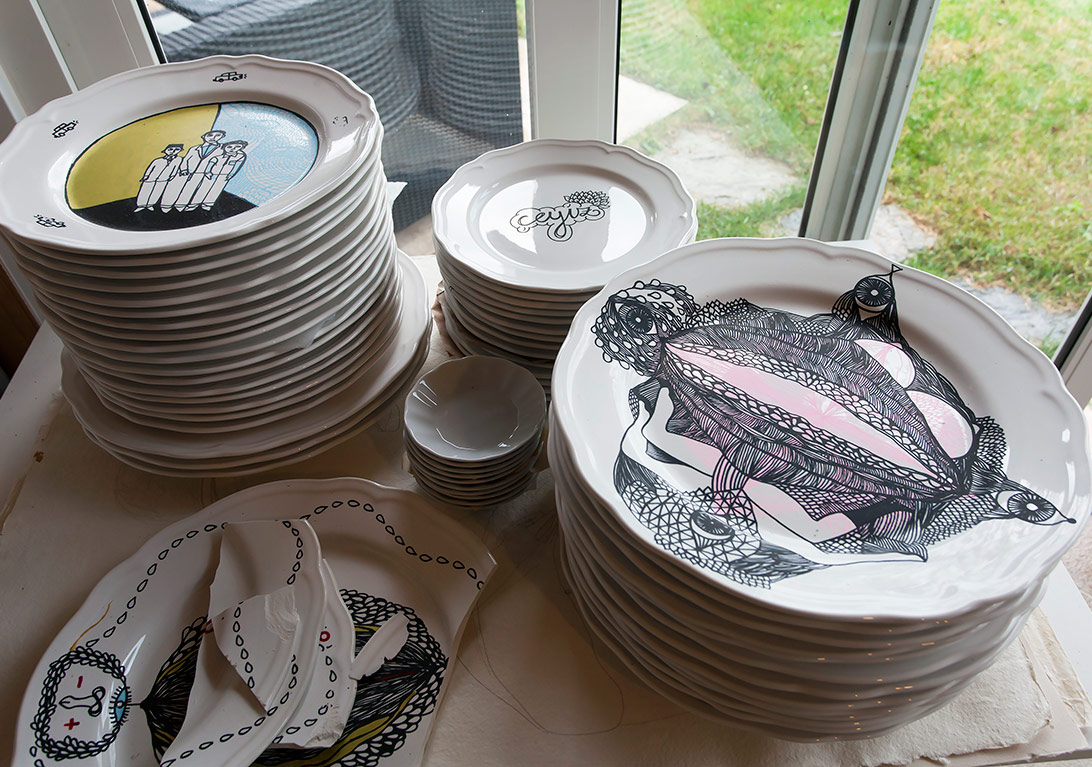
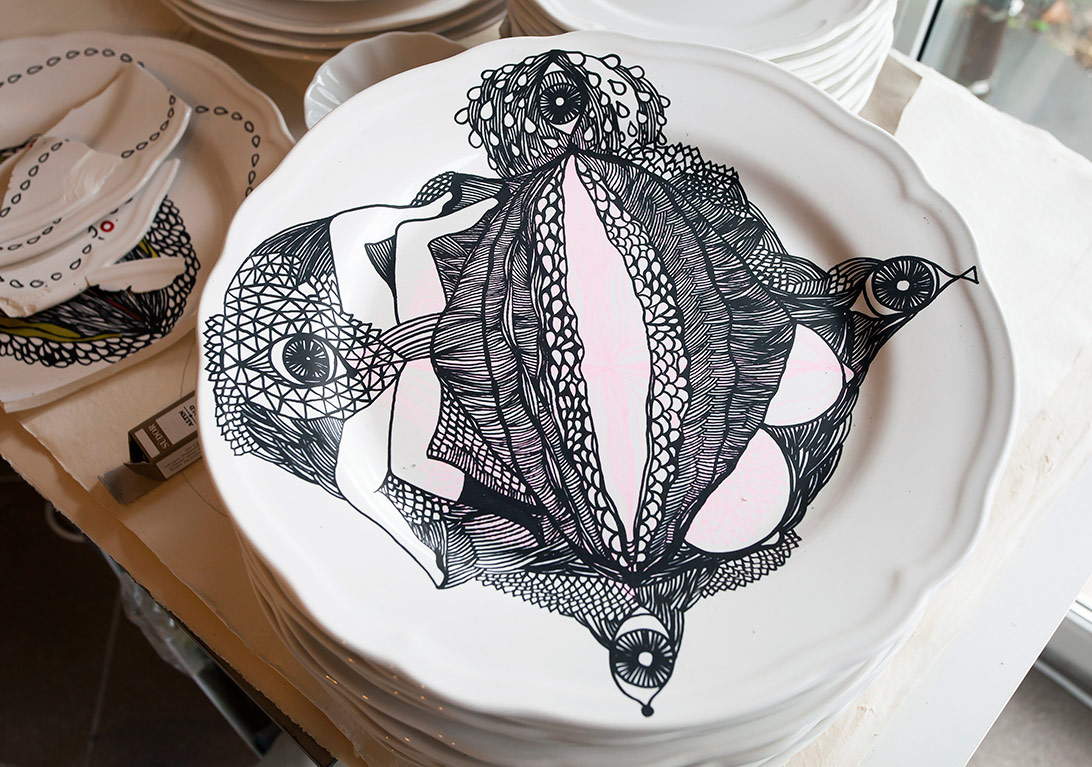
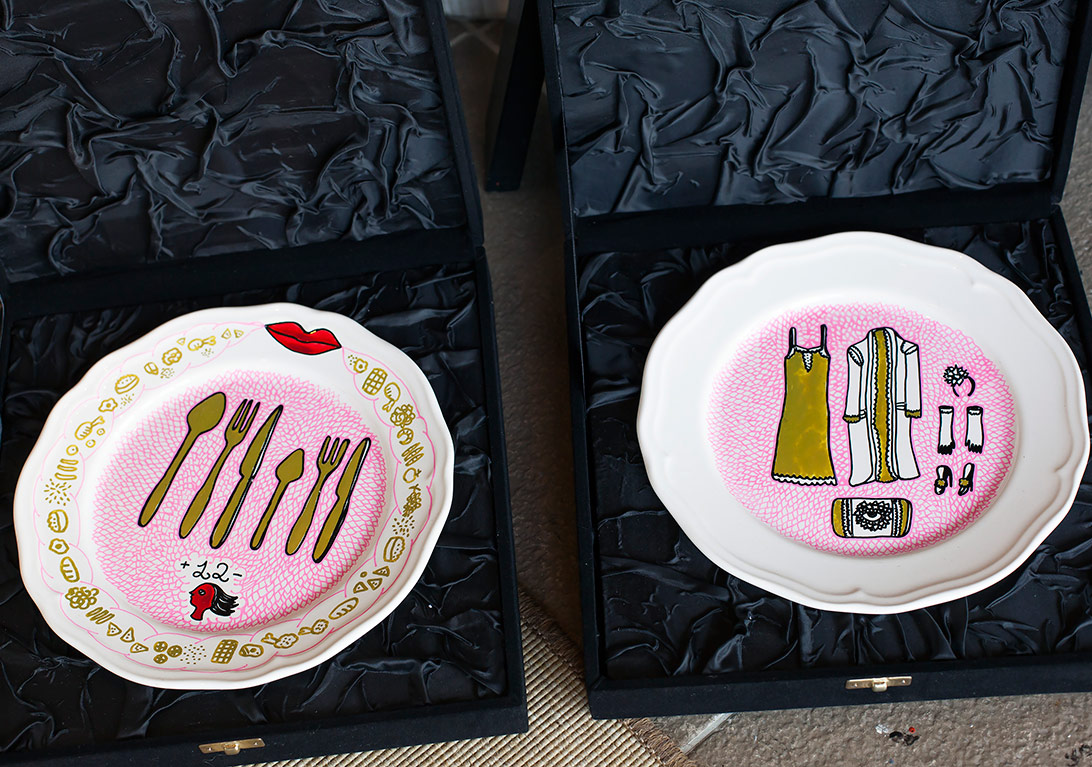
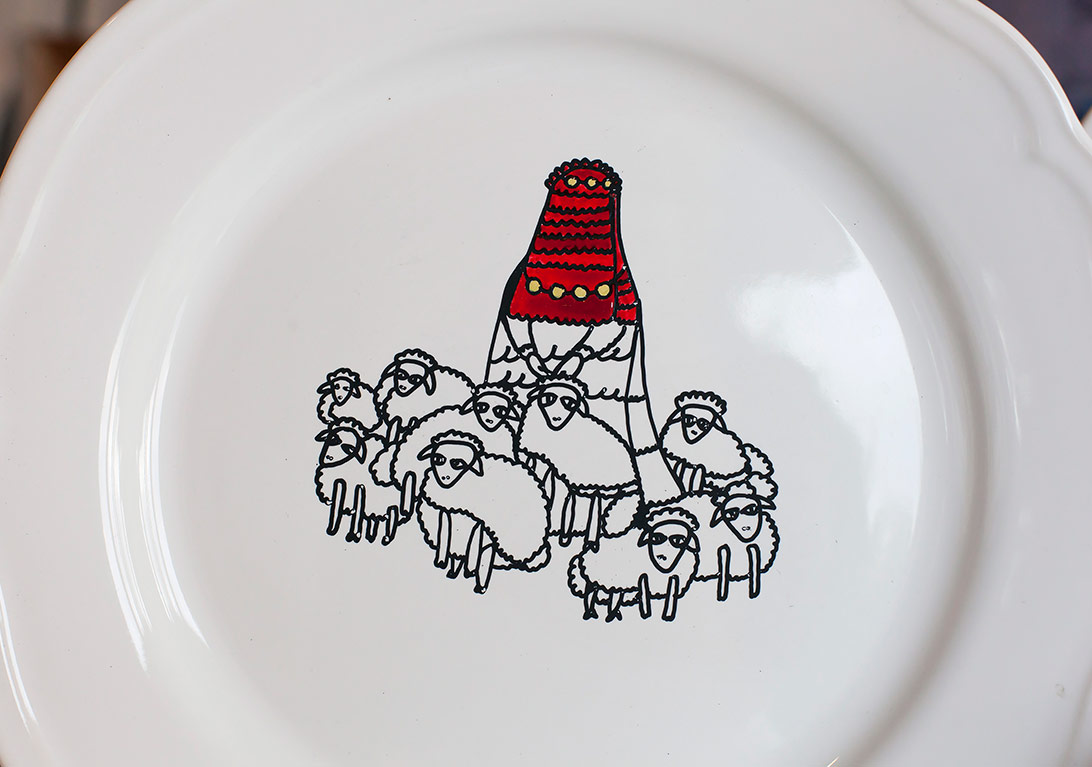
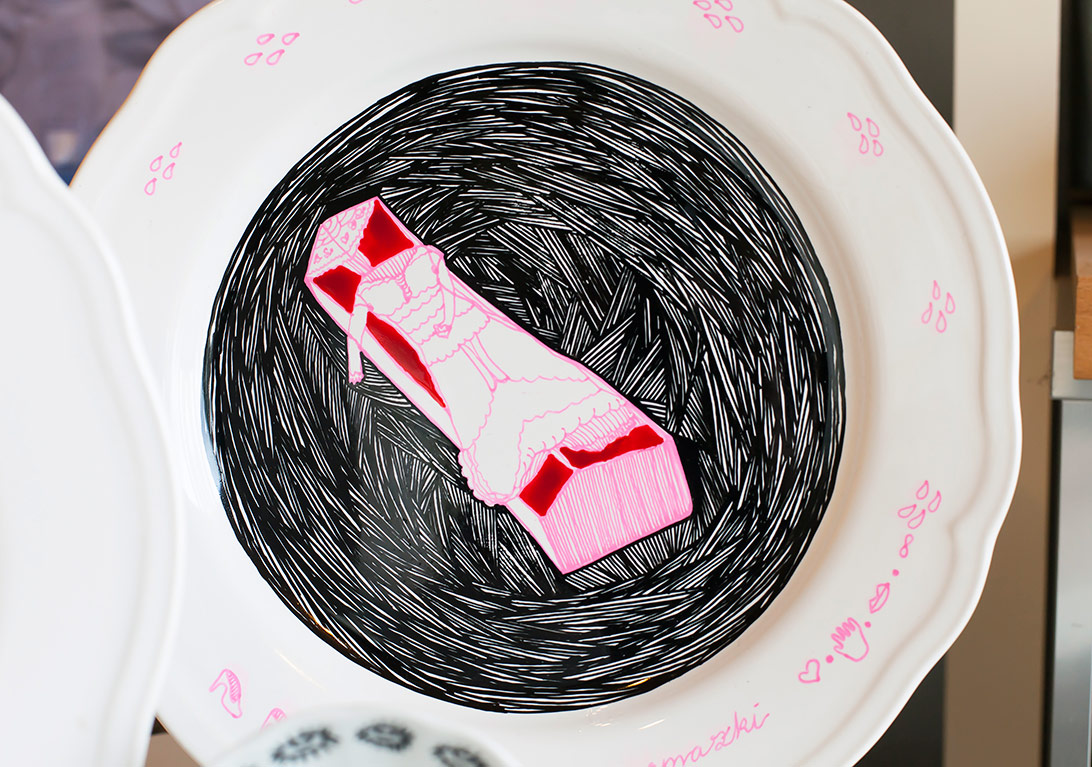
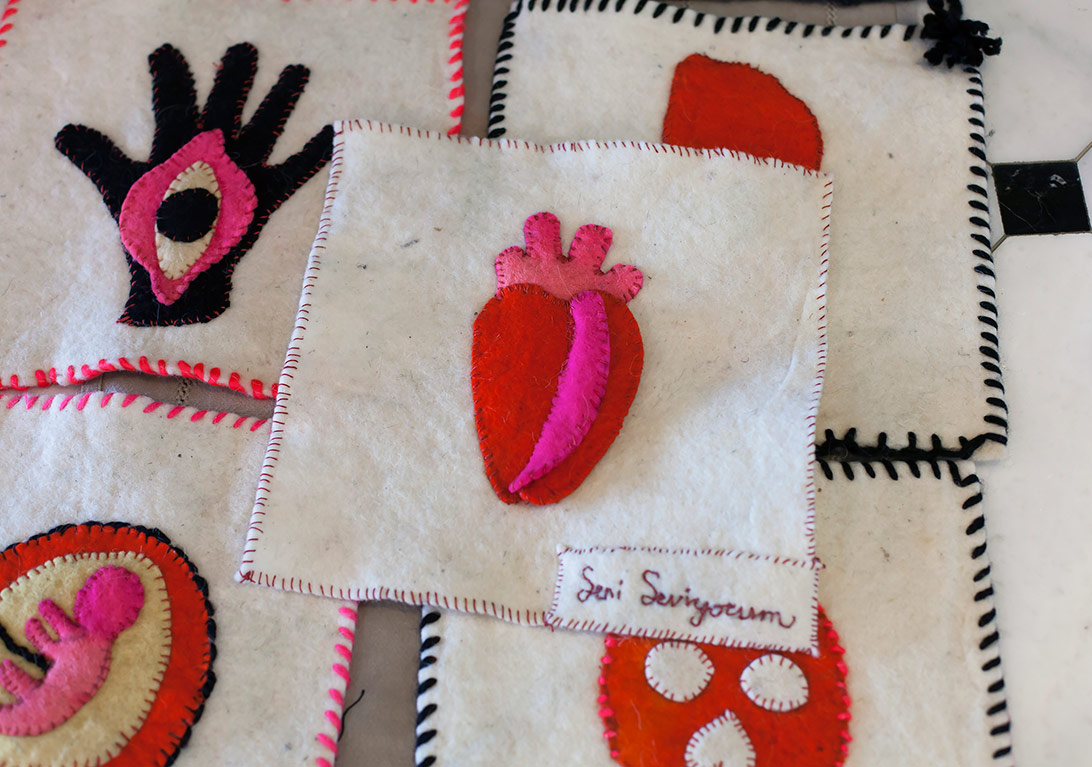
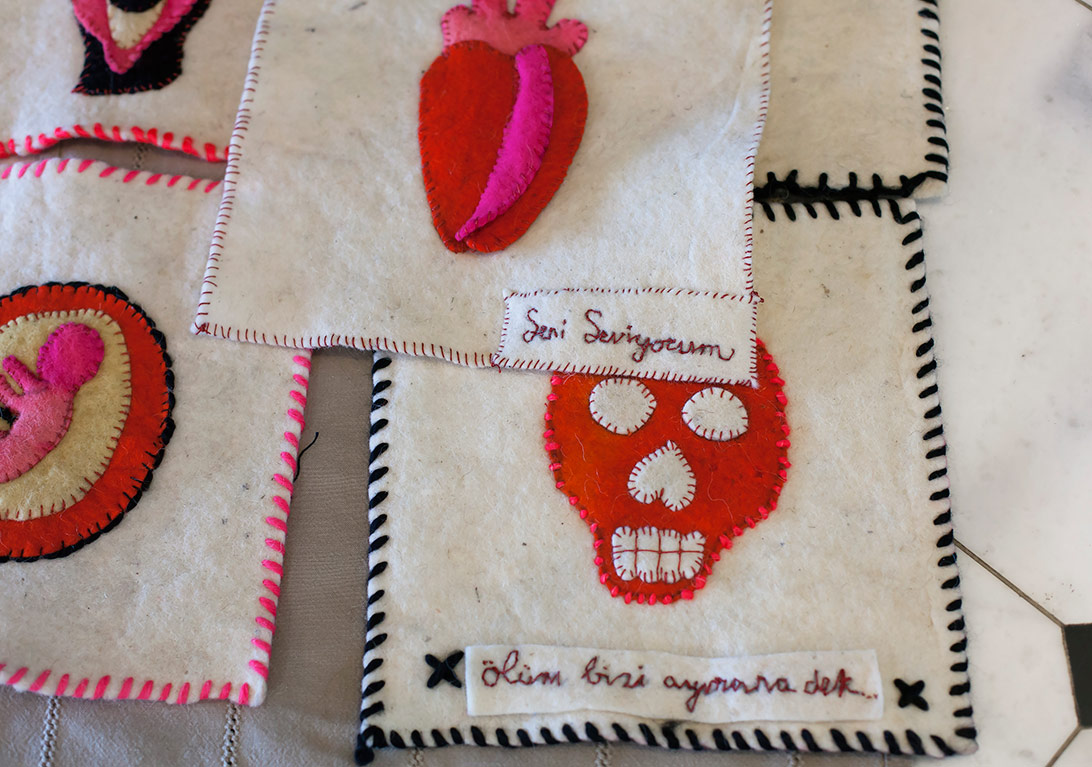
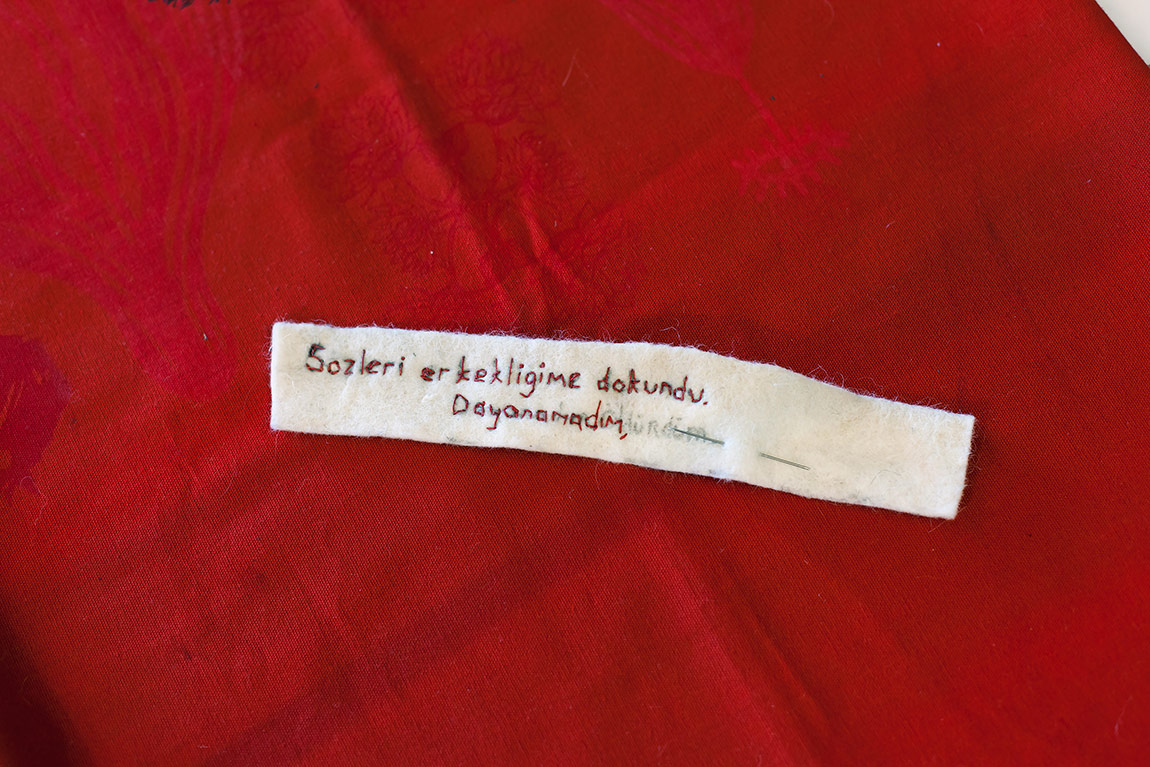
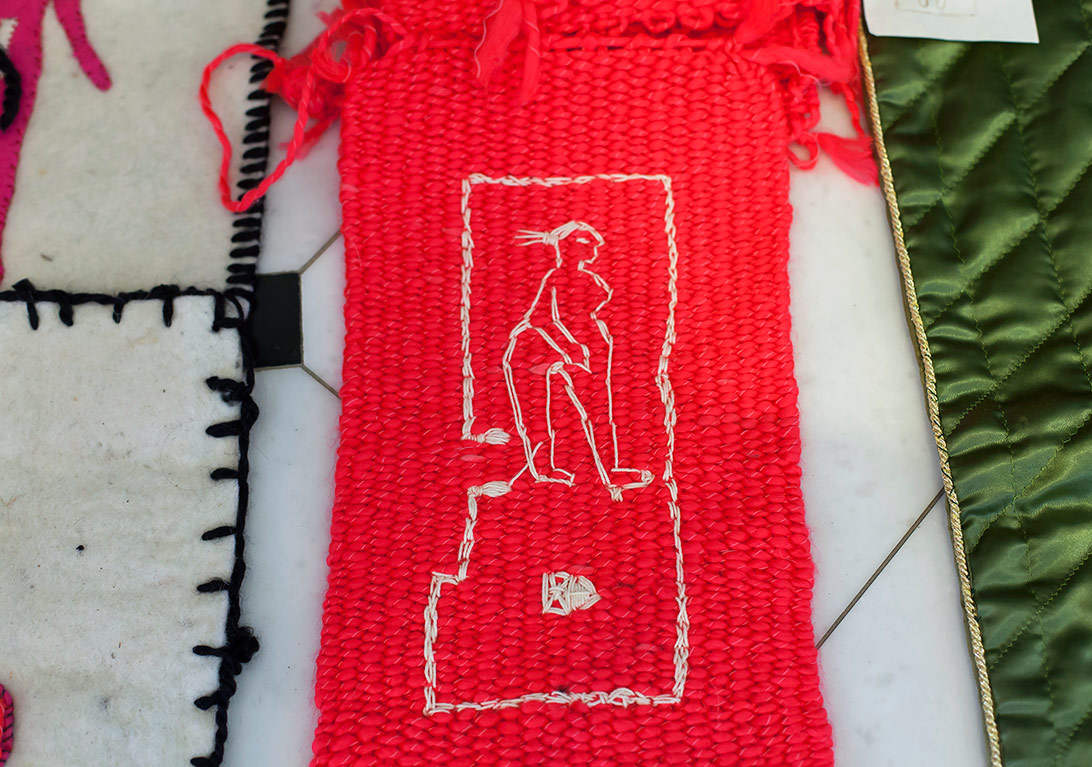
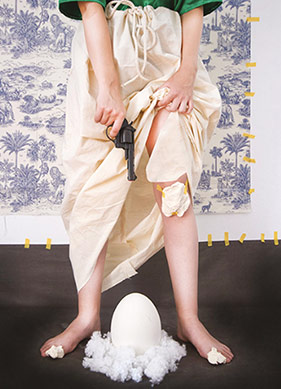
I work as if there is a bride coming out of the house. For example, there is a plate set. Plates are an indispensable part of the dowry. Girls are still packaged and sold in Anatolia—the dowry is the only thing that the girl can take from their house. Whatever the family can contribute to the dowry. There are child-brides who were sold for 50 sheep, there is rape, there are girls who were victims of jealousy murders. One of the girls was taken to the grave with her wedding dress on her coffin—this really happened. I usually work with real stories. There are felt works in addition to the plates, there is a prayer rug, I’m also working on bed linens. I’m weaving on all of them.
I saw the dowry plates before…
We have a not-for-profit collective called “Signs of Time.” We organized an exhibition at Pi Artworks. When my friends from the group the plates, they wanted to include them in the exhibition. I had just finished 15-16 of these plates. I divided this set in two and showed one of the sets in the exhibition. The other set is included in this exhibition. In total, this would be a set of 52 pieces. Since I showed them before, there are fewer pieces now. A lot of viewers found them striking, which I couldn’t believe. Sometimes I think about something and I problematize it in my mind. I think about how I can talk about a problem. This is how the dowry story came about.
What is your relationship to material? Have you taken a break from oil painting?
I make oil paintings, but I have returned to playing games with my son Omay. I like using different materials. Sometimes it works, sometimes it doesn’t. I have been very interested in felt recently. The handmade felts of Anatolia are about to disappear. There is a place where I get materials in the Grand Bazaar. This is where I encountered these felts. I was looking for something that could be shaped and that was thick. My father’s side are all tailors. This is why I was always interested in sewing. When I became interested in these materials, I reached the craftsman who makes this material. He is from Isparta. I was even more interested by this, because my father’s side is from Isparta. This is how I became interested in felt. I made a felt vulva for Contemporary Istanbul. I also started weaving carpets, but this will not be included in the exhibition. I’m experimenting, playing, looking. There is always the journey of, “How do I say this?”
What is your relationship like with collectors?
I develop relationships with collectors who want to have that. Some people don’t want to have any kind of relationship with the artist. For those who want to learn the story of the work, I talk to them of course. Some want to meet up, to listen, we eat together, we chat. For example, there is the Maisonrouge family in New York, who are still following up with me. We e-mail, we have become friends over time. We went to New York to see them and they came over here to see us.
Could you talk about your production process? Are you happy for your production to be so intertwined with your domestic life?
I don’t know [she laughs]. This is how it’s been since I got married. Since I had my son, this works better for me. But my works have overflowed from the studio and into the house. I also work where we live. Sometimes I want to focus for long periods of time, but that’s not possible when Omay is home. He doesn’t step on my work or touch anything, but it’s always, “Look mom, look at what I did.” Then our print studio comes into play. That’s where I escape to when I want to take it easy.
I do everything at the same time. This is why I work inside the house, the studio in the house and the printing studio at the same time. Before an exhibition, I apologize from the family and spread everywhere. For example, I do a bit of calligraphy, I get wrist pain, move on to something else. I do a lot of things at the same time. I don’t start with one thing and move on to something else. 20-30 pieces move together. When I don’t have an exhibition planned, I stare at a sheet of paper for hours. Sometimes I work on sketchbooks for months. The only time I really took a break was for childbirth, two years. Other than that, I have had an exhibition every year.
What is the material that you enjoy working with the most?
I enjoy working with paper the most. The story of paper is appealing to me, the fact that it comes from the tree. When I was studying at Marmara Fine Arts Academy before going to Central Saint Martins, I had chosen the print department. They showed us the calligraphy tips to be able to work in gravure. Calligraphy has been in my life since then, I have also mastered it. This is how I prepare the paper: I throw the pieces of paper on grass when it is raining and then I throw root paints, ink on it and leave it until the morning. While it’s raining, I go outside and keep adding paint. This is how I prepare the backgrounds. Those “blood” stains are a collaborative piece between me and the rain. Then I dry the sheets of paper and make drawings on it.
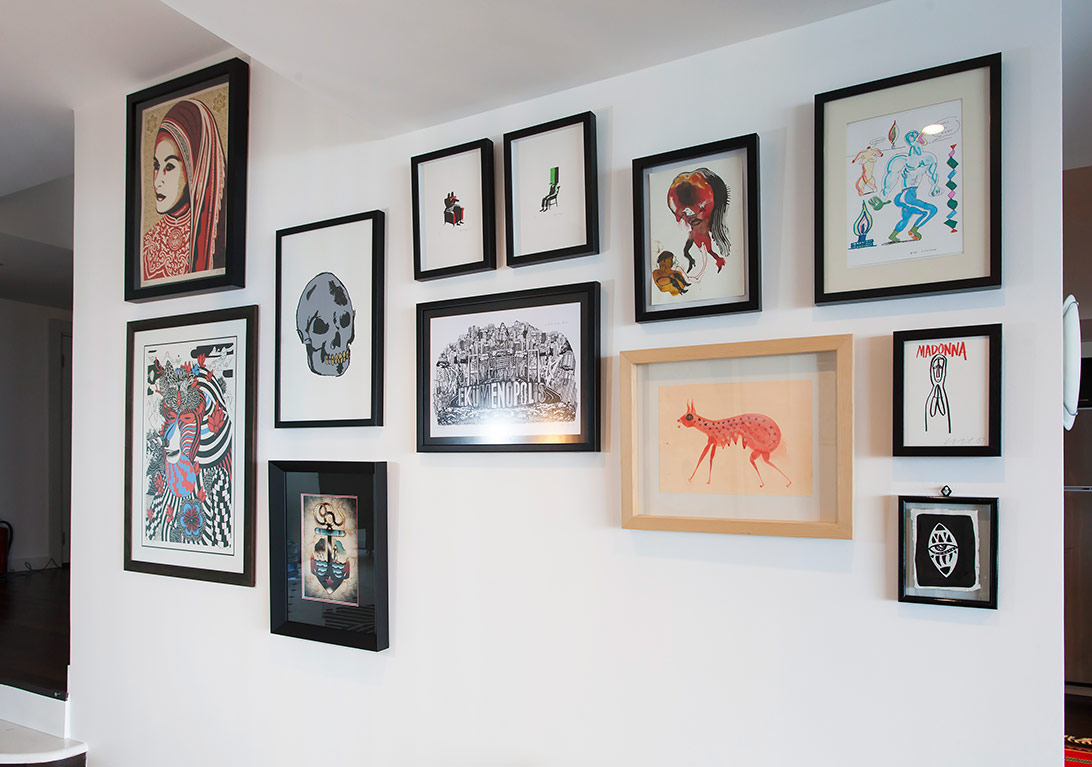
What is important here is to note that I work on whatever my heart desires. In other words, it’s not always a bloodbath. For example, I’m going to make a plate on gossip. I think this is an interesting topic. I’m also going to do something about the unseen, also called sacred geometry. I bring lots of layers on top of each other. This is because of my background in printmaking. There is always a story above and below it. There is miniature in one drawing as well as calligraphy, the planet Saturn, you can also seen an Einstein cube that represents the gate to another dimension.
We talked about gossip. Do you believe in negative energy?
Of course I do. What we believe as “evil eye” amongst our people is definitely related to negative energy, to bad thoughts. These are very powerful things and I’m very intimidated by these things. This is why it takes me a while to get myself together when I’m making works, I focus, I try to be positive, proactive, so that I can heal. I believe in negative energy. If you don’t believe in the devil, you’re ruined!
You have a son. I think mothers of sons are charged with a very important role in our society.
Yes, this is a big responsibility and yes, I do think about this a lot. I have a close friend who is a paediatrician and after my birth, I asked for their opinion, “What do I need to be careful about?” And they said, “There is something really important that you should do. Don’t do everything that he asks, be a mother who knows how to say no.” You know, male children are very precious for us and they are thus very spoiled. When you say yes to everything they want, they can start seeing women as an object who is charged with serving them, who needs to do everything they ask for. Our society has this problem. When the woman says no to a man, the man thinks how it’s possible for her to do that. I’m raising my son with the understanding that he needs to respect women, prioritize them, protect them. This includes giving the right of way to his little girl cousin when they are leaving the house.
;