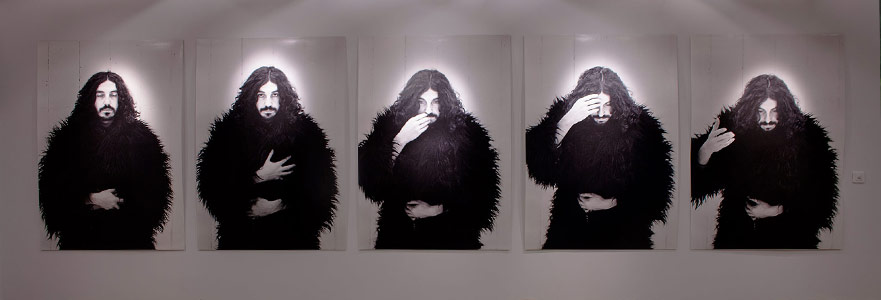
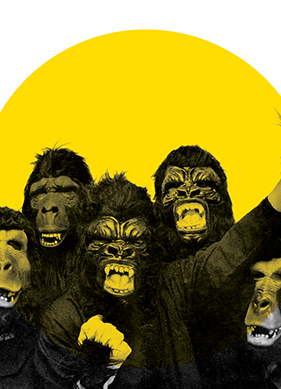
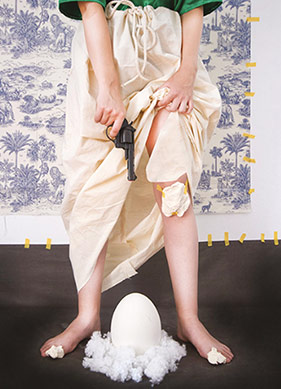
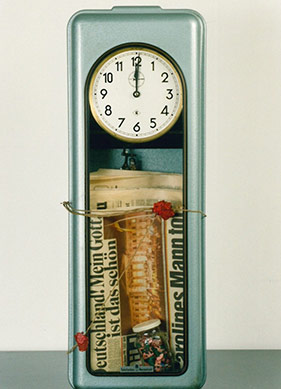
When Elif Dastarlı, in her article published in our magazine on From England, with Love, İsmail Saray, says of İsmail Saray's practice; "he shows the mischiveous hybridity of art and life,"[1] she is not wrong. The irony that can be read in Saray's practice would prove this analysis by Dastarlı right with its wide span.
We met with İsmail Saray at SALT Galata. As the exhibition continued in Ankara, Anthony Hudek, the curator and associate director of Raven Row, a contemporary art center in London, would be in dialogue with Vasıf Kortun, Director of SALT Research and Programs, and İsmail Saray, discussing the artist's practice both in Turkey and in England, looking at the issues the artists worked with in his practice. I was invited to Ankara to listen to this conversation. But because of tough weather conditions, the conversation took place in SALT Galata. At the end of the conversation, İsmail Saray and I had a talk that began with the conversation that had just taken place and moved on to topics of his life and production.
When transforming your life experience into art, I see that a lot of your works are proposals for a reading in reverse. Why do you do this?
Society is under the influence of people who set rules. When somebody yells, we go under their influence, we become receivers. When a law is established, we become its appliers, but we do not really have an idea of how to realize it. This issue of reading in reverse proposes a question for such situations? What is required of us? This? That? Prohibitions that are placed without going into detail. Us, receivers who take things as they are becuase we are living under some rules—we start to read in reverse when we ask questions. When you ask a question, you start to read in reverse at one point. When you ask a question, you have an answer. This is actually the reflex that the artist has from the beginning. Depending on where we are looking, this perspective changes. I'm seeing the book you are looking at in reverse. My left hand corresponds with your right hand and when you are writing from the left to the right, I perceive that from the right to the left. There are many different elements that shift perception. I try to complete my perception by including all my sensual organs (cognitive approach). But this also depends on bodily differences. Thin, fat, tall, short... Different forms of reading enrich the relationship that we construct with the world. It enables us to produce different solutions. It looks at warmth and coldness. Those who place the rules and those who apply them. We are lost in the middle of oppositions and artists are people who relate by staying out of this situation.
Your works are based on playing with perception.
Artists were limited at first. You are a painter, paint. So I should not hear anything? There are birds on the tree across from me. What about that sound? Look at children's pictures of tables; they say there are four legs, so they draw showing all four. Also in miniatures, everything is made widely visible. They do not hide the trees. This changed completely with perspective. Let's say that there is a rabit behind the mountain. There is also a rabit in front of the mountain. We do not depict the rabbit that we see when we look behind it. Art is made among all these rules. But when you look at miniatures, none of these rules exist. When you reflect what others do not see in your painting or in your production, they ask "where did this come from?" But I see that and with my knowledge, I reflect it on a surface. In a work that I made in England, I cleaned half of a glass that had not been cleaned for a long time. Glass is a transparent thing. By showing its presence after cleaning it, I was able to prove once again its being. This is how the presence of objects are brought back to the foreground through such a situation and trigger people to think.
When you returned to Turkey, working as a teacher at the Education Institute in Samsun, sending works to exhibitions in Istanbul and abroad, including the Paris Biennial in 1977, you worked to improve the art education. You made an effort for the establishment of an art book-oriented library in the Samsun Education Institute. You convinced the administrators of the institute to create a budget for the library and you subscribed the library to international art publications. On your Istanbul trips, you bought books for this library. All of these are like cleaning the glass. There is life there as well and actually there is nothing different there from the big cities. It is necessary to only remind people and this is a big responsibility.
I was assigned to the Dicle Primary School in the district of Ergani in Diyarbakır after finishing Gazi Education Institute. When the individual is by themselves, it is necessary to make use of the opportunities there. Each class had a different library. We had the opportunity to paint and read a lot of books outside of class. I was the fourth painting teacher there. There were also music teachers. When you arrive at such a place, of course you are influenced. I also have a mathematical, rational, and pragmatic approach. I have a method of questioning that comes with it. And there, I thought about what we could do together. I did not receive an art education in an academic sense; I am not like the artists who graduated from the academy. With my friends who also graduated from the Gazi Education Institute, we served with this instinct where we were assigned. Because of the education that I received, I think that I'm responsible for the environment that I am in.
In relation to this answer, since you already brought it up, could you talk about your years of being a student at the Gazi Education Institute? Who did you share this period with? What was the foundation that shaped you?
After entering Gazi Education Institute, the possibilities there, art-craft teaching and the education for it never made me feel out of place. I was able to adjust immediately. The work that was based on material and technique never felt strange to me. The first year was made up of studio work and 2-4 week interwals of specific works, which later gave place to painting/drawing and graphic techniques. In the second year, I selected painting from the branches of painting and graphics. I spent the third year in painting classes as well as the modeling course, which was based on technique-heavy studio work. (This course was made up of clay, casting, and sculpture work that included other types of work.) During this period, educators including Adnan Turani, Mustafa Tömekçe, Kayhan Keskinok, Burhan Alkar, Nevide Gakaydın, Hidayet Telli, Nevzat Akoral, and many others made huge contributions to our education. At that time, Adnan Turani had started to publish a magazine called "Art and Artists." Some students contributed significantly to this magazine also technically. It is difficult to recount the names of all my friends at the time, but of course we met with some of them in Europe and we also worked together in Turkey, we opened exhibitions together.
Gazi Education not only prepared us for education, but also prepared these youngsters who came from all over Turkey, who were hungry for knowledge, for life as well. Both the professors at Gazi and the life there enabled us to become individuals who were able to become one with life. For three years, we frequently attended concerts, theater, opera and ballet performances, cinema and exhibitions, conferences; as we were part of this boarding institution, we were able to dedicate our remaining time to reading and to discussions and working outside of the studio.
You are speaking the language of objects.
A person should think and produce in freedom. Those who are interested in the three dimensions usually have a wide perspective. You can work with many different types of material. Painting, wood, bronze, film, photographs... Then, if you are interested in conceptual art, let's say you are throwing something at someone, a stone or a snowball. You need to know what this material marks. What do I want to reach? This is in the domain of creativity. There are a few steps to everything that is done. We need to increase the number of steps. Thought usually remains in the first step in creativity. This is how I see painting. But with three-dimensional arts, different perceptions are present. Sound, light, touching, tasting, smelling and also time/duration/movement etc.
The exhibition, with the title "From England with Love, İsmail Saray" touches on the absence of memory in Turkey in almost everything, reading that in reverse and reminds us of İsmail Saray, who held a defining position in the cultural and artistic world in the 1970s and 80s and who produced beyond time.
Turkey is not what it used to be, it is an element that contributes to the global artistic production. There is a movement initiated by SALT. The selection of the elements who are in this movement are done according to the rules of this institution. It is also not passive. It is not a corner shop. Let's say it is a corner shop, but it puts forth a fruit that has never been seen in the world before. It makes hundreds of people ask what this is and that they have never seen it. Duygu (Demir) identified this at the beginning. And she told me, "When I started researching you, there were people who knew about you, but when I asked, what is he doing now, nobody could give me an answer. Even those who worked with you did not give me answers. They would not give me answers and this made me question things." She finally talks to Ahmet Öktem and he talks about the things I did in the 70s. Ahmet asks whether she knew about my Leonardo da Vinci book, which I had sent anonymously to those who participated in the Public Exhibition of Painting and Sculpture when I first went to Samsun.
Nobody talked to me about this book, which I had also sent to my friends. Ahmet also told me about this later. He told me that while many people in the Academy received this booklet, nobody talked to each other about it. We could not form a dialogue of differences from the inside, unfortunately. Throw me something. Should I let that happen? Please, let there be a dialogue. Let's not push ourselves into corners, we are a part of a social structure. Nowadays, there is a vast amount of freedom, but we are limited because of this. There is a fear of losing in this relationship that we have entered between ourselves. When we are asking for things from each other, do we move in relation to steps? Do we have fears, conditions? This situation directs me to, brings me to creativity.
The irony of this exhibition comes from the depths of your corpus. When saying "From England with Love, İsmail Saray" you are saying hello, I'm here and also calling to those who do not remember. With the name of the exhibition, are you reminding cultural institutions, galleries, art writers, artists, curators, and academics about the lack of memory and inviting them to read in reverse as well?
Those who are silent should not be silent, really. We encounter such instances of forgetfulness in the UK as well. Everybody needs to react to the situation that they are in. People who are not in such a freedom limit themselves. If there are no reflections within social groups, then there is a problem. The whole exhibition is a warning for the viewers actually.
This is what I understand from what you are saying. The whole exhibition holds a warning meaning just like your artistic production. This is related to your performance of artistic practice and political activism together. And this exhibition is not by any means static through the presentation of your archive. On the contrary, it is an activating exhibition.
It also activated me. Because I was able to see all of my works together. When everybody laid out on the ground the things they brought, we saw how much there was. The exhibition cracked open doors in a certain way. I was able to see the connections between the works and this was formed by SALT.
Then I want to go back a bit. Was it easy to make the decision to go to the UK?
My wife and I both did not want to go. We did not want an assignment in the capital or even in a major city. We wanted to go to a village. My assignment was moved back to the center and I was not able to teach at the Samsun Education Institute any more. My assignment was halted. I needed to be assigned somewhere else. I asked them to assign me to a village and told them the kids would be speaking English in six months. My wife is a fashion designer, the women there could learn how to sew well in six months and we are going to be a great resource for the people there. The issue was not about staying in Istanbul or in Ankara. If the individual is aware of the value of using values well, if they are able to find ways to paint when there are no paints, they can be happy. We were going to go wherever they sent us. There were going to be different situations over time. A lot of people were being arrested. Among the people who stayed, some of our friends had their families split up. We made a decision and as my wife was English, we went to the UK.
The issue of selecting and being selected in art education can be confusing. As an artist who received state funding to be educated in the UK, what would you like to say about this?
The issues of selecting and being selected are really troubling. I was sent to the UK through such a selection process, receiving a scholarship. We were selected based on our skills and the imprint we made on the administrators of the time. I encountered the same things in the UK. You would encounter this in any school. This selection directs your life. There is a number of subject assessment systems. This exists in almost all institutions. When we activate these, are we doing it to our benefit? After returning to Turkey from the UK, I was going to be assigned somewhere. Of course this happened within the framework of rules. But in 1968, I selected the UK for my sculpture education. This was a very rational thing. After the exams that were conducted, I was selected. This could be because of my skills and also because I left the impression that I took what I was doing seriously? Maybe it is something like the game that children play, "three stones." I have a work about this, there is a thought-based option in the game of "three stones." As time runs out, the pressure increases and rationality is replaced by movement. At this moment, we do not perceive the deception and going back is not among the rules. Or in other words, there is no taking back the stone. At that moment, you need to decide on everything. How do we distinguish between the movement between A and B? The state of our eye not seeing this difference. Sometimes, the mistake that I make might benefit somebody else. This is the primary condition of selecting and being selected. According to your move, the game continues or ends. If we connect this to the selection fo the institutions, some people's lives are determined based on the shifting condition of decision-making among the twelve jury members, the chaos. The queen makes a similar selection, the President, and the citizen, when appropriate...
This selecting and selection is closely affiliated with processes of creativity and creating. At "Artist Placement Group", APG, artists were selected randomly as people. There were no rules of selection... Those people entered, freely, without being connected to any rules, artistic activity. This continued for four-five years... Other institutions later changed the name of this to Artist Residency. There are many such examples in history. There are court painters. Medicis also had a painter, etc. But they are not fully free. Selecting and selection always come back to presupposition. When looking at skills, ideas about the future are produced about that person.

I would like to clarify this. Are you against institutions or are you against the rules that are applied?
I am against the tradition of irrational rules in the institutions. If I don't like a setup, I will not enter it. But when I enter it, it is natural to against rules that are shaped by relationships of opportunism, based on lack of communication that the authority is trying to apply. I am against applications that push our thought to the subjective. My main concern is with state institutions. As people who pay equal taxes, we should be able to benefit equally. Those who make decisions in the name of the public should not be subjective. What I was just referring to in terms of the three stones is the most essential example of this. (This should not be confused with ‘Üç Kağıtçılık’ literally, the three papers in Turkish, an idiom meaning deviousness, cunning)
How would you define the dynamics of conceptual art production?
There is a production resistance brought by conceptual art. Everything should be outside of imitation. The aim is not to throw a dice with six on all sides. But unfortunately, we encounter such situations in conceptual art. Everybody did it so I can do it. Sometimes conceptual art appears easy. Nobody says no when we use an already-existing object. Many avoid doing something that has never been done. The first thing I did when I arrived in Diyarbakır was this: I brought in a lot of different things to make still-lifes. If I was an astute educator who wanted to do things in an easy way, I would have brought Cèzanne's objects. The pupils could paint what they see and all of them could have produced good things. But if I bring elements that are different from each other, this would be more of an installation work that was closer to sculpture than to painting. I put the students in groups and asked them to select three or four objects and place them. Thus, I believed, there would be a constant movement and different things would emerge. There are certain steps in education. The first is preparation. And most importantly, it is not what you present to the students, but rather being aware of what they need to acquire.
;