The oeuvre of SEÇKİN PİRİM, one of the leading artists in the field of contemporary sculpture, is based on a number of neo-minimalist forms of expression, which he merges in a great manner with contemporary strategies of art and design. His work proposes an aesthetic, which is able to form post-futurist, post-constructivist and post-minimal visions of our world that corresponds with our heterogeneous and plural existence in the fast speeding high tech chaos called reality.
In his earlier works, SEÇKİN PİRİM showed a poetic approach to the dichotomy between nature and culture by reducing the complexity of reality to its formal essence. His sculptures clearly revealed their roots in nature and in various forms of abstraction methods of the avant-gardes of the 20th century. In the early sculptures, Pirim merged cubism’s fragmented formalism and futurism’s notion of fast movement with a contemporary notion of design in order to develop a current aesthetic for our computerized age. Later, a connection to industrial products and machines became stronger. Though, different from product design and engineering, his works did not reveal any concrete use, but only pointed to what they are: material manifestations of artistic ideas. Instead of natural references, now Pirim’s work seemed to draw connections to our post-industrial world, in which our life is based and depends on relationships with machines, computer and robots.
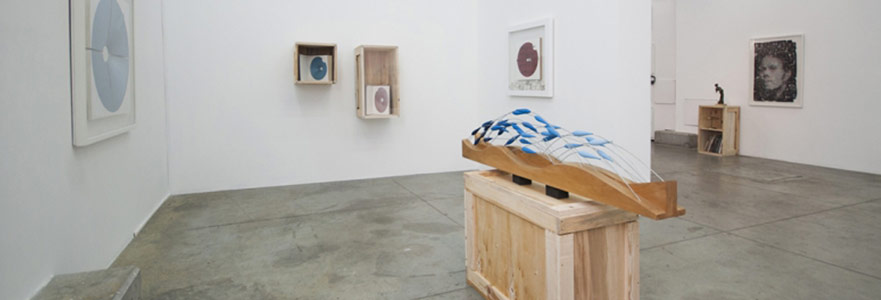
Today, the works do not represent anything anymore, and look like they follow an intrinsic motivation, which leads to an absolute abstract visual expression. Their formal character can be described as being minimal and expressive at the same time. The general form is often reduced to a clear geometrical shape, whereas its inner parts and sections show dozens of lines, which result from the use of many layers out of which the work consists.
SEÇKİN PİRİM has found a way to form his own language out of various strategies of Cubism, Futurism, Minimalism, as well as today’s three dimensional computer graphic and product design. That is why his work looks both familiar and strange. It discusses new aesthetics on the base of known art and design history. In this way, he proposes a way for sculpture to develop new ways of production, which overcome classical reproduction or postmodern eclecticism.
Marcus Graf: Seçkin, in this interview, I would like to take the chance to discuss the history as well as the current state of your work. In one meeting you told me that you regarded your work as becoming mature now. What do you mean?
Seçkin Pirim: When I follow the process from my early works to the present, I see that there is a change and transformation. As I told you, I feel that they are maturing. What I mean by maturing is that, if we think of sculpture as an individual, now I define it as a more down-to-earth person who knows what he wants to tell, who does not speak much and who is calmer now compared to his youth. The change in the works show itself when they see, live, ask questions, is criticised, is favoured - like all else.
But one thing that pleases me during this process of change is that the sculptures made one after another carry some kind of recollection from the previous one. I think this results from approaching the work with sincerity.
Besides becoming mature, you considered this phase of your work as a new beginning. What do you mean and what is new?
I’ve always identified the sculptures I made with my life. Of course this is not something new, many artists do so. My discourses in the previous exhibitions and works were all parts of my life. Certainly you should not take it as a megalomaniacal construction. I’ve always adopted the notion of reaching the unity from single parts. I’ve always believed that my problem could be anyone’s problem from anywhere of life. I think the constructions in my works which consist of units and develop into a unity, emerged accordingly. Also in my latest works I experienced a new beginning, which was in parallel with my life. I made works, which lived life in both ways: one way was slippery, more free whereas the other was organised and it consisted of systematic layers. However, if you say “Never mind life, what was new in terms of the works?”; works that forced its dimensions within its limits emerged. Perhaps –in terms of dimension- I’ve made my biggest works so far in this series. For me, it was new to deal with these technically in the manner of an engineer. The other novelty was colour. Blue, which I’ve been obsessed with for many years, appears again in degrade works; red, which stands for the terms rebelliousness and unruliness, and white that voices a man’s feelings who knows when he should be quiet, joined it...
After all, personally I clarified one of the things that sculptures tackle with most, which is the search for forms. I believe that I solved the problems of my works in plastic terms so that I feel relieved for the next step.

Let us talk a bit about your use of colour in this series. The white ones seem to draw a close relation to classic minimal sculpture, and seem clear and calm. The red ones though, like in your blue ones, relate again stronger to fields like design or machine engineering. How would you describe the role that colour plays in your work?
I think that when I work on abstract works, elements such as colour gain more importance. Because, it is easier for a spectator to form a relation with a figurative work before him/her, whereas it is more difficult to do so with an abstract work. Therefore some features have a part in helping me to from this relation. For me, one of them is colour. When I combine form and colour, what I want to express emerges as more powerful and effective.
How do you choose and decide the colour for your sculptures?
Sometimes I take many details into consideration when I decide on the colour, and sometimes it is solely an emotional decision. However I understood more clearly the importance of colour and that it changes the effect of the work completely, when I made a work of mine in blue and in red. Both of them were the same sculpture, but the feeling they communicated was wholly different. For me, it was similar to the rationale behind Brancusi's making the same work with different materials. As I said earlier, sometimes I look at a work and say "This work can be nothing but blue." with an emotional approach. If I am designing a work for the public space, I think of its relation to the space and I add the data that I collect from the space. And these are effective in the general concept of the sculpture, as well as playing a crucial role in choosing its colour.
You said that your new works forced and challenged the limits of your sculptures. That is why they have become bigger in size. How important is size?
I think that after a while, the desire to make larger scale works rises within me which is “perhaps true for many sculptors". To tell you the truth, I don’t know the internal reason for it. But I think that there were two reasons. One of them was that I thought, due to their forms and layers my recent works would express themselves in a more clear way. Because when the works got smaller, the number of layers that I used had to decrease or the intervals between them had to be much narrower. So, it would not give the impression that I was aiming at. The second reason was – it was a kind of coincidence – that when I was working on this series, I was commissioned to do many site-specific works outdoors. Because of the exterior space, the dimensions of the work had to be increased so that it could show itself and did not get unnoticed.
And coming to the second part of your question, large dimensions are sometimes important, sometimes not. It depends on the structure of the work. There may be a sculpture that fits into your palm, but then it has to be done as such, anyway. If you take it, make it larger and put it in the space, it loses the meaning in the palm of you hand. The work alone decides its dimensions.
With bigger and more complex forms, the difficulty of the design and production of your current work increase. I know that you use digital tolls and the latest industrial technologies to create your sculptures. In that meaning, the borders between artist, designer and engineer start to mingle with each other. What do you say about this?
I think art is in direct proportion to technology. For example, the invention of camera inspired some artists to do something beyond it did and opened up new horizons. Some used it as a tool for their art. Also in contemporary art many artists make use of technology a lot. So, how is this condition applied to the sculptor? Sometimes I encounter this kind of approach from the spectators: “You did not paint it yourself!” or “Did you cut every piece by yourself?”. When they learn that a technician cut it using the laser, I encounter the disappointment on their faces and an attitude that feels like the overall quality of the work decreased slightly. I am not an artist who carves the stone before him/her spontaneously. Someone working in this manner may change or has to change a work completely due to a crack or the direction of a vein in stone during the process of carving. However, this does not apply to me. When I have drawn the work and seen it in the digital medium, the result is certain. It does not undergo any change in any of the stages. I might play with its colour, at most. Since there is a tool called laser in the technology of today – and it does the same work in one day, which would take me one month to finish – it does not seem to be very meaningful to make it by hand. It provides me time and helps me to advance in this field more quickly. Because I can see the results more quickly and then make quick decisions for the next work. At this point where the difference between art and craft appears, I get separated from and the technician or the engineer.
In my latest works technology plays a great role. I draw every stage of it in the digital medium. What does it provide me? I save the sculpture from getting destructed in the process of trial and error applied on the original work. Apart from these technical conditions I am an admirer of technology. I suppose this admiration shows itself both during the production of the sculptures, and also in their forms. When you look at the works, you might see forms that resemble a machine part or a detail from a car.
In his text “Beautiful Machines, Works of Art and a Pendulum” (2007) Emre Zeytinoğlu drew connections between the aesthetic of machines and your sculptures. He underlined that your works created the impression of presenting scientific formulae, without revealing any concrete use or purpose. I think that in your current work, this relation to the beauty of the machine is reduced to a minimum. As the sculptures are now lacking direct references to the reality we live with, I do not see formal connections to a mechanic or constructivist aesthetic. Today, I find them radical, minimal or reduced, abstract.
As you say, for me the starting point of my works had nothing to do with establishing connections between machines or making references to them, however all these readings have always been interesting and meaningful in that I could look at them from a different perspective and think of new beginnings.
I can say that in terms of production and the technique I use, rather than the work’s result, it stands close to the similarities of production process of a machine.
There were some spectators that compared a work of mine called “Huzur Kabini” to a sports car or a boat; however, although the production of a machine and the production of a sculpture follow the same roads, it does not make it a machine. In my latest works, though the process went on in the same manner, we can see that the result emerged in a different way, as you also felt. At the root of my works minimalism is present, which I always stand close to and emulate, and I think that this emulation shows itself even more in my latest sculptures.
Before Emre Zeytinoğlu revealed your early works’ connection to the machine, in 2006, Levent Çalıkoğlu discussed another relation between your sculptures and reality. He exposed that your work was rooted in nature. Indeed, in pieces like “Ben” (2002) you find direct references to nature. Other works like “Son” (2006) relate to phenomena in life. I think that also this connection vanished in your work due to your focus on abstraction.
When Levent did this reading, I held the same opinion during that period of my works. I think that he did readings, which were very close to mine about the works of that period. In my opinion, staying close to nature and reality, and moving towards abstraction are again relevant to my own course of life. Perhaps I can define it better by a comparison: I always prefer t-shirts
and clothes without any indication or writing. This does not allow any prejudices and clues to someone who observes me from afar. I expect him/her to contact me to meet and understand me. Although I make my own readings, there are still some mysterious things left. These are facts that mostly I can understand and complete when I sit down on a table with the artist. If I haven't got the chance to do so; that uncompleted feeling always keeps me in love with the work. For me, abstraction is like a blank t-shirt. The reason which underlies the facts that I approach to abstraction as closely as this and depart from reality is this one.
Discussing a bit more the formal dimensions of your current work, I would like to do a comparison between your earlier works and the present ones. It seems that in contrast to your previous sculptures, in which a serial repetition of elements often dominated the work, now the pieces stand alone, as single, consistent, nonfragmental sculptures. What do you say?
In my previous works, the issue of repetition arised from my practice of reaching to the whole starting from the units. Solo forms both say the same thing while existing within themselves, and also have a role in the construction of the whole; and it manifested itself in the composition freely. This is still prevalent in my recent works, but it is more introverted. Each layer in the works, which I made with layers, is an individual that serves the whole.
Previously, the forms used to spread freely and constitute a unity, now they move in a whole whose contours are drawn. In fact this is the result of the series “Disiplin Fabrikası”. In recent times, we are trying to move according to the contours that are drawn or given to us in life.You can see this in sociological and political perspectives. These works contain the effects of life, which is forced into being compulsory and without options, however the fact that the other surfaces are without layers and slippery, is the war of those who want to live in the opposite way.
Due to your extensive use of serial repetition in your works, you caused dynamism and movement within the sculptures. They had an outward power. Now, the sculptures look more like objects, which are frozen within a movement. They are still standing. What do you think?
Again, I connect this problem to the results of our condition in life. When I look back at the works, which I have created without much thinking and loading into, I realise that the way my life changes is reflected on my sculptures that are also changing. I think this is an instinctive behaviour for an artist. I regard these frozen states as the effect of being able to do nothing for the problems one encounters and being under the obligations of immobility.
In the past, often your works were transparent. Now, they occur to be more solid. What do you say?
One of the reason why transparency was often present in the previous works and also the beginning of this was the exhibition “Olduğum Anlar”. In accordance with the concept, I needed a translucent and transparent material. I met with plexiglass at that time. This exhibition was an exhibition where light was also used and which consisted of only plexiglass works. Then I liked this material very much, and it has always excited me to find out what I can do by pushing the limits of this material. During that period I used it especially as transparent. Afterwards, with the beginning of “Disiplin Fabrikası” colour entered and transparency disappeared. The material is still the same, but it is not transparent any more. This way also in accordance with the concept; it stemmed from my desire to have more clearness, visibility and solidity.
In previous works, except the site-specific commissions, you mainly created sculptures on pedestals, whereas now, they often have a site-specific character, in the way that they melt with the environment, and adopt themselves to space. How do you see the relationship between the sculptures on pedestals and the site-specific works?
A lot of elements occur that demands my attention when doing a site-specific work.Especially in the field of sculpture, this gains more importance. The spectator’s point of view... Such questions as visibility, the relation or non-relation with the space step in. Like David was made with a larger head proportion due to the point of view...
All of these play major roles on the sculpture during the construction stage of the work. Of course, I try not to compromise regarding my artistic and plastic principles, when keeping these in my mind. I think that the works on pedestal are remote regarding the relation between the spectator and the work itself. I am in the opinion that a warmer relationship emerges in works that are made on the space which integrates the spectator.
What role do the exhibition or installation spaces play in your work?
The exhibition spaces are generally the places where I let myself free. As I said earlier, here I can set my own rules. I have got the chance to act more freely, apart from the elements that I have to pay attention to when doing a work for a space. But I’d like to state it clearly that generally after the works I have done for a space, exhibition pieces emerged.
All these problematics made me think constantly, and find alternative paths due to the conditions of a space. I am in the opinion that the site-specific works I have done so far, advanced me artistically and plastically in terms of artistry.
Currently, you use a lot of transparent pedestals, in which the sculpture looks, as if it would melt with the pedestal. Is this a way to overcome the difference between the sculpture and its carrier?
In fact, yes. It is a way I chose in order to separate the work from its pedestal when I had to display it on a pedestal. Traditionally speaking, the pedestal that we use in white, resembles the mat used in order to bring a painting to the foreground, nevertheless it mostly interrupts the work. In order to minimise this condition, I chose a transparent pedestal. Sometimes I have used it by integrating it into the work, and even making it a part of the work. When small-scale works are done, whether you want it or not, and although it is not preferred, one may have no choice but to use a pedestal. But I am still thinking how else I can solve this situation in small works. I suppose there is something which I’m not pleased completely, yet...
How do you see the role of the pedestal?
Honestly speaking, I can say that I received some criticism that my works are not suitable to be displayed on pedestal, nevertheless pedestal is sometimes like the frame of a sculpture. How and in what shape we use it, is important. Sometimes it makes the work disappear, and sometimes it emphasises it. It is like choosing a frame for a painting. I think a logical choice would be for the benefit of the work.
Before, due to their formal relation to nature and design, your works had an aesthetic of the beauty and divine. Some even have a great decorative attitude. Your current work seems to be more intrinsic, by having a self-referential aesthetic like we know it from classic minimal sculpture. What do you say?
I suppose the state of being decorative in sculpture is still a very thin line that is not wholly clear. We can say this for my works which I made with highly aesthetic concerns, plastically. I suppose this may always be a matter and condition for an artist that is in search for forms. I think that this situation ended when, in time, the forms settled and became fulfiling for me, and when I began to think more about the discourse concerning the content of the work. And, as you say, I think that a kind of attitude that puts its aethetic into the form and is close to a minimal sculpture in terms of the complete work, manifests itself.
In the end of our interview, let us talk about your recent work with paper, which is minimal and abstract. Where did you get the idea from and how did you start?
The process of my paper works actually began with a funny thing I did addressing a collector. After a comment from a collector, “I want to buy a sculpture, but I haven’t got any empty space.”, I planned to make a library sculpture and I designed a book. When you look at it, it looks just like a book in a bookcase, but when you open it, you see the forms of the current paper works. Then I added a note inside and gave it to the collector. I made a series of 7 called “7 Günah” using this kind of books. Then I decided to make another version of the same series for the plane of wall. My paper sculptures on the wall began with this “7 Günah” series and thereby I began to work with paper very often. With every work I was discovering new things and this gave me immense pleasure. Currently colour has entered, I have tried new dimensions and used fragmentations. The work “Bir Heykeltıraşın Kütüphanesi”, which consists of approximately 15 books, will be in this exhibition.
How do you relate these paper works to your sculptural oeuvre?
My series of layered works began with my paper works in terms of chronology. Afterwards, the sculptures appeared. While I was working with paper, I was also thinking how I could turn these into forms, how I could make them as sculptures. Because as a person who is engaged in sculpture, when I was doing more painterly works on the plane of wall, the love of three dimension began to intrigue me. This time I tried plexiglass, which I used often, instead of the sheets of paper which I cut as layers and pile onto each other. At first, I did works on the surface of the walls like paper. They looked like the paper works which protruded. Afterwards they came down slowly and turned into sculptures that created their own freedom spaces. In this context, they established close relations regarding their forms and content. They served each other. Each time I discovered something new in the scultures, it showed itself in the paper works. And vice versa...
What do you expect from your future works, and where do you think you artistic journey will lead you? Do you have any upcoming, future or even utopian project ideas?
When I work on a work, a detail that I come by always excites me regarding the next work. Each work has given birth to the following one. Following this exhibition, I have new ideas now. It is not a job for me, it is a way of life... And keeping in mind that I can never get retired, this journey appears to last long. There are many things that I want to create. All my life, I’ve wanted to design a sculptural building and also sculptures in which one can enter and wander. I hope that I will have enough time and opportunities to realise these.
;