Can you tell me about yourself. How did you decide you wanted to be an artist?
I was born in Queens, NY. I originally studied to work in the video games and entertainment industry. I wanted to make commercials or work for Pixar. So my first aesthetic interests were not traditional painters, sculptors, or even video artists, but video game designers and science fiction movies. But rather than pursuing a commercial, entertainment or technical career in 3D modeling, I became more interested in its ability to work in the analogical space of contemporary art, specifically in video art as well as sculpture through 3D printing.
In this ever changing world, do you believe that video art will always remain contemporary?
I think artists have always approached new technologies in exciting ways and have consistently shown everyone else whats possible with those technologies. I operate as video artist, but I don't use video, I use computer animation. But I think the lineage is still there. Iconic video artists like Matthew Barney and Bill Viola were big influences on how I approached my art making, even though my process was completely different. There is so many exciting things happening in video art, look at the work of Hito Steyerl or Takeshi Murata.
Can you tell me about your artwork that is on display at the moving images fair. Your artworks in general? The messages, the material used.., the purpose
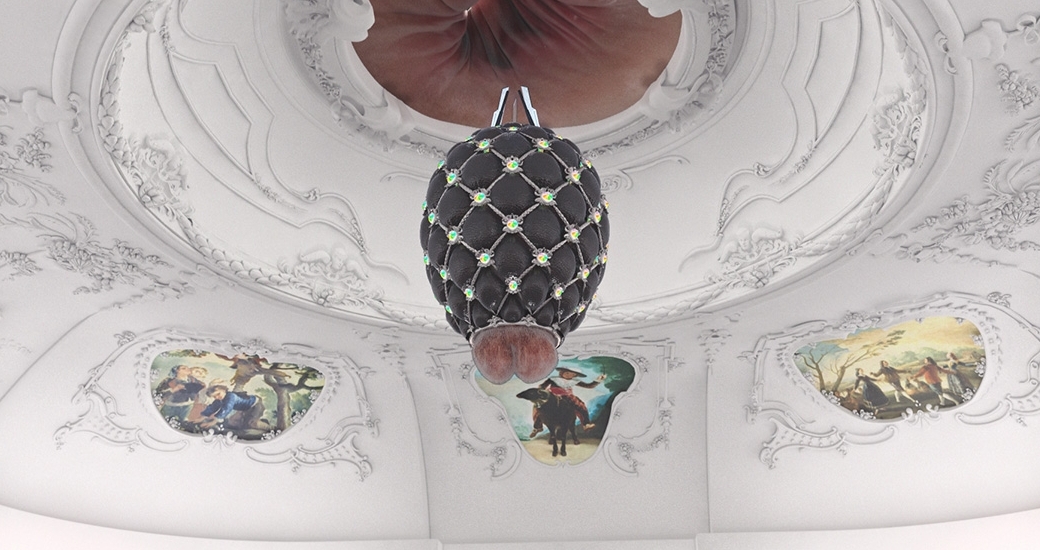
I am exhibiting The Pavilion. It is a seamlessly looping video installation which envisions a fantastical architectural space conflating Baroque architecture, Faberge eggs, human orifices, and a luxurious walk-in closet. There is no beginning or end, it is more like a window onto another world in which a virtual structure continually spawns strange egg-shaped pods. It is kind of a meditation on creation and degradation, suggesting the cyclic nature of power and extravagance.
When you talk about a window that opens into another World, can this be the artist’s World, in other words, your World?
Yes, it is possible to say so.
One of the elements that I have observed in your work was that the walk-in wardrobe was quite tidy and simple. Would you say that this reflects your way of life?
Most certainly, everything in my life is very orderly; in boxes and labeled.
I would like to hear more about this particular work; we are in a very tidy room. The room is tidy to the point of being out of reality. Everything is still but there is a connection with the outer World via the two humongous Windows on both sides of the room. Even though this is a film, for most part of it, there is no action other then the music in the background, we are almost faced with a frozen Picture frame. All of a sudden, very unexpectedly, in the center of the room, one sees a light and a lid opens to give passage to an unrecognizable object that could be resembled to a space ship and/or a big bug. This object has a black Shell that reminds us of the Shell of a bomb, topped with antennas as would have a bug and the bottom of the object is in the shape of an organic part that could be alikened to big lips. This object goes up towards the ceiling in a continous motion and goes out from a lid that opens up and disappears in the sky. Could you please tell us the story that puts together the real and the fiction.
Here exist real and fantastic elements; the fantastic elements are designed to invite the viewer to take him on a journey into his own life and question it. To wake the viewer up, to add mystery to the story ... The spawning action that breaks the monotonous cycle, symbolizes novelty. There is a sense of planned uncertainty. Technology affects us in many ways, but do we become more mechanical with it? There are also historical references here, the paintings on the ceiling, the baroque architecture and the interior design of the room are all references to the past.
Do you think art today cares for the past or the future?
Well for me, I look a lot at the past. I look at dead artists more than contemporary ones. I think its important to contextualize our technology-driven economy and media saturated environments historically, because its easy to get caught up in the notion that our technology somehow makes us new and different than past societies. Ultimately however art always operates in the present.
How would you describe the evolution of new media art in the world. Is it where it should be? Has it fulfilled its ontological purpose ?
I think a lot of young artists today, myself included, don't self-identity as a "new media artist" despite significantly using digital technologies. Perhaps this is because the work is often not primarily about the media or the technology, but rather uses it as a medium to critically examine larger social and cultural issues. I don't think it was ever a very effective term to begin with, and I don't really know what to call whats going on today, if it even needs a name.
How would you define aesthetics when new media art is concerned?
Today its totally Baroque, but with neon rainbows, disco lights and pixelated flesh.
What is the most important feature of your work? What kind of aesthetics do you pursue?
The most important feature of my work would be the logic of the objects and environments I create, as the narrative unfolds through a system of iconic conflation. This system is encased in a sharp, glossy aesthetic, which comes from my background in the commercial field. I have consciously remained complicit in the process—and even imagery—of the commercial applications for computer graphics. From car commercials to architectural renderings, a slick, seductive, pristine sheen persists as a vehicle to unpack a subversive, political, yet still subjective exploration of power, value, and the role of technology.
What kind of messages do you intend to give to the viewers?
The work is designed to maintain an unsettling ambiguity where meanings or messages barely materialize, or are purposefully hidden. As viewers enter my worlds, with its sharpness of a car commercial, with its imagery gleaned from a kind collective cultural databank, and its permeating sense of power and authority, I hope they can gain some critically insights on the apparently seamless condition of our media-saturated lived experience.
Do you believe in the master & slave dialectic of Hegel?
It very logical and makes sense, but I would bet our self-consciousness and the nature of how we interact with each other and manipulate our environment is much more fluid than Hegel's orderly dialectic would have us believe. Perhaps technology has taken over the role of the slave, and is on its way to becoming the self-conscious master.
What kind of power does the viewer have when observing or judging your artwork.
The viewer brings a lot to the experience. The work is filled with iconic elements, from religious iconography to elements from science fiction culture, so there will always be a subjective read of the work, and I like that.
How do you feel about having a work on display in a fair in Istanbul?
Istanbul is quite rich in the sense of icons, that is why I was very happy to have a work on display there and I hope to have another possibility to Show my Works there in the future.
Jonathan defines his work as a ballet of iconic imagery, nothing specific. His aim is to invite the viewers to question who they are and where they are going.
;