Monumentality has been a spatial and symbolic requital of power through history. Considering the vertical and horizontal understandings of space in relation to cities and architecture, 20th century modernism was a movement to reach for the sky. Undoubtedly this understanding was not something new. We also see it in various historical moments and geographies including Babylon, Gothic and Samarra. In “Proposals on Monumentality,” the exhibition you have recently curated, you are focusing on the relationship between monumentality and memory. Yet, this memory is one that is associated with both remembering and forgetting. Monuments certainly are made to remember. So, how does our memory towards them work?
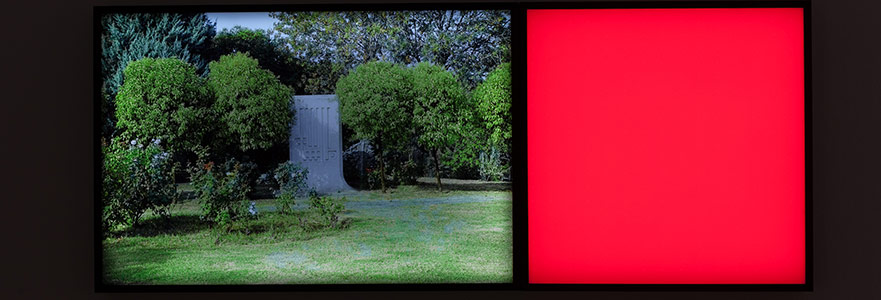
When we look at monuments, architectural structures and various urban contexts today, we see simultaneous processes of construction and destruction. At the first stages of imagining the exhibition, the initial questions we asked were 'What makes a monument ‘monumental’?' 'What kind of experiences, thoughts and feelings do monuments recall?' and 'What kind of social roles do they play?' Then we focused on questions such as "Can monuments go beyond representing the past?' or 'Can they process over forgetting?' Therefore, rather than suggesting a static understanding of monumentality, this exhibition attempts at presenting different perspectives or 'proposals' within the frame of memory, space and power. Concentrating on various histories and locales, the show also questions if monuments can go beyond triggering collective memory and express fragmentation and forgetting as well. For instance, Amina Menia has been photographing monuments that are forgotten and often vandalized in Northern Algeria for her “Chrysanthèmes” (2009-) series. On the other hand, Christian Jankowski in “Heavy Weight History” (2013) questions, in a humorous way, the idea of carrying the weight of history – ‘fighting' or 'challenging’ the complicated pasts as the sports commentator in the video describes it – via portraying a national weightlifter team’s attempts to lift five different monuments in Warsaw. Here, the artist is using the language and tools of media. In her “The Demolition of the Russian Monument at Ayastefanos” (2011) project, Aslı Çavuşoğlu is critically dealing with intentional demolition process of a war memorial in Yeşilköy (previously called Ayastefanos) district of Istanbul in the beginning of 20th century in relation to the documentation of this process and the role images play in history-writing.

The monuments in the works you mention do not get imprisoned in the representation of historical context but rather problematize the state they are in now. We tend to look at history from today’s perspective like these artists who are looking at monuments form a certain distance in their works. It also seems that the temporal distance allows the artists a critical space in which to engage with social questions around monumentality. In Menia's photographs, for example, we observe an urge to ‘record’ or ‘document’ the current state of monuments. Also prevalent in some other works in the show, this idea of recording a certain memory is also related to the questioning the established codes of looking at history. This memory is not stable but moving, or something that has a potential. So did the specific places that the artists come from or are dealing with in their influence your choice or the way you planned the exhibition? Did certain geographies play a role in deciding on the works?
Your note on looking at history from today is quite pertinent. Yet the works in this exhibition tend to jump across past, present and future. While putting the exhibition together, the artists’ conceptual interest in monumentality and the coil of historical, architectural, personal, collective and aesthetic relations around monuments were more determining rather than their geographical engagements. Therefore, the works do not necessarily have the exact same relationship to space and time. For example, Iman Issa’s installation, entitled “Material for a sculpture commemorating a singer whose singing became a source of unity of disparate and often opposing forces” (2010-2012), suggests a new monument by abstracting an already-existing monument in Cairo, which Issa has been familiar since childhood, in its name and structure. Like the other works in her "Material" series, this installation looks at the symbolic values of monuments in conjunction to personal history, memory and language. The artist recreates a monument without revealing its original’s name or location, and removes it from any previous loaded history. On the other hand, in “Conceptual Monument” (2012), Santiago Sierra offers a monument, which will not physically exist, drawing our attention to monuments’ relation to authority. The artist’s 6 Million Euro-budget monument project, initially proposed to “Design Competition for the Leipzig Freedom and Unity Memorial”, was rejected due to its immaterial character. His work can be considered a manifesto imagining Leipzig’s Wilhelm Leuschner Square to be accessed and utilized as a democratic and non-authoritarian space by the public. It acquires different meanings and contexts depending on where it’s shown. For instance, when this work was exhibited in the 13th Istanbul Biennial, it prompted a unique and rather timely discussion of ‘public space’ in the post-Gezi movement period. Certainly in Dubai, where the local perception of monumentality is very much shaped and reshaped by the building of high and flamboyant architectural structures and the constant urban flux, Sierra’s manifesto hopefully will call for potential new meanings or questions.


Having lived in Dubai amidst this monumental architecture for a while now must have been influential on your framing of the exhibition. Your comment on the possible new questions that Sierra's work might raise in this particular urban and cultural context can be projected onto the rest of the works as well. For sure there are eye-opening aspects to looking at monumentality’s various historical, personal, collective and aesthetic contexts with the local context in mind. I think it is also important to remember this year’s Bahrain Pavilion in Venice Architecture Biennial, titled “Fundamentalists and Other Arab Modernisms”. Curated by George Arbid, the pavilion’s spatial arrangement included a visual documentation-themed book focusing on the memory of modern Arabic architecture ranging from Qatar to Syria and from Iraq to Morocco. Located in the Arab world, Dubai with its current urban state can be linked to the global world maybe more than it is to the geographical and cultural codes of the region. In his same-name essay, Bilal Khebeiz described Dubai as “a city manufactured by curiosity”. What are your ideas on the city as someone who is currently living there?
During the exhibition’s ideation, we have thought quite a bit about its relationship to the city it would be held in. After we started planning the show, Dubai was announced the host city for Expo 2020, greeted with joy. This news can be and was interpreted as a prologue to the building of many more structures, such as Burj Khalifa and Burj Al Arab that quickly became the symbol of Dubai that Khebeiz mentions as well. The perception of 'monumentality' here is very much driven by size and representation of power. Designed by 'starchitects', many museum and cultural institutions such as Guggenheim Abu Dhabi, Louvre Abu Dhabi and Abu Dhabi Performing Arts Center, planned for Saadiyat Island in the neighbouring Abu Dhabi, for example, can be all placed within this frame. Similar architectural approaches can be traced in places like Qatar, Kuwait and Saudi Arabia. All these grand projects can be analysed in light of Khbeiz’s remarks on Gulf's passion for monumentality. It is thus crucial to explore the kind of experiences and memories that these monument-institutions will prompt in the future. On the other hand, currently the constant construction of new buildings trigger a sense of placelessness and oblivion in places we live in. Especially in our fast-changing world, it is quite important to remember and imagine Sierra’s statements on people’s full competency over a public square and the conceptual quality of the monument suggesting it will not be physically or architecturally realized. Also, Seher Shah’s series, entitled “Mammoth: Aerial Landscape Proposals” (2012) has much relevance. Like Sierra, she draws on the idea of non-physical monumentality. By making various formal interventions into her partner Randhir Singh's landscape photographs, she erases some parts and locates black objects in some others. The simultaneity of image erasing and adding processes along with her unique abstraction open up new spaces of memory in these landscapes, exploring the complex relationship between remembering and forgetting.

;