You have had your education in Sculpture Department of Eskişehir Anadolu University and Mimar Sinan School of Fine Arts, and later in post-conceptual art practice in Academy of Fine Arts Vienna. There exist a variety in your works due to having your education in schools with different approaches and academic traditions. First traditional understanding of sculpture, and then gradually going towards an art without material, in which the meaning of sculpture expands, the classifications are reduced... Would you like to tell us how did you live these transformation during your education, which you have recently completed?
I think I chose this education since it would take me to this level. Sculpture education definitely gave me a lot of things; but I have also spent my time rejecting this period due to my will to go beyond the borders of this education. In other words, it united me with rather a different and out of discipline practice by being a big example to what I want to do as well as what I don't want to do. In simpler words, my need to have a work space is actually what kept me in sculpture ateliers. At the end of the day, I chose not to have one discipline as basis.
Sculpture led me to all forms rather then the ones that is somehow characterized as sculpture. Later on I went towards kind of works, which are open-ended and its process somehow continues rather than a practice that I do know what I is going to come out in the end. I can say that the intervention performance started like that. If we formulize it: I transformed from sculpture to what is not sculpture and from there I went on to the one with continuity and then to an area, where the material is a medium. The time I spent in the Academy in Vienna was completely different. The education I had there was more theoretical. It was an art education without a material, and on activism and politics. This period clinched my tendency towards an art without material.
'The Venus of Willendorf' (2014) is an intervention / performance related to Willendorf sculpture in Vienna Natural History Museum which you have realized without any permissions and make fun of west centred, patriarchal history writing. You print the explanation text that you have written, in a pamphlet form and stick them to the explanation sticker of the sculpture. After this one, you have realized another performance in Beşiktaş market, where you were personally selling underwear with Willendorf Venus figure printed on: 'Venus in Besiktaş' (2014) This work is now in a sound installation form. Your motivation in the first performance arouses curiosity as well as the one-to-one dialogues you had with people in Beşiktaş based on this. What was your basic motivation in the beginning and in what kind of an experience did it involve in the public market?
The intervention / performance in Vienna started with the idea that it is necessary to create a breakage in history writing. A fracture in the flow of information, which is accepted unconditionally. Imitating a classical museum text and pamphlet, I mentioned that Venus of Willendorf is actually an erotic figure with the way she was standing and the type of her body. Female body attributed to fertility with the patriarchal history writing; yet I mentioned that Venus sculpture in fact represents the confidence to her body as a female. I collected these new printed museum pamphlets, which were approximately 200 in number, in a box and placed it on the booth of sculpture exhibited in the museum. I realized these kind of guerilla performances since the result is ambiguous, the continuity of the process and with a desire for information transfer. This is knowledge that the spectator will or will not see coincidentally... I thought, I would improve my practice besides the explicit and planned works; I tried an angle that is open-ended and the knowledge transfer is faster.
Istanbul was a completely different experience. I wanted to carry on with the project and I was thinking about the difference in between two cities when I came to Istanbul. After the museum city tone of Vienna, I thought people were what was representing Istanbul: A lot of people with great diversity. In other words, there was an environment, where I could have spoken about this matter spontaneously. I printed the picture of Venus sculpture onto underwear and realized the sales in Beşiktaş market. I had a quick word with the people in the market -especially the females- on Venus, female body and femininity. I did some sound recording with a couple of videos... This project started with a curiosity. My aim was not to inform a deceleration; but rather to tell my idea and get some idea. I was wondering. The results were unbelievably diverse and interesting. The conversations were rather different and surprising than I expected. Having its documentation prolongs the process in the name of comments and talks over the project.

Your solo exhibition, which is going to be held next month (January 2015) in Alan Istanbul and is going to include differenet materials such as video, photography, cabinet as an architectural element, installatio, is again about history writing. Yet this time you are getting ready for a more comprehensive set up. Would you like to mention what kind of an approach did you develop this time, without ruining its magic before it is opened?
After two years of off-space projects, this exhibition is possibly going to be the collection and the result of the issues I have been working on for a long time. I am in the role of being a historian in this project. I am trying to explain how history is written as a sarcastic and amateur historian. I am looking at the history as a whole rather than a part of it or an incident that occurred. How is history written? How do I look at history writing? How do I unite history writing with my own practice? I am using the similarities that I have found in between the history writing method and my own practice. I connect so many and various mediums in one space. These pieces also do connect with a big installation that is covering the space in its full extent and also effecting the pieces. I am going to correlate the movement of audience in the space and perception of space with the history writing in this installation, which is going to change the space of the spectator and their style of spectating an exhibition.

Whatever the material and method are: sculpture, installation, performance / intervention... Most of your works have got a sight-specific side that have a one-to-one relationship with the produced area or the area it occupies. Why does the context of space have got so much importance for you?
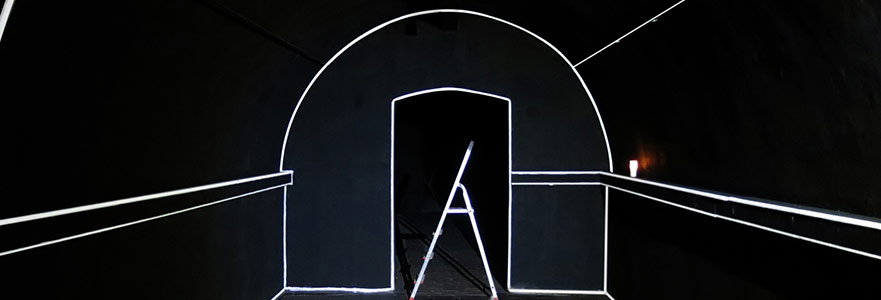
I think I have a way to approach space like Boris Vian. I want the space integrate with the works even if it is an intervention or gallery exhibition. Because I percept and think about the works with venues. Frankly, we all percept everything with the space. A space changes according to our perception and the way we perceive it. I aim to have the content or the shape of space with the work. I work like this even if it is a private or a public space. I don't use the space only physically or formally.. I also find it important to work with its structure as content of space.
Vienna Natural History Museum, Bernardine Monastry in Lviv etc. are also formed of projects I used space. I, at least, connect the works structurally with the space when the space is stable in content like in galleries I love associating the space with the something like an installation integrated with the wall or covering the whole space. They are all one - that is what I think.
The sculpture installation series called 'Sözün Görüntüsü (Vision of Expression)' and 'Gördüm (I Saw)', which you have made several years ago, are works that play with words and graphic images and visually grabbing the person totally. The language you make by re-producing the forms and symbols that are accustomed with, in different contexts and unexpected forms, shows your dominance in conceptual sculpture. The humorous language that you set with these works, do in fact shows itself in the subject matters, which are interested now.
Yes, they both were quite different projects. But, they show similarities in dimensionality, space and the effects that they have left on spectators, which you have explained pretty well... The works here reach an end result by connecting with the perception of spectator. They again had information; they were the works with a footnote. And these footnotes are increasing in every project. Projects change fast. They are all different from one another: both as form and as in content... But the humorous language that you have mentioned, I suppose remains either directly or indirectly. This humorous language can also show itself as structure as well.
;