What is happening in the building? Is there a renovation going on? From what I heard, the Empire Project is moving out and this building is becoming a hotel. Everything from the past is being demolished.
I have a totally different Istanbul in my head. My Istanbul is the Istanbul of the early 1970s. I am afraid I also started to be engulfed by nostalgia. “When I was a child, it used to be…”, “The streets in my time…” I tend to say such things more often. I have moved away many times and Istanbul has always drawn me back. I spent a lot of time racking my brain trying to define my relationship to Istanbul and finally one day I understood what kind of a relationship it is. It is like the love of a teenager for a young woman in their neighborhood, who keeps having rough, bullying boyfriends, who might be poets as well.
Our joys and pleasures are dying down. Unfortunately this is not the case only in Istanbul, but cities like New York and Paris also suffer from the same problem. A global amnesia is at stake. A sterile world that bears no trace of our own is being created.
We are becoming part of a whole. When it comes to art, people tend to engage with a piece of art, whether it is a painting, photograph, drawing, poem, play, music or a dance piece, only at a superficial level. All kinds of art are being made at increasingly lower standards. In a place where superficiality reigns, we find ourselves as a foolish Don Quixote who keeps fighting – because art is worth it - despite the enormity of the chaos we are in.
Can you observe such superficiality in the art market as well?
Art used to be a practice of people who only did what they loved to do with no support or financial security. As a result of economic growth, it now started to be embraced by those who see it as a great market. A rapid change took place without any consideration for necessary infrastructures.
Now with the current crisis, everyone is discontent. In my opinion nothing major will happen. Artists will continue to make art. No one will worry whether there is any gallery or not. Since my father is an artist, my approach to these issues is a bit different than that of my colleagues. Maybe I have a different mission because of that. I am always after artists that I believe in and whom I think needs to be supported; always trying to follow high quality works without prioritizing commercial concerns. This approach inevitably establishes a certain identity.
I am fighting for something important and sacred, something that I truly believe in. Art might be a decorative element for many people, but for me it is much more than that. In a country where thought can still be a crime, art is a very important tool to express all the things we cannot say. It is a breathing space that can get through prejudices. For that reason, when I was opening the x-ist gallery, the main question I asked myself was “what is needed?”
Shall we talk a little bit about the foundation of x-ist? What was its main objective?
These days, people tend think the primary task of a gallery is to focus on the needs of its customers. For me that was not the case. My priority was always the artist. I approached my work almost as a collector, I felt excitement and jealously at the same time. Rather than having any materialistic objectives, I wanted to address a need. In a place where young artists do not get enough support, it was very important to have an establishment like x-ist.
When my gallery co-partner Daryo Beskinazi came to me and said “Kerimcan I want to establish a gallery”, I had no interest in a gallery that would present the works of my uncles and aunts. Those kind of galleries already existed. I wanted to do something that would fill a gap, to create a space for young artists to develop their work in a healthy and comfortable environment. I cared about young and productive Turkish artists and after some time we have seen how correct this initial intuition was.
And the Empire Project followed that…
Yes. With the Empire Project, using the words Turkey and Turkish started to feel awkward. The Ottoman past and where we actually come from are intriguing subjects.
The fact that I have worked for the exhibition “Farewell My Homeland – Anatolia: a History of 150 Years of Migration in Photographs”, which was organized with the support of the Rockefeller Foundation and the European Union, helped me trace back my own story. Being Turkish involves being part of a multilayered cultural context.
How do you define Turkish art then?
The phrase “Turkish art” doesn’t sound right. Balkan, Cherkes, Laz, Georgian, Zaza, etc. Asian art market is considered to be the second biggest market after the European market. In that larger picture, it is not possible to explain the Turkish context on its own. The Balkans, North Africa, everywhere that the Ottomans have gone and left booby traps are starting points for us.
Defining Turkish identity without taking into consideration these complex relations deprives it of its multicultural nature. These thoughts formed the intellectual background for a new gallery structure, which is the Empire Project. It almost came like a revelation. That was it! I knew people would misread it. They think I have established an empire.
I have seen you listening to Tolkien’s audio books. Does fantastic literature shape how you view artists and their works?
The first great book for me was Frank Herbert’s Dune. There are books that I re-read every 7-8 years. Merlin, King Arthur, Italio Calvino, and Notes from the Midnight Driver are some of the authors and books that I love.
You have made a radio program about fine arts on Açık Radyo. Could you please talk about that experience?
Daryo’s enthusiasm initiated that program on Açık Radyo. I do think it was the first of its kind. We made 52 programs, the recordings of which have all disappeared. We talked about art throughout 2005. I had a love and hate relationship with Dario. We were continuously messing with each other. What we were doing at the time was so right but also very enjoyable. Actually I find it important to open up the stage and show behind the scenes. We communicate with the public at very superficial levels. When things get serious in the art field, intimacy disappears. Going into a gallery has almost become an act of taking sides. Artists are being splint amongst galleries. People are coming together only at openings and funerals.
And yet, the gallery is the most important site after the artist’s studio. It needs to be safe and cozy, but also a place where one can confront oneself. Almost like unexpectedly seeing your own reflection while walking on the street. The gallery helps the artist to look at his or her work at a distance.
What do you think of art practice in Turkey?
The art scene in Turkey has gone through very painful periods. In the 1960s, the country couldn’t yet find its identity. No words could describe the poverty of the country’s political and cultural infrastructures. We are talking about an art that had no precedents, that was lost. We still don’t have enough cultural centers, museums, and archives, they are still insufficient. People started to discuss SALT. I find an institution like SALT so essential. Archiving creates a memory. There are still a lot of things to do from that point of view. We are really at the start of everything.
From the point of view of young artists this is actually a very fortunate time. But it is necessary to be realistic. There is a generation of young impatient artists. They think they will immediately be gallery artists, reveal which side they choose, and make sold-out exhibitions. An artist believes in his art but struggles to make a living until he or she is fifty. Those as the likes of Damien Hirst, Tracey Emin, Saatchi Gallery reached some top positions as a result of big marketing campaigns. Young artists have similar expectations. While there are many gaps in other aspects of their practice, they want to have access to the White Cube at once. But infrastructure is very important.
In that sense, the impatience of artists and as a consequence their inability to resist against the speculative buyers in the art market sabotage their own career and future.
The art market is experiencing a difficult time in a context where prices are reduced 20, 30, and even 40 per cent because lack of sales. The market consists of buyers with no refined taste, who wouldn’t want to buy any figurative painting at all. On the other hand, the state officials say they envisage the development of conservative art. These are funny times and our fight will be a long one.
How did your path cross with Jasper de Beijer?
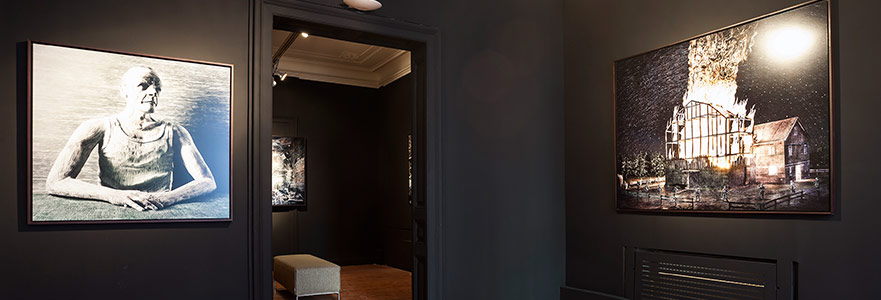
Empire Project opened with an exhibition of Jasper de Beijer in 2011. It has been four years since then. Jasper was working on some of the issues that I also wanted question. Questioning the position of an individual within an empire. As a Dutch artist, he feels the predicament of his nation. The Netherlands has some similarities with the Ottoman Empire, but when you say to a Dutch person that their country is also an empire, you get an interesting reaction. They don’t recognize the Netherlands as an empire. Their practice of work, exploitation, and what they do in Indonesia are actions of pure capitalism. In that sense they view the notion of “empire” from a completely different perspective. How can we explore this notion from our local context through the Ottoman experience?
Jasper’s first exhibition was about the dealings of the Netherlands in Indonesia. He tells a different story. “We are the memory” is about Germany’s confrontation with its past, the 1st and the 2nd World Wars, great bombardments and the disappearance of architecture that embodies memory, as well as questioning of memory that embodies a dystopian future. I was impressed with Jasper’s productivity and interrogations from the moment I encountered his work. I even felt a strong jealousy when I first saw his work in Miami in 2008.
This year, after his exhibition “Mr. Knight’s World Band Receiver” at the Empire Project, a selection from his five different series of works will be shown at 42 Maslak Art!SPACE until the end of March. In his work, Jasper creates a dream world while questioning historical facts at the same time. He takes the audience to an adventurous journey from Europe to Africa.
What do you think of presenting Jasper De Beijer’s work at 42 Maslak Art!SPACE?
Zeynep Salman and Marcus Graf had another project previously, which they realized with the support of another corporation. Our paths crossed at that time.
Zeynep also has a gallery experience. She has worked for Gallery Apel in Ankara for many years. Her approach and sincerity got me very excited, made me feel hopeful and supported. Their aim is to create a space for art and a centre of attraction at 42 Maslak. Their project sounds very reasonable to me as it is intending to establish a healthy environment for art. That requires positive criticism rather than simply appreciating it as a great initiative.
Maslak is becoming a centre for art. There is also the Elgiz Museum, which hosts a private collection. Such initiatives will create a valuable point of attraction. Currently the institutions that support art and the infrastructures that could promote such endeavors are very weak. In this context my task is to offer support with a sincere, constructive approach.
It is great to operate across Istanbul’s various neighborhoods. I have a desire to organize traveling exhibitions. But not with a top-down attitude, there can be ways to show art with greater sincerity and concern for reaching local residents. That is absolutely necessary.
There are possibilities for that, but it needs the dedication of people. However, currently the first step is to provide additional support for a gallery. Art!SPACE is very important in that sense.
Galleries are trying to do their best under very difficult conditions. The number of gallery visitors is decreasing. People’s enthusiasm and eagerness are fading away. So it is important to provide new opportunities and spaces for art. Artful Living is also creating another platform which I find very important for the current state of art in Turkey. Until now the fundamental problem in art criticism was the shortage of young writers and institutions to support them. Artful Living promises to fill that gap. Such initiatives are invaluable, necessary and important.
;