ÖNCEKİ
16 HAZİRAN, PAZARTESİ, 2014
SONRAKİ
If you go back and think about plastic arts, what are the first thing that comes to your mind?
I used to paint. I was seriously interested in painting and I used to love painting. I have seen this habit from my mother. Surely having classical works of art such as Hoca Ali Rıza's on the walls of my home also had a big impact. I used to go quite close to those paintings and draw a detail of it without realizing that I was doing a modern work. When you take two-centimetre area and draw an enlarged version of it, then surely you end up with completely different details. When I showed it to my parents and when they ask "What on earth is that?", then I use to explain as it was a detail hidden in the tableaux on the wall. They didn't see the hidden in there. There were so many people, who didn't understand what I was doing or drawing.
So your characteristic of being detailed goes back to your childhood...
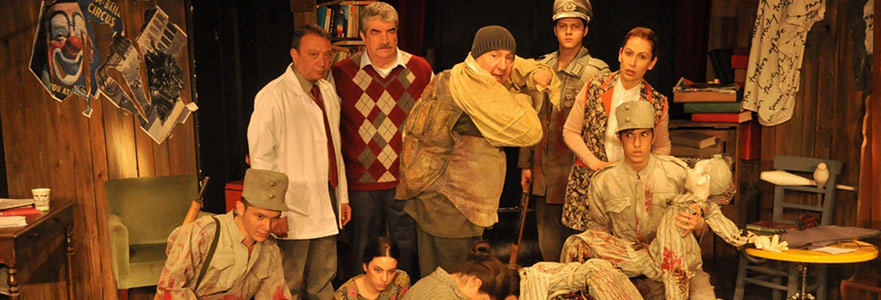
Yes. I drew and painted for a long time. But then I drifted away. I had acting in my life. I started to deisgn sets rather than painting. You need to use drawing to do so anyway. I still do. For instance I designed the set for our last play 'Kaplumbağa (Tortoise)'. Specifically the directors need to be related to drawing, pattern and painting. They need to have tough wrists.
When you were a child, you made drawing inspired by the works of people like Hoca Ali Rıza. So did you visit exhibitions or museums in your youth? What kind of artefacts used to impress you the most?
I used to be a child, who grew up in art and be in serious contact with every branch of it and get influenced from them. Opera, ballet, painting, sculpture... Those were the primal elements of my life. Surely I used to visit museums and galleries. I love classical painting a lot. When I was in my 20s, I used to have a German friend who was in art education. That friend introduced me to modern painting. I saw the paintings of Willem de Kooning and Picasso in the books he gave me as a gift and I loved them. For example, Van Gogh impressed me in a gallery visit during a Europe trip. I was quite impressed when I first saw Adnan Çoker in art galleries in Beyoğlu. It was the same with Bedri Rahmi Eyüboğlu. When I was working as a trainee in city theatres, I witnessed talks on painting a lot of times. Stage designers like Turgut Atalay were also from Academy; they were artists. They all were individual stage painters. I learned a lot from them. It is hard to comprehend theatre without comprehending painting.
The person, who feels what kinf of a picture he/she is in on stage and constantly live that picture in his mind, is called an actor/actress. The director is the person, who transfers the verbal material on paper into a visual material. The visual language used on stage is directly related to painting.
What kind of effects did the works of the names you mentioned -Willem de Kooning, Adnan Çoker or Bedri Rahmi Eyüboğlu- on you? How did that reflect to your art?
Their approach was determining. Bedri Rahmi's efforts to go from local to universal and Adnan Çoker's references from the universal to the spirit of the local were important. Ferruh Başağa used to have big effect on me. I used to be friends with Ömer Uluç. I find the works of Ömer quite mind opening. We were interested in anything as young theatre artists. Painting, sculpture, cinema, opera... We were not one those tv show young actors. We were different. We were nourished from everything. For example when you are reading a book, you constantly draw pictures in your mind. The same when you are listening to music...
So how did these kinds of nourishments effect your work?
I worked with a lot of painters. For example, Turhan Selçuk made the stage design and the sketches of your play ‘Gözlerimi Kaparım Vazifemi Yaparım (I Close My Eyes and Do My Duty)’.
Was it a common thing to work like you did in that period in Istanbul or in Turkey?
No. You wouldn't be able to reach anyway... The director of my theatre was Handan Selçuk, who was the wife of Turhan Selçuk. We did this collaborative work by this means. Turhan Selçuk is a very important artist and man of ideas. The different periods of changing face of Turkey and Istanbul had to be reflected on the wall and Turhan Selçuk's caricatures were going to reflect this the best. I still have those 60 caricatures. Turhan Selçuk, Haldun Taner and I worked together. The play written by Haldun Taner was designed with a different concept. He turned the play into a comic book. We worked with Gürel Yontan, who makes modern designs and sculptures, and our famous artist Mehmet Güleryüz in the play ‘Hoşçakal İstanbul (Goodbye Istanbul)’. We were already doing the works, which are now named as installation.
Do you visit exhibitions, galleries in order to nourish yourself?
I follow the new exhibitions as much as I can. I especially like the exhibitions of painter and sculptor Çağdaş Erçelik, who did our stage design of our play called 'Beni Yeniden Sev (Love Me Again)'. There are glass works in the new opened exhibition in Lüsyen Arkas museum in İzmir. The works from famous artists like Galle, Daum, Lalique and I liked them. When you visit exhibitions like that, your work unavoidably gets effected. I also have a personal collection. I have been buying painting for the last 30 years. I can't afford it lately since they got very expensive. The collection contains foreign impressionist and Turkish modern works. I also have a 200-piece puppet collection involving puppets from 18th century until now from Ottoman to Turkey.
You did the stage design ofyour plays such as 'Kobay (Guinea Pig)', ‘Ben Eskiden Küçüktüm (I Once Was A Child)’, ‘Hoşçakal İstanbul (Goodbye Istanbul)’. We also see that you designed your last play 'Kaplumbağa (Tortoise)' as well. There are both puppets and video art.
Both of them appeared as the presentation style of the play slowly emerged. Video art was a necessity. A selection was made out of 200-300 videotapes and we also did some shootings. We installed puppets in the play that takes place in a circus of violence, since the Tortoise sees the images of people, who died in political unrest and prison camps.
Have you ever used video art before?
No; I didn't. I used puppets and dance before; but not video art.
What kind of an effect did it create?
Everyone says that 'cheesy comedies sell; nobody wants to go and see this kind of serious works'; but we had a full house in all our performances.
;