How do you guys know each other? Did you decide to apply Mamut all together?
Evren: All of us were graduated from Marmara Fine Arts Faculty. After the academy, we worked together for a while and did group shows together.
Serkan: Evren was planning to apply to Mamut and told us to do so.
Evren: I saw on Artful Living that its deadline was extended and I told my friends immediately. I was tempted when I learned who was going to be on the jury, and I wanted to show them my portfolio.
All of you took part in a few group exhibitions before and some of you even worked with galleries as well. What expectations did you have while applying to Mamut, did it meet your expectations?
Serkan: Every gallery works differently with artists. Sometimes you don’t want to work with them in their terms and conditions. Mamut came along that time, when we did not want to work with galleries but wanted to show ourselves on different platforms such as independent group shows.
Evren: All of us had solo shows before and participated in group exhibitions. However it’s also a good thing to be a part of this kind of an exhibition. It is very different than what we were used to. The thing I like the most about Mamut is, the selection of the artists was made by a jury that includes a wide range of art professionals with different backgrounds, such as artists, art writers and collectors. That makes the whole selection process a lot more democratic and objective. Most group shows are made from a single curator’s point of view. We need to get more feedback from all parts. Also Mamut is a new alternative to the other two contemporary art fairs in Istanbul and it presents a qualified selection of young and emerging artists.
Meliha: Also I would say that with the help of Mamut, a lot more people had a chance to know about independent artists like us. People started to notice young artists.
Did you feel like anything was missing regarding the organization?
Serkan: To be honest, I didn’t feel like anything was missing. The reception, the presentation, the people who visited the fair and the general audience, all of them were very satisfying. Dealing with almost fifty-five artists one-by-one and doing it all in three to four days are almost impossible. I think they managed it pretty well.
Evren: Working with Mamut’s young and talented crew helped the whole thing run in a very good way, without any hierarchy. I enjoyed having genuine conversations with people. It wasn’t missing anything, but I would suggest them to hold a separate reception for only the participating artists and Mamut crew, so that they can get to know each other. Besides that the whole thing was very successful.
Your current exhibition entitled as “Red Line” is on view at Bozlu Art Project nowadays. Can you tell us a bit about this experience?
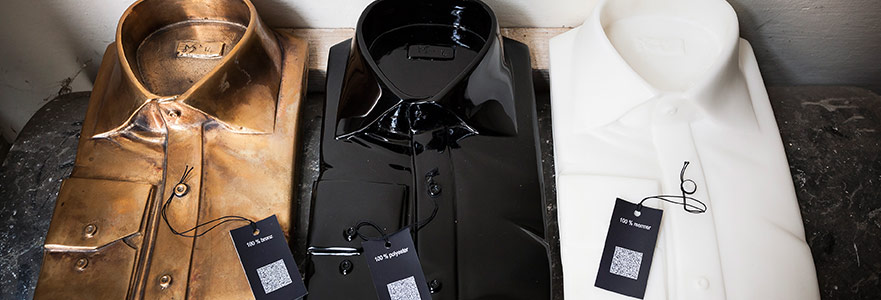
Evren: The owners of the gallery were already familiar with my work, even before Mamut, but seeing there again might helped with the decision. First, we worked on a group exhibition together and after that they offered me a solo show. “Red Line” brings together a group of sculptures that I work on for almost two years. The exhibition was opened on the 26th of February. It was a pleasant experience and all of the works were produced in the last six months. The works I showed at Mamut were the first examples of that series. Before that, I used to work only with wood. Later I wanted to use polyester too and I showed the results of these experiments at Mamut. It was a nice experience, I got positive feedbacks.
What does a ‘red line’ mean to you?
Evren: I use the term ‘red line’ as a metaphor outside of its related political or militarized meanings. It applies to all components of life. I investigate the right to deny any kind of sociological, cultural and psychological schemes that are imposed to animals, to plants, to nature and to people. I want to investigate the intrusive situations of this life and show that the reality is not unchangeable. We act in a hostile way even when we try to show our love to nature. I mention this kind of paradoxical situations in my work.
In your sculptures, we can see those limitations turn into something else and different traditions come together. How do you do it?
Evren: It starts with sketching the design. Then I start playing with the medium. The design does not have to do with anything in particular, sometimes they take an abstract form. I like to create those organic forms out of geometrical shapes. When I bring a traditional material along with a modern one, it allows me to create an alternative narrative helping the viewer read the artwork in many different ways.
In your last series, you use polyester and wood together and that allows you to create a new dialogue between these two different mediums.
Evren: Yes, I was trying to bring these two different mediums together for a long time. One is a synthetic and artificial material, and the other one is natural. In fact, since these materials are related to those concepts, I wanted to bring them together. In the end sometimes eclectic but unnatural results appear. However when the forms fit, you can show the concepts of inwardness-outwardness very well. In my works, sometimes you see a naturally formed wooden structure coming out of a synthetic material, sometimes it is the opposite.
Do you prefer to call yourselves sculptors?
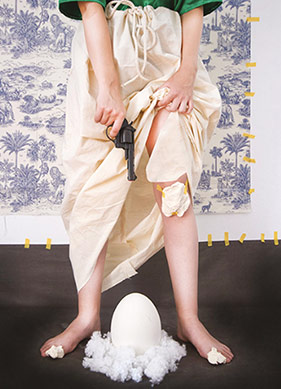
Serkan: To be honest, I don’t call myself a sculptor. I’m not a painter either, I can start working with any kind of medium out of the blue. I can say that I’m in love with making art. I like working interdisciplinary. My solo show may consist of paintings as well as a sculpture, video or a photograph. I usually start creating from concepts. Then I choose the medium according to that.
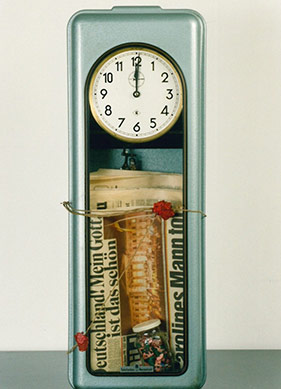
Meliha: I don’t call myself a sculptor either. However, I use the language of that discipline. Both the spatial setup and the medium of my works grow out of that language. In my last works, I use metal wires and their shadows to include the space more into my artwork. That’s why you get to see a 2-dimensional piece on the wall when you just look at the shadows but when you look at the work itself, it is a sculpture. Additionally, it creates a cinematographic effect when you are totally immersed with the work. I don’t think ‘being a sculptor’ is enough in the contemporary setting.
Especially in your latest works, you investigate the relation between light and shadow, matter and non-matter. Were these dualities always a part of your artistic practice?
Meliha: I try to use the best material that is related the concept of my work. Last year at Mamut Art Fair, I showed a series of works entitled as “upside down”. In those three pieces, I mostly used stone and bronze. For example, while I use the polished side of the stone in one work, I used the rusted side in the other one. The series had two names: “upside down” and “umbra light”. The name also suggested the formal relation between light and shadow in a sculpture, as well as the contrast between social classes as a concept. The pieces I work on nowadays (“Resistance Objects”) came after the Gezi uprising. Although I worked with the concept of being transparent before, this time I get the chance to delve into it deeply. That’s why I chose to use metal wires, the concept of transparency led me there. I cut and stitch them together, instead of sculpting.
;