How did Hush Gallery form? What kind of experience is to manage an art gallery in Kadıköy?
İbrahim Gürman: We started as Hush Gallery in 2009. That was my last year as a student in Art Management Department. We have found a place with my friends and decided to make a hostel. The ground floor of the building looked appropriate for a gallery. Thus the idea to blend two things emerged. It was really amateur; I was a student and I had no idea of being a gallerist. First we have started with photography exhibition since we were a hostel; yet now we exhibit examples of contemporary art. The gallery has found audience over the time. The gallery reached to different level as our experience grew and started to get to the point, where it is now. However, Kadıköy is a place out of art market centers as well as mass tourism districts. Therefore, we moved on by getting position according to these conditions. We moved on from our local values and focused on introducing them. We couldn't have any success on sales for a long time. We have formed a sponsorship mechanism within this structure that we have created as hostel and gallery, in order to survive. We sponsored ourselves. We made a one year gap to gallery after being active for four years in Bahariye. Now we continue in Yeldeğirmeni.
Bilge Ertem Gürman: We have both an exhibition area and an office in our new place. We have exhibitions changing in every 1,5 or 2 months periods. We exhibit the one or two works of artists, whom we are in touch with, in this open space, which we use as office as well. We keep their records. We aim to develop the accessible art concept with "Open Space" area.
How did the dynamism in Yeldeğirmeni start?
İ.G.: Yeldeğirmeni was being perceived as unfavourable even for the residents of Kadıköy. The city is a changing concept. People, on the other hand, do have requests from the city like cafés or places that they can spend some time. Some opportunities were presented here for the people. Some came out with a request for culture. New galleries and ateliers were started to open. The municipality bought the wrecked church on our street and made it an arts center by renovating it according to its original.
B.E.G.: I have been here since October 2013 and a change happened according to my observations. Artist ateliers, Mural İstanbul, TAK (Design Atelier Kadıköy) and Don Kişot are effective in this matter. There was a resistance here as well during Gezi Resistance. Opening of Don Kişot here as a pioneer and Yeldeğirmeni solidarity being an active solidarity were also important in this manner. I think our gallery has got a breathing space in this district; because there is a communion and solidarity here. Also, Yeldeğirmeni is a place, in which one of the oldest apartment building project was lived, and it is open to different cultures.
İ.G.: The existence of Hostel on this street has created a big change. English expressions in the workplaces has started to increase and the relationship of districts' residents have started to develop. Since Erasmus students were staying in the Hostel, they rented flats and started to live in this area after a while. There appeared many people here renting their flats for students. Thus the appearance of district has started to change.
Has any other galleries rather than yours opened?
B.E.G.: Nur Bardakçı was opened a gallery named "Bi' Atelier". A multi-diciplined production atelier named "İskele 47" was opened. Some of the ateliers made themselves suitable to exhibit works. For instance, Periferi Collective formed a space, in which you can go in any time of the day, have a chat and witness their productions.
Is there a support from local government?
B.E.G.: There is no concrete support of municipality. Meetings with Yeldeğirmeni ateliers were held and we attended those. A collective event were thought; it hasn't been realized yet.
İ.G.: The municipality wanted to make an organization, in which ateliers were going to take place. It separated a budget for that; but it did not work. When there is so many ateliers, then it is harder to move. We are talking about almost 100 ateliers. In fact they made a concrete effort with this; but it didn't last.
These kinds of attempts of municipality can be perceived as creating a long term income. The first reaction of people in Tophane was related to this. The facts like rents would be getting higher and these kind of place would be opened in the area caused problems. There is nothing as such over here; but some of the ateliers are quite sensitive about this. Our rent is also quite different now when compared to our first rent; but the city is developing. The important thing is that this development has the character of involving everyone and everybody taking their part in this change.
I believe that residents over here have rather a more open point of view when compared to Tophane.
B.E.G.: Definitely. There is a serious sociological problem there. On the other hand, strong neighbourhood relations, good communication and the existence of different cultures become prominent here.
İ.G.: Here is a place, which has been containing different cultures for a long time. For instance, Sephardi Jews from Spain who has come during the Ottoman times, settled here. This cultural richness is seen quite clearly. This new transformation here is not as harsh as in Tarlabaşı. It is rather a renovation work carried jointly out with the public.
How is dynamism in Yeldeğirmeni in the contemporary art area viewed as?
İ.G.: Everybody is aware that there is something going on here even if they are from Kadıky or not. There is always a comparison with Cihangir. Moda is full and here looks like an alternative.
B.E.G.: I started to do tours around here like 'art walk' after a research on Yeldeğirmeni. I am talking about the history of the district, the buildings and mural works; I take the attendants to galleries and artist ateliers in Kadıköy. This excites me a lot as well as the people, who join in. Various kinds of people come to Hush during the day and tell us that they are really curious since they see how beautiful and different this place is.
What are the possible events here?
B.E.G.: We want to make an event synchronously with the ateliers and the artists in the district by determining a date together -multivocality is more beautiful. We are planning an artist talk next month with Özge Topçu. For instance, we do that and another atelier do a performance; another one offers tea and yet another one associates with a work or show a video. We can realize this without a big budget. We are in fact open to any kind of project.
We have a fellow gallery in Viterbo, Italy called Disambigua Art Space. We have closed our season last year from an artist in that gallery named Ricardo Ajossa. The curator and the owner of the gallery Carla Paiolo has also come. We worked here for a long time. Ricardo realized some of his work here in nine days period. The next step is us to visit them. Therefore we will maintain the communication in between two galleries.

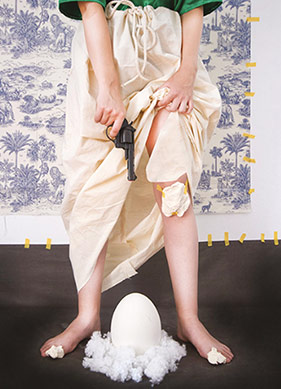
Let's talk about Özge Topçu's exhibition in your gallery called "İstihale Buhranı (Alteration Depression)”. Would you like to tell us your exhibition and its relation to this place?
;