The importance of the exhibition, which was first held in 1980 with İstanbul Art and Sculpture Museum Association's initiative within the scope of 8th International Istanbul Festival, is certainly very big - it has the quality to become the example for may institution and event specially in the sense of sustainability. It is almost impossible to disregard the Today's Artists Exhibition's endurance within the context of our contemporary art and institution relations, which are opened and closed arbitrarily as well as not being able to overcome the continuity and content problems. On the other hand, it shouldn't be forgotten that since the first day it was realized, the event shows a little section on the relationship in between art and private sector within the context of its connection formed with the private fund such as Hisarbank, Pamukbank, Garanti Bankası and lastly Akbank.
Surely continuity is a fact that indicates only to the function of these type of events. Yet what is more important is the contribution quality of the these type of exhibitions -especially the events with "Today's Artists" title - to the art scene... Surely this exhibition fills a huge gap within the context of providing a platform for young artists to exhibit their productions since the first time it was held. If we consider the fact that the areas for the graduated or yet to be graduated students to show their work is limited even today; the network of relations are more intense than ever, then it is notable that this kind of exhibition started to be organized in 80s -right in the middle of a highly meaningful timing.
The continuation of Today's Artists Exhibition with rather a traditional model such as panel until the mid 2000s imply a negative tone from various angles. While in theory it seems as if it can have a pretty important presentation area, it is not easy to say that the reward wining or exhibited work of an exhibition, which has been held for such a long time, does not present the current dynamics of contemporary art in practice. As it happens in most of the exhibition with a panel, the name of the panel specifies the quality of chosen and winning names in Today's Artists Exhibition as well and a quality exhibition is held some years due to the nature of the system, while works in such a 'conventionalism' that do not fit to the name of the event at all, in other years.
It is quite a cool mission on paper showing an important section related to "new" art, which nobody sees in the atelier of art schools or the ones that the young ones carry on; yet, is it really possible to think that artists and prize-winning names decided by curator -even by a foreign curator- and the space consultants are an alternative to a panel system? Is this really a radical change? Or else is this only a change that evolves from panel to curator and exhibition designer? Frankly, although it is not right to load a surrealistic mission to this exhibition such as radically change the art scene, shouldn't it be open to alternative suggestions especially from the point of presentation styles?
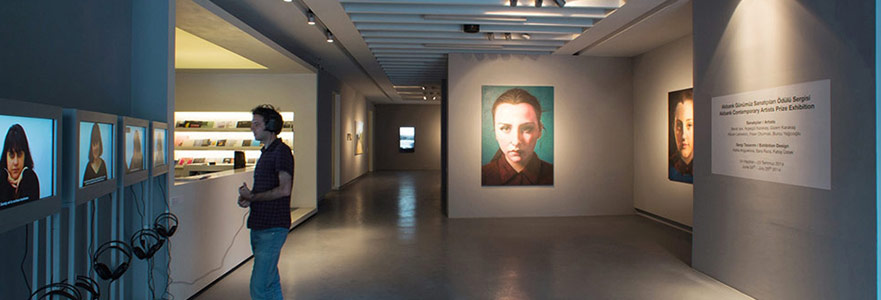
While we are watching the 2014 Akbank Today's Artists Reward Exhibition, which will be open until 25th July in Aksanat, it is necessary to evaluate the whole hisstory and the mission of the event.
This year's exhibition, in which six artists were rewarded including Berat Işık, Ayşegül Karakaş, Gizem Karakaş, Alican Leblebi, İhsan Oturmak, Burcu Yağcıoğlu, has also got three exhibition designer including Katia Anguelova, Sara Raza and Fatoş Üstek. Exhibition design should not enhance your expectations since what is called design does not go beyond randomly placing the work of these six artists on the ground floor of Aksanat. Yet, it is not even a design that is beyond the "hanging on the wall" act that can be observed in old fashioned group exhibition... I don't know how can it be explained that the exhibition, which made its mission to support the young artists and especially to incentivize them with monetary award, can disregard the fact that the most important stage of contemporary art is "exhibition design"... Yet, shouldn't the exhibition, which has been releasing itself from the the old construction and getting into a new construction foreseen by the century for some time, realize the same renewal that was done for the selecting committee on the design as well? Maybe this "representation" work should also be done by the young ones along side with these young artists, who find an opportunity to showcase their work only once a year in an institution such as Aksanat.
Lets have a look at the rewarded and worth to be presented work of he exhibition... Frankly, the 4 channelled video installation of Gizem Karakaş called "Attention! Attention!" is ahead of the other works even though it hasn't won the prize-award. Gizem Karakaş's video differ from the rest since it mirrors artists' -especially the young artists'- dilemma with the voices in their heads that they live daily, and their effort to hold on in the art scene in a ironic and spectacular way. She conveys the real relationship, which everybody knows, yet avoids to concretise, in between the quadruplet of gallerist, collector, press member, audience, and a young artist.
Karakaş's video is almost have the characteristics of today's young artists' documentary. In fact it deals with around which dynamic framework that the art and the industry develops and the necessity to act with different ideologies for each actor in this structure, in a striking language. Although Karakaş's work look ironic, it is dramatic within the context of its presentation place being right in the middle of an exhibition with a competition and its reality. Karakaş is reminding us that to have place and to be seen in the art scene does mostly happen through coincidence rather than the work itself with her work that demonstrates young artists' extraordinary existence struggle while they are trying to have a place in art environment. She is trying to grab the attention of the collectors by reminding them that she is young and still very cheap; thus the gallerist, whom she is trying to reach to for a possibility of a personal exhibition; the press member with a few sentenced writing and the audience, which she needs maybe the least. In fact there is a need for more monitors as such in order to tell the struggle of a young artist in the art scene. This is a complicated system, in which the artist has to explain his/herself to a range of people from curators to institutions, from critics to panels and reach out, come into terms with everyone of them by getting into a different role.
The first prize of the competition is Burcu Yağcıoğlu's video and paper work in the exhibition. In her video called The Land, the artist narrates images, which are surreal and play with our perceptions, by collaging images such as sheep and landscape. The artist's paperwork called Tall Story and Excite from the series titled The Wonder Book of Animals contain photos and texts taken from an animal encyclopaedia published in UK in 60s. The artist, who transfers the details of classification and branding of this encyclopaedia, containing the discourse of 60s, is drawing the attention to this "human" point of view that looks down on everything else.
The video of Berat Işık titled Oasis is a documentary of a resistance... Reşit Zengin creates a documentary reading over his personal history related to the tragic drama lived in South east Turkey within the duration of 30 years. He is presenting the losses of 30 years, ideological, political and humanistic pressures, transformed values and a naive, but strong section of urban system, migration and ecology. Reşit Zengin's oral history touches upon the reality more than the whole hypothesises and theories.
Ayşegül Karakaş's paintings tears the figure apart from its original environment and puts them into a dreamy fantasy by placing them in space, where we can not really figure out where it really is. While she continues the portrait tradition, she gives a spooky spaceless feeling to the spectator. Reality and the surreal gets mixed into each other.
The last two artist of Today's Artists Exhibition are Alican Leblebici and İhsan Oturmak. Leblebici, who bases his work on portrait and auto-portrait that are one of the frequently used theme of art history by the artists, establishes a cycle contrary to the accustomed one. Building his auto-portrait over on the portraits of other people, he forms a self presentation over what is not seen and unlike. Finally, there is a 5 piece work of İhsan Oturmak that is realized on canvas with oil and chalk. The artist, who is trying to question this concept couple based on uniqueness and series, is questioning the state that the society and individuals becoming a mono type and part of an ideology.
The concepts, problems and situations that this year's today's artists present are in fact the facts that contemporary art has been thinking about for a long time. This shows that there is nothing much changed in the front of the young ones and it doesn't look there will be much for a long time either.
;