ÖNCEKİ
18 ARALIK, PERŞEMBE, 2014
SONRAKİ
Paris -the city of lights even though it has been the center of attraction for art lovers with all year long exhibitions and events, November has a specific place for the photography lovers. Paris becomes the capital of photography in November due to Paris Photo fair, which has realised the eighteenth this year and an important meeting point especially for collectors, galleries and institutions, and Photoquai Photography Biennial, that is organized in every two years, as well as Paris Photography Month (Mois de la Photo à Paris). Surely this year the tradition remained; we accepted the invitation and went to Paris.
Leaving Paris Photo aside, it wouldn't be lie if I said we circled around the city again thanks to Mois de la Photo, which involved more than a hundred exhibitions invcluding the exhibitions of names such as William Eggleston, Garry Winogrand and Alberto García-Alix and a lot of parallel events, and also Mois de la Photo Off containing fifty-something exhibitions. Since it is not possible to mention all this in one article, we will be looking at the exhibitions of the late period works of three names from different genres who form worlds in between reality and fantasy. (1)
A shelter under the rulership of birds
Let us start with the exhibition of Roger Ballen, who is one of the most idiosyncratic photographer of our time, called 'Asylum of the Birds' sharing the same name with his latest book. Borned in 1950 in New York, Ballen has been living in South Africa, where he went in order to be a consultant of geology and mine companies. Leaving his documentation concern he had during the first period of photography and pursued to create a new reality with his photographs,Ballen is a photographer, who realizes images that belongs to his 'non-existing country'. People, who are considered to be 'marginal' by the society, the places these people live, weird drawings on the walls of these places, strange objects such as wires and cables and various animals both alive and toy are all play the leading roles in Ballen's photographs. All these elements can exist in an extraordinary balance without forestalling each other in Ballen's photographs. Not attributing big meanings to his photographs and reviving the images formed in his mind with the possibilities and materials of this world, Ballen says on his photographic approach: "Photography is an art that is related to the moment included in. The effect of this situation is not seen as much in other forms of art. When you start the shooting session, it is not possible to guess all the movements that will be formed - at least it is like this when you are working with people. I find it very interesting and magical to reach different images in the photographs with no people in, when I take the photographs of the same thing over and over again. (...) In fact you don't decide previously on what kind of set-up it is going to be in the photographs in a full sense. We have a subconscious shaped with the experiences we had or whatever we lived up until now. If I have things to do in my mind, they can change with what that 'moment' awakes inside me." (2
Ballen has taken the photographs, which are spread on the third floor of Galerie Karsten Greve (3), in a 'house' -kept as a secret- in the suburb of Johannesburg , where people and animals live all together in its full sense, within period expanding to six years. (4) The cast of this scene devised by Bellen in this place that looks like an absurd and spooky theatre set, are the residents of this house - in other words, people and animals and especially the birds, which are around all the time. The drawings on the walls of this mysterious place have an important role in the multi-layered photographs, which can be placed somewhere in between still-life and portrait like in most of Bellen's works. The pictures, which are drawn either by Bellen himself or by the subjects, is a sign that the artist's affection for street art and graffiti. Open until 10th January, 'Asylum of the Birds' is the most fresh and extreme evidence of Ballen, who doesn't doubt to walk around in the layers of human mind while searching for the "essence", not giving up trying to define radical and unexplainable. The bonus of the exhibition is the model of Roger Ballen with a bird on his lap, greeting the spectators in the entrance of the gallery.
Bullet proof heroes after the loss of their childhood
A young girl with winking pig mask on his face, a cleaver on her hip and wearing a butcher's apron. A young man with deer horn painted on white on his shoulders; his torso is naked and staring to the audience with his fragile expression in his eyes.
A pale pink dressed Mohawk, who is blowing to his pipe that is transformed from a gramophone. A warrior taking firm steps forward with his helmet on his head and iron pointed vest on his back. Looking as if they have just came our from a costume party, these boys and girls are the heroes of Australian photographer Vee Speer's last series called 'Bulletproof! Governing the walls of School Gallery Paris' (5) until the 6 th December, these young ones are familiar for the people who follow the world of photography. Speers has taken the photographs of this young girl and her young friends six years ago in front of the same grey wall as kids, who just left the imaginative birthday party. Even then, those kids with interesting costumes looked strong, cunning, beautiful and amazing. They are again with us after six years and now they are in puberty as they got taller and bodies have taken its shape. (6) Speers is now taking their photos when they are living the first loss of their life -the loss of their childhood He is dressing them up same as six years ago; putting them into costume and sometimes hiding them under masks. But this time he is providing them with various tools in order to fight with the adult's combative world and unending anger: Such as an axe, a butcher's cleaver, bullfighter's clothes or a cow horn... As if saying tit-for-tat, tooth for tooth... Even though they seem like they are winking at a new violence wave in this day and age when we are sick of all those wars and fights, we can't help ourselves staring at the heroes in 'Bulletproof'. The heroes of Speers look like as if they belong to a different time, a mythological future or dystopian past or visa versa. They might be coming from Alice in Wonderland or beamed up from the movie 'Delicatessen'. Maybe these uncertainties make them magical.
Speers summarizes his photographic approach as "I don't like following the herd. I prefer to seduce spectators with photographs, which can be both disturbing and beautiful, but at the same time leaving a space for them to get into my world. My portraits brings elements, which surprises the spectators and reveal complicated feelings - they are telling stories situated somewhere in between fantasy and real, explicit and unexpected.". His exhibition in School Gallery was attractive with the presentation of costumes and accessories used in the photographs as well as the photographs themselves.
A long journey made to this place called home
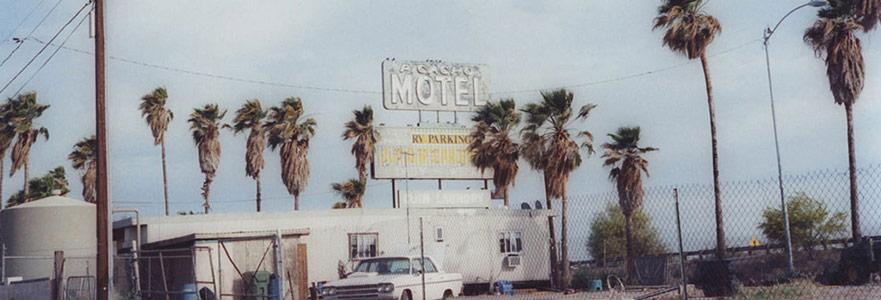
Now we have come up to the last exhibition that is the topic of this article. British photographer Matt Wilson's exhibition titled 'This Place Called Home' in Galerie Les Filles du Calvaire(7), which ended on 30 November... Wilson is a proper traveller. A traveller, who hits the road with his bag on his back, transfers his encounters in these journeys and his feelings by the end of these encounters to his photographs, which are not easy to explain. Just like Stephen Shore, Joel Sternfeld, Alec Soth and people like them, who followed the path Robert Frank has started... Wilson is rather telling more of an unplanned, light weight road story, which goes back and forth in between reality and fantasy. This is a road story starting in Europe, then reaching his home land UK and going back to Europe without forgetting Eastern Europe; stopping off in France quite often and turning to Cuba at some point and in the end jumping to States...
Wilson is telling almost timeless stories in this small sized photographs that one really needs to get closer in order to understand the details included contrary to our daily trend of large prints. These photographs can also be emulation for landscape described in the master pieces of nineteenth century British literature or landscape paintings done by Flaman painter family Brueghelle.
There is 'corruptness' in Wilson's photographs that you can't make sense of at first sight. But this 'corruptness' does never forestall the stories told in the photographs; contrarily makes the feeling in these stories stronger. Misty images in daylight, the grainy details in the darkness of the night, pale colours reminding watercolours... Photographs look like they are from the 70s rather than today. The reason for this is put of date films that Wilson is using. Taming this technical corruptness with time, Wilson is creating a narration that is blurring the borders between reality and fiction by involving parameters such as reverse light . He is making the story either with a person or an empty road by mixing his personal history with his encounters during his long journeys towards 'this place called home'. What is left for us as the spectators to be curious about it all and read them all with our own personal history.
;